

The Rebranding of Squad Announcements Continues
Why Uruguay delivered a masterclass, Spain got it right, and the reigning champions disappointed
Hi everyone! I’m Carla, and this is Off-Ball Logic, the weekly newsletter where we step away from the 90 minutes on the pitch to dissect the business strategies, marketing mechanics, and economic engines that are really driving the modern sports world.
Subscribe to get it in your inbox:

We're back to analyze how the latest squad announcements rolled out over the past week1. However, our focus isn’t on the names themselves—it’s about how these video presentations reflect brand identity and what the national team actually means to the fans.
That’s why squad announcement spots shouldn't be taken for granted anymore; they've evolved into powerful communication tools to build hype and set the tone for the upcoming World Cup.
Before starting, something I became aware of (thanks to you readers) is that this is apparently an idea that is commonly seen in the NFL. I believe that, in an era where we are so conflicted about the “Superbowlization” of football, seeing a practice adapted in a distinctly football-specific, identity-driven way is actually encouraging.
Let’s start with Canada, who posted their announcement 2 days ago. The presentation itself isn’t much to write about: names with players and a back-and-forth transition to a building that I assume is the CN Tower in Toronto — please confirm. I brought this example because it’s the only one of the three hosts that chose video over an in-person event.
Now, speaking of hosts, we need to talk about in-person events like the one done by Ancelotti in Brazil, which has also been replicated by South Africa and, not long ago, the USA — with their coach announcing the roster with the already-named players present. This is something that sounds similar to how NBA players enter the arena and looks very USA-like, though I was expecting something more Hollywood-like and more memorable, considering they are the kings of movies.
The real question is: what did they want to say? That doesn’t mean all squad announcements must mean something, but considering that a video was absent and a personal presentation was the medium of choice, perhaps the goal was to show unity — to the players present, and to the people watching.
But of course, unity to their people can be displayed by the people themselves. And this is what Spain did, in a similar modus operandi to Bosnia — but with some specific distinctive attributes of Spanish identity that should be mentioned.
The first is the presence of craft by workers, men and women. It is important because they speak of how workers build day by day the country that is now supporting their national team. People also participate in the naming of players that made it to the squad, with landscapes interacting with the narrative.
The timing is also very subtle and perfect. Unlike Norway, they started with the coach and finished with the King of Spain, Felipe, who is also a present figure in football — the Copa del Rey, the Cup of the King, is always awarded by the King.
Furthermore, the wording he brings up is important: “porque cuando juega nuestra selección jugamos todos” — when our team plays, we all play. We are supporting them — but the message is that we are also part of how they perform.
Subtle, elegant and strong. I believe it’s one of my favourites, though not the favourite in this new round.
The Netherlands also did their announcement but it felt standard, except for the reference to the orange — and perhaps I’m missing some specific references because I’m not a local.
My favourite is definitely Uruguay, a spot presented today that delivered a masterclass in identity, community and — funnily — product placement.
The format isn’t new — player names appearing in everyday locations, like England did. But there are people interacting with them, in common attributes of Uruguay’s everyday life: the hairdresser chat, friends drinking coffee, kids swapping stickers after school, people drinking mate, a man going on a boat. The fact that people — not players like in France, not the storytelling itself like England — are connecting the dots is what makes it strong.
The song choice is just as important: “Cielo de un solo color” (sky of a single color) — a popular Rioplatense2 song by the band No Te Va Gustar — sings about the harsh life and experiences of Uruguayan people and the ability to thrive. The song became popular in 2010, during the national team’s 4th-place finish. Performed by a rock band in collaboration with a murga band (murga being a music genre exclusive to Uruguay and extremely popular there) it has a strong chorus that sings “ay celeste regálame un sol” (oh light blue, give me a sun), which recalls the “celeste”, the nickname of the Uruguayan national team, and the reference to the sun, which also appears on the Uruguayan flag.
The spot finishes with two young men identifying someone on a bike who turns out to be Marcelo Bielsa, the national team’s coach — a widely known figure worldwide, also known for his love of cycling. All the performances, including Bielsa’s, are amazing and give us the possibility to enter the everyday life of Uruguay and how life is lived there.
And regarding product placement: throughout the spot, different sponsors of the national team appear — a bank, a mobile phone company, among others. But they play specific roles in the narrative and might even look organic to someone who isn’t aware that those are brands in Uruguay.3
Now let’s cross the River Plate4 to the spot of the reigning champions of the Cup of Life: Argentina. I might not be objective, and curiously enough, everything I was hoping to watch happened. But differences in idea and execution can significantly affect the outcome.
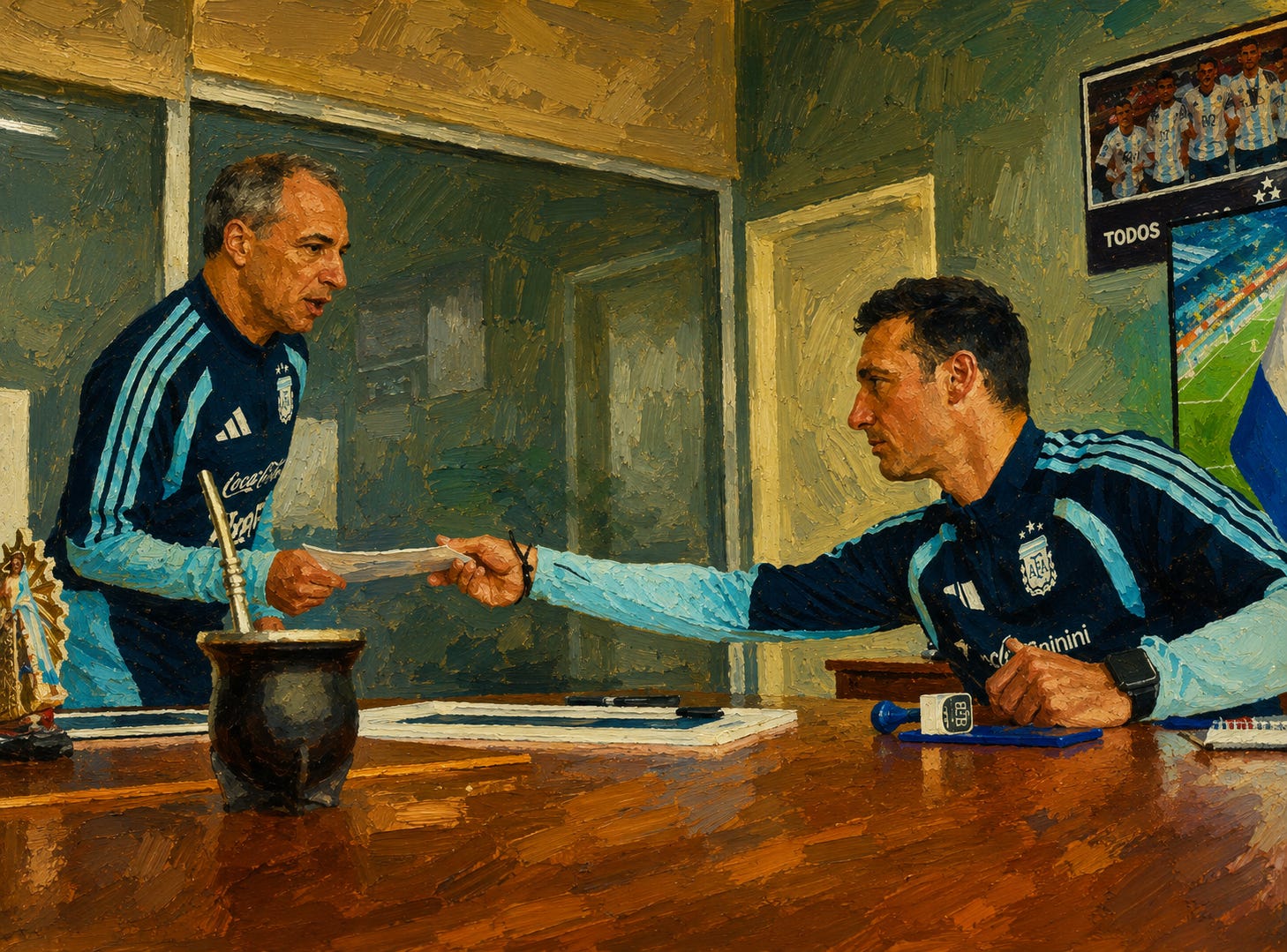
The video starts at the Argentine FA training ground — named after Lionel Messi following the 2022 title — where we see in perfect definition a mural of the team that lifted the cup, a man on a machine mowing the lawn, and then the offices of the national team — where we imagine, and our imagination matches reality, that the first character in this spot is Lionel Scaloni, the main character of the previous 2022 announcement. Scaloni has already chosen his final list and he’s ready to send it to FIFA.
But he decides that someone special is going to send it: Marito. This choice is not random — and I believe it’s the strongest and most positive decision made for the announcement.
Marito is not just anyone; he’s the historic kit man, and in football that is a role for unsung heroes, for silent soldiers. He’s the one who knows that, without him, players can’t play, but he doesn’t care about the credits. He’s one of them, but he’s also one of us. Argentina has a historical relationship between kit men and champions, with a legendary bond between Diego Maradona and the 1986 national team’s kit man Galíndez. So yes, the decision to include Marito is very Argentine and perhaps not easy to identify as a brand attribute for foreigners, but I find it very strong.
Scaloni asks Marito to send the list “con la fuerza de todos los argentinos” (with the strength of all the Argentine people). The scene cuts to a series of images of the heroes of yesteryear alongside the heroes of today: Kempes, Maradona, and the 2022 national team squad with Messi as their leader. We can also see a Diego sanctuary that I believe is in the Argentinos Juniors museum.5
And now the list travels — hand to hand, “con la fuerza de todos los argentinos” — with a song in the background called “Tierra Zanta” — a play on “tierra santa” (holy land) — by the trap singer Trueno6, which became popular during the 2022 World Cup7.
But let’s talk about the people and the places. Argentina is a rather long country that spans different geographies — the puna, the Andes, the jungle with the Iguazú Falls, and Patagonia being the most well-known.
The list travels to a young man in the center of Buenos Aires, a kid at a monument in Rosario, a woman in the northwest of Argentina 2,200 meters above sea level, a young woman in a park in Mendoza (the land of Malbec wine), and a man in the the southernmost urban settlement on the planet: Ushuaia.
And here’s the thing: I can understand that the obvious choices for identity positioning — namely, the Iguazú Falls and Patagonia with the Perito Moreno glacier — were skipped in favour of places more distinctive to football and Argentine culture, like Rosario, the city where Messi was born, and Ushuaia.
But the execution is the issue: the decision to use AI-generated images of low quality creates a non-organic, erratic effect that makes the viewer lose the premise of “la fuerza de todos los argentinos.” And details matter — we can expect some level of excellence from a brand that became an economic powerhouse at the national team level because of its history, its trophies, and the presence of Lionel Messi.
The low image quality completely contradicts having Google Gemini as a partner, especially since Gemini generates some of the best AI images out there right now. Honestly, it would have been easier and way more impactful to just have people from those locations record themselves passing an envelope on their phones. It would have felt so much more authentic and intimate.
The spot finishes with the squad list, with a background of somewhere supposedly in Kansas — but I read somewhere that it may not be. Can’t confirm.
In a nutshell: as a local, I feel disappointed by the outcome. As a marketing professional, my take is that the result didn’t land at the level of quality expected of a renowned football brand like the Argentine national team.8
A P.S. about New Zealand. Even though I stand by my words about the rights and wrongs of the squad announcements, the presentation is now gaining more and more visibility after the unexpected fame of defender Tim Payne.
Which ones did you enjoy the most? And which ones did I get completely wrong? Let’s discuss below.
Thank you for being part of this journey!
Carla | Off-Ball Logic
Keep in mind that all rosters are provisional until FIFA makes it official on June 2.
Rioplatense is a term meaning “from Argentina and Uruguay” — both countries share the Río de la Plata (the Plate River).
As a child of Uruguayan parents I may know them all, but some friends who didn’t visit Uruguay frequently also identified this product placement.
Río de la Plata translates literally as “River Plate,” hence the naming of the football club.
The remains of Diego Maradona are located in a private cemetery and are not available to the public. Public-made sanctuaries like this one and the one in Napoli serve as tribute spaces.
Who recently performed on the Jimmy Fallon show.
There were some people who were not happy with the choice of song, since Argentina is a country widely known for tango, and locally is identified with great figures of folklore and rock. But I believe that sometimes there is a trade-off between tradition and modernity that needs to be made.
The same, but with professional wording.
No doubt the Uruguayan stood out. Great connection with the roots.