

Scaling the Social Status of the Padel Lifestyle
Edition 2 of 2: The Grassroots Engine

Welcome back to our series! In Edition 1, we explored how padel engineered a premium global identity and unified its professional circuit.
Today, we are looking at the real economic engine of the sport: the grassroots level. From the brutal real estate requirements to the “secret” equipment loop, here is how local clubs are turning a massive profit.
Welcome to Off-Ball Logic, the weekly newsletter where we step away from the 90 minutes on the pitch to dissect the business strategies, marketing mechanics, and economic engines that are really driving the modern sports world.
Subscribe to get it in your inbox:

Club Infrastructure
Building and running amateur clubs has evolved from a local passion project into a highly optimized real estate play.
Because padel courts are incredibly compact, operators can maximize their revenue per square foot far better than with traditional tennis. A standard panoramic court with tempered glass and specialized turf usually costs between $26,000 and $32,000 for the materials alone.
However, the true launch cost is heavily dictated by local labor, groundworks, and whether the club is indoors or outdoors.
Note: Based on local reports shared on TikTok, building a padel court in Argentina ranges from $25,000 to $50,000 USD—significantly less than the other regions in this table. However, local revenue is correspondingly lower due to the currency exchange rate.
The Real Estate Hustle and Its Hurdles
In markets with extreme or unpredictable weather (Northern Europe, the UK) or where the sport is aggressively marketed as a premium, year-round lifestyle activity (the USA, the Middle East), the focus is overwhelmingly on indoor facilities. In the U.S., nearly 40% of all courts are now indoors. This demand has triggered a massive commercial real estate trend: repurposing empty logistics warehouses and abandoned big-box retail stores into vibrant padel hubs.
But there is a catch. Padel has brutal structural requirements that make finding the perfect building incredibly difficult:
Competitive play relies heavily on defensive lobs, making a minimum ceiling clearance of 26 to 30 feet an absolute non-negotiable. If ductwork or lighting gets in the way, the court is essentially useless for sanctioned play.
The column grid in a standard warehouse must perfectly accommodate the rigid 33x66-foot footprint of a padel court. If the columns misalign, operators are left with massive amounts of non monetizable “dead space.”
Existing concrete slabs in industrial spaces often have dips or cracks. To get the perfect, true bounce required by professional standards, operators frequently have to pay for expensive concrete leveling or total replacements.
Because finding these specific buildings is so difficult, niche real estate advisory firms such as Capricorn in the US now specialize exclusively in helping padel franchises hunt down the perfect big-box inventory nationwide.
Non-Professional Marketing: Revenue, Vibe, & Gear
The days of the exclusionary country club are fading. Modern padel clubs are cashing in on a flexible “pay-to-play” model, and the core secret to their rapid profitability is the four-player split. Operators can charge premium hourly rates for the court, but because the cost is divided by four, the per-user price remains as accessible as a standard boutique fitness class.
Pricing power is heavily dictated by regional court scarcity, local real estate premiums, and peak vs. off-peak demand.
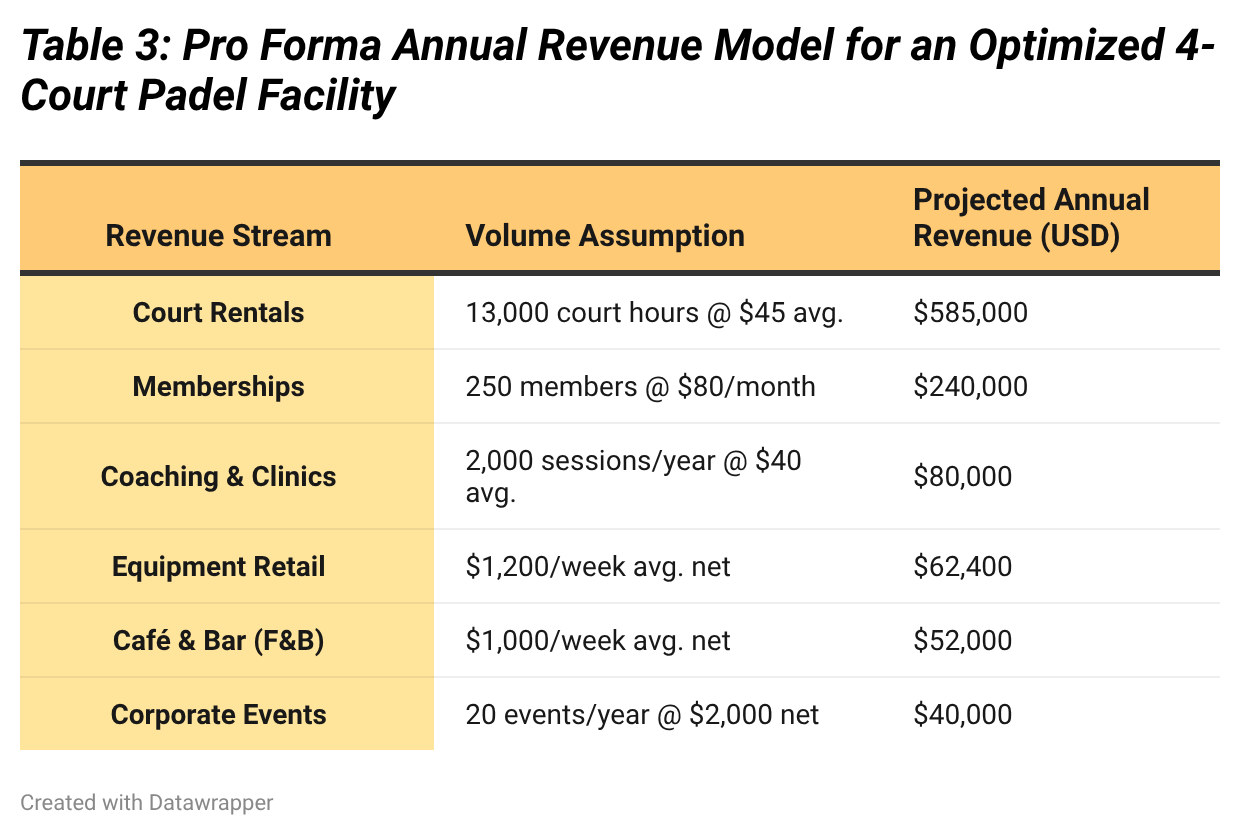
A well-located, professionally managed facility with four to six courts, operating 12 hours a day, can achieve 30-35% profit margins and pull in up to $1.5 million annually.
In high-demand regions like Argentina, a single, well-located court can recover its initial capital investment in as little as 10 months, while a full complex with premium amenities generally sees a return on investment (ROI) within three to five years. Incredibly, the operational break-even point usually hits at just three to five hours of rentals per court, per day.
To maximize profits, smart operators layer on secondary revenue streams: tiered monthly subscriptions, corporate team-building events, and coaching clinics. Most importantly, they monetize “dwell time.” Because padel is inherently social, players linger. Adding premium cafes and lounges transforms a simple court into a highly profitable social hub.
Lifestyle Marketing & Tourism
Retention relies entirely on this “lifestyle” vibe. Clubs market themselves as welcoming, highly aesthetic spaces on Instagram, hosting inclusive “Americano-style” tournaments where players constantly rotate partners to destroy the intimidation factor. Content marketing on platforms like Instagram and TikTok prioritizes the aesthetic and energetic vibe of the club—highlighting the stylish cafe, the post-match drinks, the high-end apparel, and the vibrant community—rather than focusing purely on technical, elite gameplay.
This lifestyle appeal has even birthed a booming padel tourism industry. Affluent players from colder climates are booking dedicated trips to Spain or the UAE just to play. Recognizing this, luxury chains like Club Med are weaponizing padel as a core asset. Compared to a massive 18-hole golf course, padel courts offer resorts a remarkably high ROI on a microscopic physical footprint.
The Equipment Goldmine
The global equipment market is a reliable indicator of the sport’s health. In 2023, the global padel sports market size was valued at approximately $342.21 million and is projected to surpass $500 million by 2032. The U.S. padel gear market alone reached approximately $10 million in 2024, with leading brands projecting hyper-growth of 70% or more in 2025.
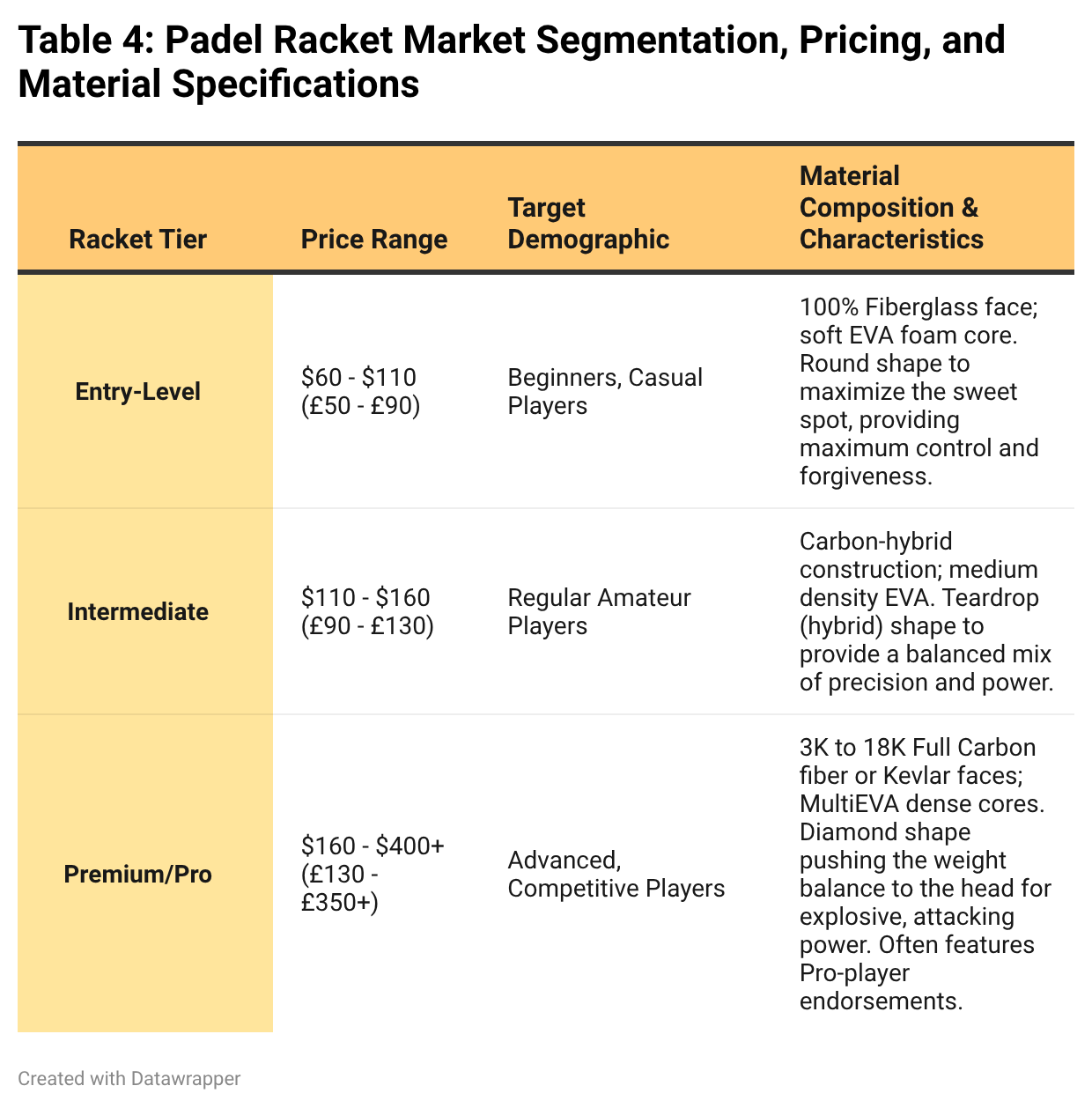
The manufacturing industry is fiercely competitive, dominated by heritage racket sports brands leveraging their legacy R&D (Wilson, Babolat, Head, Dunlop) and specialized padel-first giants heavily entrenched in Spain and Argentina (Bullpadel, Nox, Adidas, Drop Shot).
Europe remains the undisputed leader, accounting for over 55% of the market share.
But the real commercial engine of the gear industry is a brutal physical reality: the short product lifecycle.
Because padel rackets lack strings, the structural face and internal foam core absorb every impact. Over time, the carbon fiber micro-fractures and the foam loses its elasticity, resulting in a “dead” racket. Active players are forced to replace their rackets every 6 to 12 months. This built-in obsolescence guarantees a continuous, highly resilient loop of recurring revenue for pro-shops and global manufacturers alike.
The Bottom Line
Padel’s journey from a Mexican backyard to a global investment powerhouse is a masterclass in modern sports business. It’s the perfect 21st-century game: easy to pick up, highly social, and perfectly suited for tight urban real estate.
At the pro level, the QSI buyout unified the tour, paving the way for massive broadcast deals and institutional capital. At the local level, amateur clubs are acting less like traditional gyms and more like highly profitable hospitality hubs.
As padel pushes into the massive US market, it faces its biggest test yet: going head-to-head with the low-cost explosion of pickleball.
I’d love to hear from you:
In the battle for North America, will padel’s premium, heavily-funded model win out over pickleball’s grassroots boom?
Let me know below!
Thank you for being part of this journey! See you next week.
Carla | Off-Ball Logic