

How Beckham Built the House that Messi Filled with Gold
Analyzing the 16-year evolution of the MLS business model and the shift toward global digital monetization.

Hi everyone! I’m Carla, and this is Off-Ball Logic, the weekly newsletter where we step away from the 90 minutes on the pitch to dissect the business strategies, marketing mechanics, and economic engines that are really driving the modern sports world.

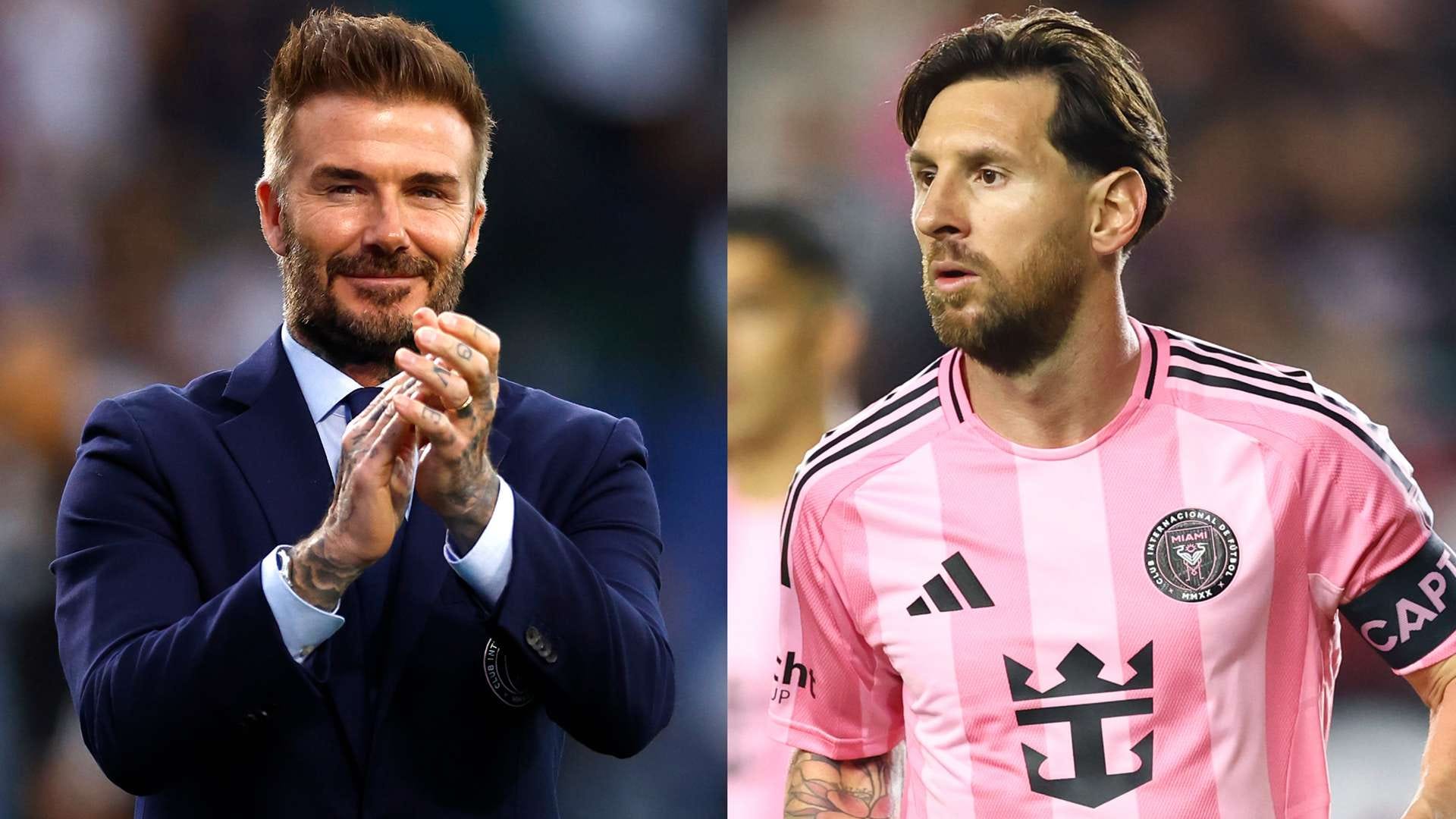
In the history of North American football, two signings represent tectonic shifts. The first, David Beckham to the LA Galaxy (2007), was a stabilization mechanism—a proof of concept that provided a precarious league the legitimacy it needed to survive. The second, Lionel Messi to Inter Miami (2023), acted as an exponential multiplier; a strategic injection that transitioned MLS from a domestic entity into a global content engine.
In signing Messi, Beckham was likely looking at a blueprint he helped design, yet he understood better than anyone how much the economic landscape had shifted since his arrival.
While both involved icons, a granular look at the contractual architectures and media landscapes reveals two entirely different realities.
Note: Although we’ve analyzed both shifts, it’s critical to note that the true test will be the long-term impact once Messi eventually leaves MLS, whether through transfer or retirement.
The “Messiah” Precedent: Pelé and the NASL
Before Beckham or Messi, there was Pelé. In 1975, the New York Cosmos signed the Brazilian legend to “win a country.” Pelé transformed “soccer” from a peripheral immigrant game into a cultural phenomenon, attracting sell-out crowds of 80,000 at Giants Stadium.
However, the Pelé era remains a cautionary tale. While he provided instant credibility, the league (NASL) relied on “vanity capital” and unsustainable spending. When Pelé retired, the star-driven bubble burst, and the NASL folded in 1985. His legacy was the proof that the U.S. could love football, but it lacked the business infrastructure to keep that love profitable.
2007: The Stabilization Phase
In 2007, David Beckham joined a league that was effectively in “recovery mode.” Just five years prior, MLS had faced insolvency, contracting to just 10 teams. The business fundamentals were fragile: average valuations hovered around $35M, and media rights brought in a mere $7.5M per year.1
The commercial model was primitive, relying almost exclusively on ticket sales (with an average attendance in 2006 of just 15,000) in oversized NFL stadiums that “killed” the product’s visual appeal on TV2. The introduction of the Designated Player Rule was a financial bridge, and it allowed MLS to acquire the very first global IP in football while maintaining the strict cost controls necessary to avoid the fate of the NASL.
2023: The Exponential Multiplier
By the time Lionel Messi arrived, the league had undergone a total metamorphosis. It was no longer a project in survival but rather a venture in scaling. By 2023, the average franchise valuation had surged to $582M, with clubs like LAFC nearing the $1B mark3. The expansion fee for San Diego FC hit $500M—a staggering 50x increase since the Beckham era.
Crucially, Messi’s arrival coincided with a landmark 10-year, $2.5B partnership with Apple4. This signaled a strategic pivot from fragmented cable television to a global DTC (Direct-to-Consumer) model. While Beckham’s matches were often difficult to find outside the U.S., Messi’s were instantly monetizable across 100+ countries5.
This digital maturity was matched by physical infrastructure; by 2023, most clubs played in modern, soccer-specific stadiums with average attendances of 21,000–22,000—figures now comparable to Serie A or Ligue 1.6
The Regulatory Innovation and Its Consequences
The 2007 arrival of David Beckham was a catalyst for a regulatory overhaul. The Designated Player Rule allowed MLS to bypass its own rigid salary cap by letting owners pay superstars directly without depleting the league’s shared budget pool. Under this rule, a player’s cap hit was fixed (at $400,000 in 2007), while the “excess” salary was off-book.7
While Beckham’s $6.5M salary was a 70% cut from his Real Madrid wages, his team engineered a deal based on revenue sharing across all club touchpoints—from merchandise to concessions.8 However, the most lucrative asset was the $25M fixed-fee expansion option—a clause Beckham later exercised to establish Inter Miami. As expansion fees surged to $500M (San Diego FC), this single contractual line item generated a staggering $475M in unrealized equity.
Lionel Messi’s 2023 contract, with a base salary of $50M–$60M, is merely the floor of his compensation. His true value is tied to the global distribution engine. By receiving a cut of Apple TV subscriptions, Messi’s incentives are vertically integrated with the league’s streaming success—a move that saw 110,000 sign-ups in 24 hours.9
His profit-sharing deal with Adidas further cements his role as a “quasi-corporate partner” in the league’s commercial licensing arm. Finally, through an ownership option in Inter Miami, Messi is directly tied to the club’s 72% valuation jump, moving him from player to stakeholder in a global sports asset.10 (and repeating Beckham’s story).
The Media Landscape and the Ecosystem Conversion
The contrast between the Beckham and Messi eras is most visible in the “pipes” through which content flows. We have transitioned from a localized, linear broadcast struggle to a global, data-driven streaming singularity.
In 2007, Beckham’s arrival triggered an initial 50% viewership spike, with early games drawing up to 522,000 households on ESPN2.11 However, this “Beckham Bump” proved difficult to sustain; average viewership eventually regressed to 253,000, a stagnation mirrored by the 2010 MLS Cup.
The primary barrier was structural: the league was hamstrung by domestic-focused cable deals, while international rights were sold piecemeal. This fragmented landscape meant fans in the UK or Asia had no reliable way to watch Beckham live, severely capping the monetization of his global fame.
Messi’s 2023 arrival coincided with the launch of the MLS-Apple partnership, creating a “perfect storm” for vertical monetization. The results were immediate: subscriptions to the MLS Season Pass more than doubled, with Apple recording its highest-ever volume of new subscribers on the day of his debut.12
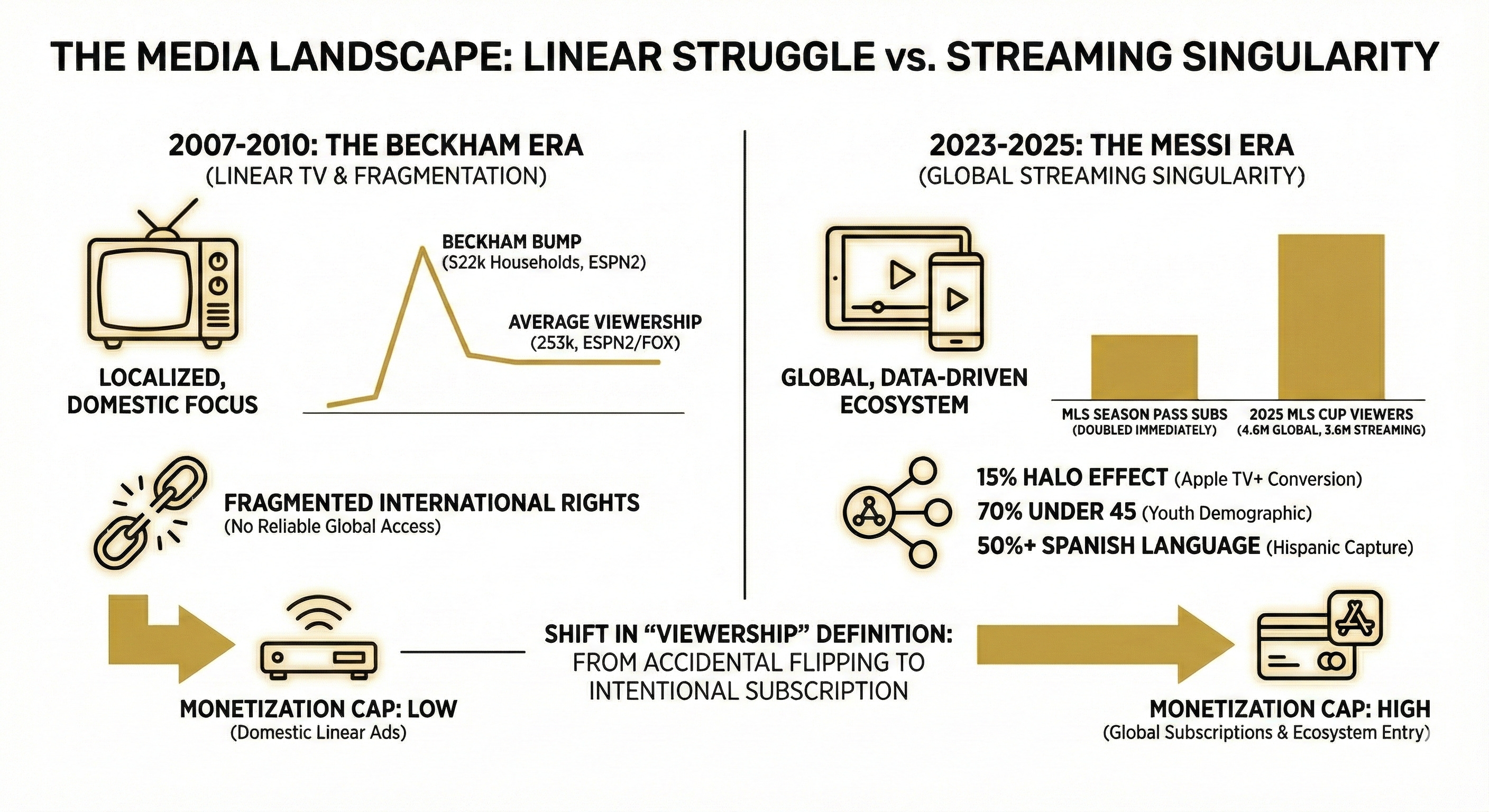
For Apple, the real win was the “Halo Effect”, converting 15% of fans who signed up for the MLS Pass converted into broader Apple TV+ subscribers, shifting the audience from domestic and aging to global and young (with fans tuning in from over 100 countries, with 70% of the Apple TV audience under the age of 45.13), and with Spanish-language viewership surpassing 50%, finally engaging the Latin American market at scale.
The Fan Economy Impact
Both David Beckham and Lionel Messi transformed regular-season matches into “must-see” events, but the scale of their impact reveals a fundamental shift in pricing power and merchandise elasticity.
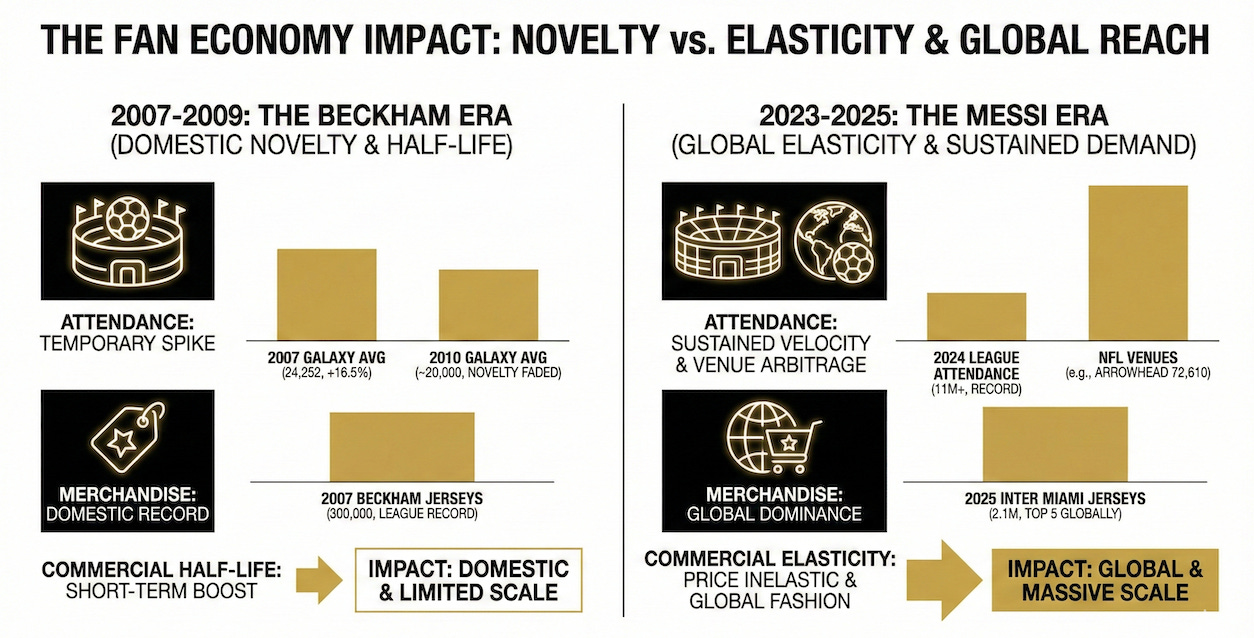
Beckham’s arrival provided an immediate “novelty bump.” In 2007, the Galaxy led the league with an average attendance of 24,252—a 16.5% year-over-year increase.
During that latter half of the year, his away matches accounted for nearly 10% of total league attendance. However, this effect had a commercial “half-life.” By 2010, the novelty had waned, and attendance regressed to pre-Beckham levels as the “away tour” magic faded.
In contrast, the demand for Messi has displayed extreme price inelasticity, with secondary market prices surged by over 1,000% for Inter Miami home games and 400–500% for away matches.1415 And unlike the Beckham era, where games remained in smaller soccer-specific stadiums, Messi’s arrival forced a shift to high-capacity NFL venues to meet demand.
While Beckham’s impact cooled after two seasons, Messi’s demand remained at record highs into 2025, helping the league surpass 11 million total fans for the first time.16
Building a Global Fashion Staple
The scale of merchandise sales illustrates the jump from a domestic success to a global lifestyle brand. In 2007, the Galaxy sold 300,000 jerseys—a league record at the time that drove a massive 730% increase in MLS merchandise revenue.17
By 2025, Inter Miami reached a stratosphere occupied only by European titans. The club sold over 2.1 million jerseys, ranking 5th globally behind only Real Madrid, Barcelona, PSG, and Bayern Munich.18 The “easy pink” kit moved from a team uniform to a global fashion staple, representing an order of magnitude leap in commercial licensing.
The Asset Class Shift
The ultimate scorecard for these signings is the financial health of the franchises and the league. The data reveals a definitive pivot from steady appreciation to explosive, multi-generational growth.
Revenue Growth: Following Beckham’s 2007 arrival, the LA Galaxy saw significant growth driven by record jersey sales and the landmark Herbalife sponsorship ($4–5M annually). This led the Galaxy to become the first profitable franchise in MLS history. However, their revenue streams remained traditional: localized ticket sales, domestic sponsors, and stadium concessions.
In contrast, Inter Miami’s revenue trajectory is unprecedented in North American sports history:
2022 (Pre-Messi): $50–60M
2023 (Partial Messi): $120–130M
2024 (Full Messi): Projected >$200M
2025 (Projected): $250M+
This 300%+ growth in just two years completely dwarfs the proportional gains of the Beckham era, shifting the club from a local sports team to a global commercial powerhouse.
Franchise Valuations: In 2008, an MLS expansion team cost roughly $30–40M. The “Beckham Effect” was primarily one of stabilization since it provided a floor for valuations and prevented a league-wide collapse.
The Messi Era has triggered a vertical takeoff. Inter Miami’s valuation skyrocketed from ~$600M to over $1.03B in a single year—a 72% increase. This ripple effect lifted the league-wide average to $678M, with four clubs (LAFC, Atlanta, Galaxy, and Miami) now member of the “Billion Dollar Club.”
The most critical financial insight is the decoupling of valuation from revenue. While elite European clubs typically trade at 3–5x revenue, Inter Miami and other top MLS franchises are trading at multiples as high as 10x. This suggests that investors are no longer valuing these clubs as traditional sports utilities, but as high-growth tech platforms, pricing in the massive global future that Messi’s IP has unlocked.
Conclusions
To Recap:
Comparing David Beckham’s arrival to Lionel Messi’s is less a comparison of two athletes and more a study of two distinct phases in the lifecycle of Major League Soccer.
Beckham’s arrival was an investment in survival. He put MLS on the map, proved the Designated Player model was viable, and stabilized a league that was then teetering on irrelevance. His economic impact was primarily domestic and his legacy is the very structure of the league and the expansion of the map. Quite literally: without Beckham, there is no Inter Miami.
Messi’s arrival is an investment in dominance. He utilized the foundation Beckham built to launch MLS into the global stratosphere. His economic impact is international—driving subscriptions in Europe and Asia and turning pink jerseys into a South American fashion staple. His legacy is the total commercialization of the league via the Apple partnership and the shattering of the valuation ceiling. He has transformed MLS from a “retirement league” into a global lifestyle brand that now competes with European giants for mindshare, if not yet for on-field supremacy.
In quantitative terms, the “Messi Effect” is approximately 4x to 10x the “Beckham Effect”, depending on the metric (Revenue, Valuation, or Merchandise). However, strictly separating the two ignores their causal relationship. The ecosystem required to monetize Messi (specifically the robust franchise values, the soccer-specific stadiums, and the regulatory framework) simply would not have existed without the stabilization of the Beckham era.
Beckham built the house; Messi filled it with gold.
I made a promise in my previous posts and notes: this deep dive wouldn’t go live until we hit 100 subscribers. Last week, we officially crossed that line.
As I mentioned in one of my notes, this first milestone is a major validation of Off-Ball Logic. It proves there is a real appetite for sports business analysis that looks beyond the traditional U.S./Europe axis.
Thank you to the first 100 of you for trusting this “outsider” perspective and validating the thesis behind this newsletter. I couldn’t think of a better way to celebrate our growth than by sharing this with you.
For a more detailed breakdown of Messi’s impact in the MLS, please read my previous post:

Thank you for being part of this.
Carla | Off-Ball Logic
ESPN, MLS Reach Eight-Year TV Deal That Includes Rights Fees - Sports Business Journal
Major League Soccer on television - Wikipedia, accessed on February 2, 2026, https://en.wikipedia.org/wiki/Major_League_Soccer_on_television
LA Galaxy | Research Starters - EBSCO
The Messi Effect - Antenna
Beckham helps kick up some MLS numbers - Sports Business Journal
Lionel Messi drives a surge in MLS Apple TV subscriptions - All Football
MLS Cup final breaks viewing records with a big bite of the TV apple - Inside World Football
[OC] Messi’s impact on Ticket Pricing Elasticity : r/dataisbeautiful - Reddit
Spend it Like Beckham - Samford University
Enhorabuena por tus 100 y por el excelente análisis Becks-Messi
This is an excellent, well-written article. I remember when David Beckham signed with the LA Galaxy, which introduced the DP rule. His signing was a definite turning point for MLS. This not only gave the LA Galaxy but also other teams the confidence to spend the money to bring stars in and get something in return. Let's remember, earlier in that decade, two teams contracted from MLS because they could not survive. Now, one could argue whether they are taking full advantage of having Lionel Messi in the league. What seemed like a good deal with Apple TV could actually be hindering even more growth in the U.S. This is probably why the Apple TV deal has been shortened, because both parties are not getting what they thought they would get out of it. Hopefully, MLS capitalizes on Messi being here by growing the salary gap by a substantial amount to bring even more stars here.