

The Business of Inter Miami
Breaking down the revenue, valuation, and league-wide impact of the Messi era.

Hi everyone! I’m Carla, and this is Off-Ball Logic, the weekly newsletter where we step away from the 90 minutes on the pitch to dissect the business strategies, marketing mechanics, and economic engines that are really driving the modern sports world. We analyze the market shifts that turn clubs into global brands and the data points that define the industry’s future.
Subscribe to get it in your inbox:

Today we are looking at the numbers behind the most significant commercial shift in North American football (or soccer1) history. The arrival of Lionel Messi at Inter Miami CF was not merely a transfer but a macroeconomic event that restructured Major League Soccer’s valuation models and revenue streams. Spanning from his debut in 2023 through the 2025 season, the data reveals a complete shift in the commercial viability of football in the United States2.

Financially, the club, which debuted in 2020, has evolved from a mid-tier expansion franchise into a global “super-club”. The “Messi Effect” generated an estimated $84 million in incremental ticket revenue for opposing clubs in the first 18 months alone, driven by aggressive dynamic pricing strategies and venue shifts to high-capacity NFL stadiums3. Socially, the club has eclipsed traditional US sports heavyweights, boasting engagement metrics by late 2025 that rivaled leading NBA and NFL franchises4.
Revenue Growth
Prior to 2023, Inter Miami’s revenue profile was typical of a newer MLS expansion team, hovering around $50 million annually with limited global appeal. By 2024, revenue stabilized at a record high.
This surge placed Inter Miami in a financial tier previously occupied only by European powerhouses. Operating income for the 2023-2024 period was reported at approximately $50 million, a remarkable margin for an MLS club driven by high-yield sponsorship and premium seating.
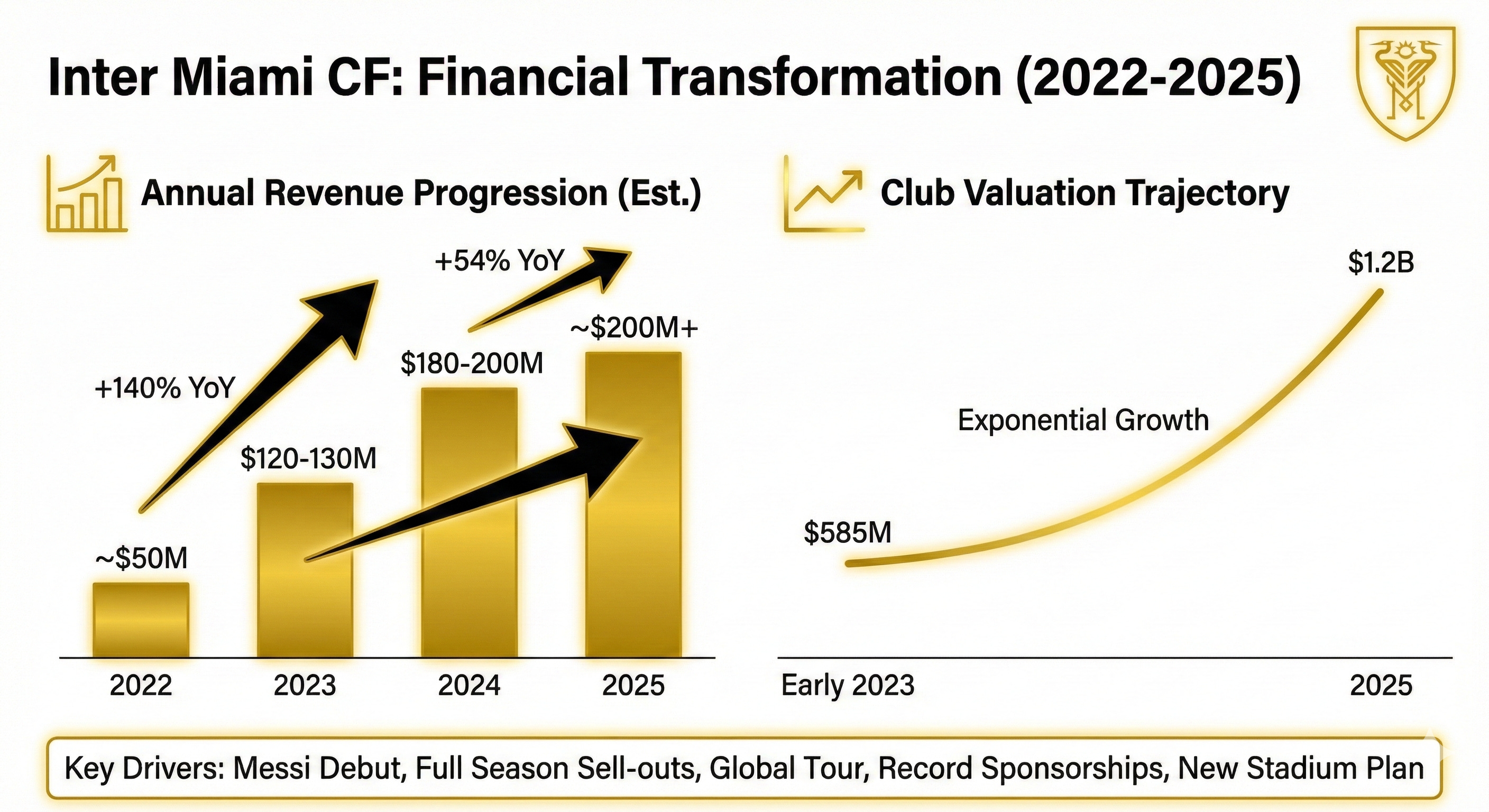
The correlation between this revenue growth and franchise valuation has been exponential. In early 2023, Inter Miami was valued at approximately $585 million. By 2025, the valuation surged to $1.2 billion, representing a 17% year-over-year increase, the highest growth rate in the league.
Sponsorship Strategy
This “Messi Effect” fundamentally altered the club’s sponsorship hierarchy. Post-2023, the club shifted from local partnerships to global blue-chip partners. In 2024, sponsorship revenue alone was projected to reach nearly $60 million, double the previous season’s figure and significantly higher than the MLS average of approximately $17 million.
Key partnerships solidified during this period include Royal Caribbean (jersey sponsor), JP Morgan Chase (stadium naming rights), and global brands like Duracell and Trapiche. The strategy shifted from volume to yield, leveraging the scarcity of association with Messi to command premiums standard in European leagues but anomalous in the MLS ecosystem5.
Sharing Economy
The phenomenon created a unique economy where opposing teams could budget for massive financial windfalls. Data indicates that Messi generated nearly $84 million in incremental revenue for other MLS clubs by mid-2025.
According to Goal.com:
A spokesperson from Sportsmillions.com said: “Whether it’s $50 or $750 a seat, people are willing to stretch their budgets just to be in the same stadium as Messi. Seeing Messi in the flesh is not just a game anymore, it’s a once-in-a-lifetime event, a bucket list moment. Clubs know it, fans know it, and the numbers prove it.
Teams like the New York Red Bulls saw ticket prices surge from $45 to $496 for the Miami fixture, and the Columbus Crew saw prices rise from $35 to $421. To accommodate demand, franchises relocated matches to NFL venues.
The Chicago Fire, for instance, generated between $7 million and $10 million from their Soldier Field match, a sum greater than all their other home games combined for that season6.
Sporting KC: 4th largest standalone MLS crowd
NE Revolution: Broken club attendance record
Chicago Fire: Shattered previous club record.
Columbus Crew: Record for non-NFL event at venue
Vancouver Whitecaps: Club record attendance.7
Media Rights & Social Reach
The 10-year, $2.5 billion partnership between MLS and Apple TV coincided with Messi’s arrival. The service saw a 280% spike in subscriptions on the day of his debut8. By the end of 2023, the service had surpassed 2 million subscribers9.
Critically, the audience is young and highly engaged. 70% of viewers for the 2025 MLS Cup were under the age of 45, with an average viewing time of 70 minutes10. The platform also allowed MLS to bypass fractured international rights deals, making Inter Miami games accessible globally without blackouts, a key selling point for non-US markets11.
However, we are seeing a strategic pivot. Reports in late 2025 indicate that the standalone “MLS Season Pass” model may be restructured for 2026, integrating content directly into the broader Apple TV+ ecosystem to mitigate churn and capitalize on the upcoming 2026 FIFA World Cup12.
This digital dominance extends to social media, where Inter Miami has effectively “broken” the scale of MLS.
As seen above, Inter Miami’s following on platforms favored by Gen Z dwarfs that of major NFL franchises, including the Super Bowl-winning Chiefs.
Merchandise
The commercial “halo effect” is perhaps most visible in jersey sales. While Messi naturally tops the list, his presence has elevated his teammates into the top tier of commercial viability, creating a “Miami Quadrant” at the top of the sales charts.
Notably, other Inter Miami players like Sergio Busquets (Rank 16) and Benjamin Cremaschi (Rank 23) also appeared in the top 25, showing that the brand’s popularity lifted the profile of the entire roster13.
Challenges
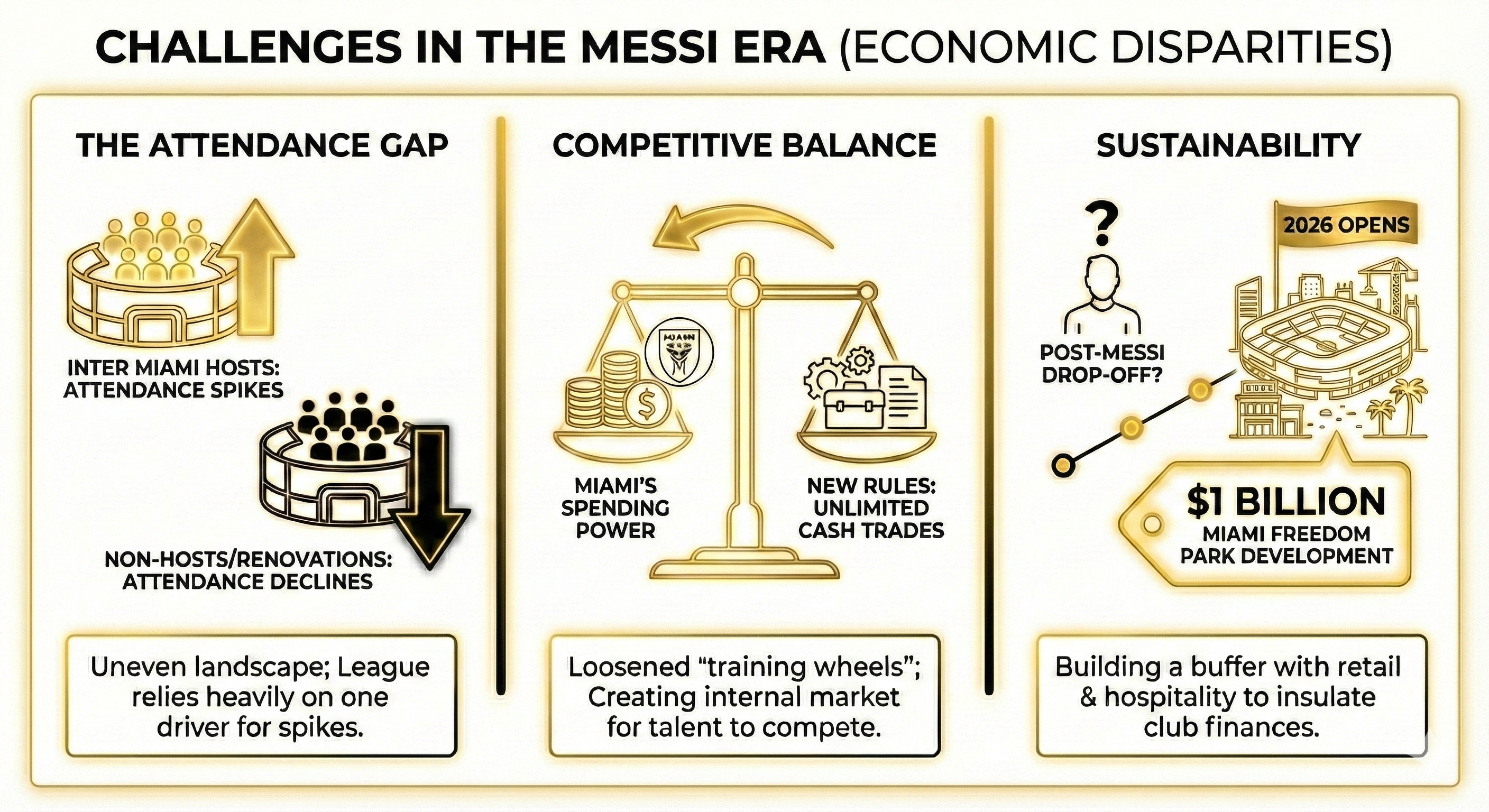
While this era has created unprecedented prosperity, it has introduced significant economic disparities that the league must now manage.
The Attendance Gap: While Inter Miami drives spikes for hosts, teams that did not host Miami or were undergoing renovations saw attendance declines, highlighting an uneven landscape where the league relies heavily on one driver14.
Competitive Balance: The success of Miami has emboldened the league to loosen its “training wheels.” Upcoming rule changes regarding unlimited cash trades are designed to allow other teams to compete with Miami’s spending power, effectively creating an internal market for talent15.
Sustainability: The looming question is the “post-Messi” drop-off. However, the club is building a buffer through the $1 billion Miami Freedom Park development. Scheduled to open in 2026, this complex will control surrounding retail and hospitality, insulating the club’s finances.
There is a fundamental shift underway that deserves our attention. As James Callan mentioned in Inside the Boardroom, MLS operates under a unique “single-entity” model, where clubs function as investor-operated franchises rather than independent entities. Membership is strictly controlled, markets are chosen strategically, and teams enter the league through expansion rather than traditional sporting merit.

The looming question is: how is the “Messi effect” pushing the boundaries of the status quo within this rigid, structured system?
A Note on the “Beckham Effect”
When we talk about the “Messi Effect,” we often need to compare it with the last time such a seismic shift hit the MLS and revolutionized the sport: the arrival of David Beckham (one of Inter Miami’s current ownes) rin 2007. I am currently working on a deep dive comparing these two eras, how the business landscape has evolved from Beckham’s LA Galaxy to Messi’s Inter Miami.
I will release this exclusive comparison once we reach 100 subscribers, so stay tuned and please share Off-Ball Logic with your network!
Future Outlook: 2026 and Beyond
As we look toward 2026, the club is preparing for a “perfect storm” of synergies: the final year of Messi’s contract, the opening of Miami Freedom Park, and the FIFA World Cup in North America.
Infrastructure as Buffer: The $1 billion Miami Freedom Park complex is designed to insulate the club from a post-Messi dip. Unlike the current temporary venue, this 25,000-seat stadium will generate revenue 365 days a year through on-site hotel, retail, and office leasing .
Global Integration (Copa Libertadores): Negotiations are progressing for MLS participation in CONMEBOL’s Copa Libertadores. Inter Miami’s inclusion would open a massive new revenue stream and competitive tier, further validating the roster investment16.
Calendar Alignment: The league is actively adjusting transfer windows and scheduling to align better with the European calendar. This shift is critical for facilitating the movement of high-value talent, reducing the friction of mid-season arrivals17.
Broadcast Evolution: As we mentioned before, reports indicate a strategic pivot for Apple TV in 2026. To mitigate churn when Miami isn’t playing, MLS Season Pass may be bundled more aggressively into the core Apple TV+ subscription, shifting from a pure revenue play to an ecosystem lock-in.

Conclusion
The “Messi Effect” will be studied for decades as a case study in star power economics. By leveraging a single asset, Inter Miami shortened a decade’s worth of brand building into 24 months, forcing the entire league to modernize its infrastructure, media strategy, and valuation benchmarks.
As the league transitions to 2026, the challenge shifts from capitalizing on mania to managing legacy, ensuring that the millions of new digital followers translate into a sustainable football economy that endures after the #10 jersey is retired.
Next Week: With the Chinese Super League bubble officially burst, we’ll analyze where that capital is moving next.
Carla | Off-Ball Logic
Just for context: throughout this text, “football” refers to what is known in the U.S. and other countries as soccer. On the few occasions I mention American football, I will specifically reference the NFL.
Goal.com: The Inter Miami Phenomenon. https://www.goal.com/en-us/lists/lionel-messi-inter-miami-84-million-revenue-mls-clubs/blt298064d7c076c836
Goal.com: Messi generates nearly $84M for rivals. https://www.goal.com/en-us/lists/lionel-messi-makes-84m-inter-miami-mls-rivals-argentine-superstar-ticket-boost-revealed-prices-soar-over-1000-per-cent/blt4d3defa8eae9cb13
Fuel VM: 2025 NFL Social Media Rankings. https://fuelvm.com/2025-nfl-social-media-rankings
SponsorUnited: The Messi Effect on Brands. https://www.sponsorunited.com/insights/messi-mls-2024
Front Office Sports: Inter Miami Game Provides Gains for Chicago Fire. https://frontofficesports.com/inter-miami-game-provides-short-long-term-gains-chicago-fire-messi/
World Soccer Talk: Lionel Messi sets another MLS attendance record. https://worldsoccertalk.com/news/lionel-messi-sets-another-mls-attendance-record-in-inter-miamis-thrilling-win-over-columbus-crew/
Antenna: The Messi Effect. https://www.antenna.live/insights/the-messi-effect
World Soccer Talk: How many of MLS Season Pass 2 million subscribers are free? https://worldsoccertalk.com/news/how-many-of-mls-season-pass-2-million-subscribers-are-paid-20240216-WST-489878.html
MLSSoccer.com: MLS Cup Delivers Record Viewership. https://www.mlssoccer.com/news/mls-cup-delivers-record-viewership-and-social-engagement
Sportcal: MLS achieves record broadcast interest. https://www.sportcal.com/media/mls-achieves-record-broadcast-interest-for-2025-regular-season/
Sports Media Watch: Apple TV to end MLS Season Pass. https://www.sportsmediawatch.com/2025/11/mls-season-pass-discontinued-apple-report/
MLSSoccer.com: Lionel Messi leads MLS best-selling jerseys in 2025. https://www.mlssoccer.com/news/lionel-messi-leads-mls-best-selling-jerseys-in-2025
Sports Business Journal: MLS Season Preview: The Messi Effect. https://www.sportsbusinessjournal.com/Articles/2024/02/19/major-league-soccer/
The Athletic/NYT: MLS Calendar and Spending Changes. https://www.nytimes.com/athletic/6806368/2025/11/14/mls-calendar-change-impact-future-spending/
The Athletic/NYT: Inter Miami to play at the Copa Libertadores: https://www.nytimes.com/athletic/6992679/2026/01/23/inter-miami-copa-libertadores-jorge-mas-messi-mls-conmebol-concacaf/
The Athletic/NYT: MLS Calendar Change: https://www.nytimes.com/athletic/6806368/2025/11/14/mls-calendar-change-impact-future-spending/
Carla !
Well done, again. I like what you’re doing here. You know how to pull the business levers into view.
Two things:
First, una preguntita…underneath the “Lionel Messi Effect”
who actually captures the Messi-driven surplus, by mechanism, after MLS rules and Apple TV platform economics take their cut? Where does the money land, and who misses it?
I ask this often because I lived in Miami pre-and post- Messi arrival. I watched the city flip into spectacle mode, the same kind of street buzz I saw when I was again living in Miami and Lebron came the Heat.
Great energy, but also a zoo, with nonstop attention and global eyes.
And yet I didn’t see the carryover into the broader city. I saw far more community touchpoints from the Heat era than I ever saw from Inter Miami CF. I can point to more moments where the club avoided local engagement than moments where it invested in it.
So I have a challenge for you, if it’s interesting.
I’d love a follow-up with your eyes that traces who captures the upside (club, league, sponsors, secondary ticket sellers, platforms), who eats the costs (hosts, staff, city logistics), and what the club returns to the community, if anything measurable.
If we call it a macroeconomic event, we need to audit where the surplus went. Especially in a city like Miami with significant socioeconomic disparity
You have a real eye for threads…keep going!
Great article!