

The Business of the World Cup, Part 1: Before It Was a Business
How posters, radio, and political propaganda laid the groundwork for the most commercially powerful sporting event in history, decades before the business existed

Hi everyone! I’m Carla, and this is Off-Ball Logic, the weekly newsletter where we step away from the 90 minutes on the pitch to dissect the business strategies, marketing mechanics, and economic engines that are really driving the modern sports world.
Today we’re starting something a little different.
Over the next five editions, I’m going to trace the full commercial history of the FIFA World Cup — from its founding in 1930 to the $13 billion commercial cycle it is today.
Subscribe to get it in your inbox:

There’s a photo of me at five years old that I’ve been thinking about a lot lately. I’m standing next to my brother, seven years older — and he’s wearing the USA 94 gear. The full kit: the t-shirt, the cap, and the bag. And I remember exactly how I felt wanting to have it too.
That tournament gave me Striker. Four years later, France 98 gave me Footix. At five, and then at nine, I wasn’t thinking about licensing deals or FIFA’s commercial strategy — I was just completely, irrationally obsessed. Not just with the football, but with the stuff: the mascots, the kits, the Happy Meal toys, the symbols. The visual universe that the World Cup built around itself every four years.
It took me a long time to understand why that obsession felt so different from regular fandom. The distinction, I think, is this: World Cup merch doesn’t function as merchandise. It functions as a materialisation of meaning — objects that carry the emotional weight of something far larger than themselves. And uniquely, it manufactures nostalgia before you’ve had the chance to feel it. The sticker, the mascot, the kit — they aren’t souvenirs of an experience you’ve already had. They’re promissory notes on one you’re still living.
But the question is: What is the meaning of the World Cup? What does it symbolize?
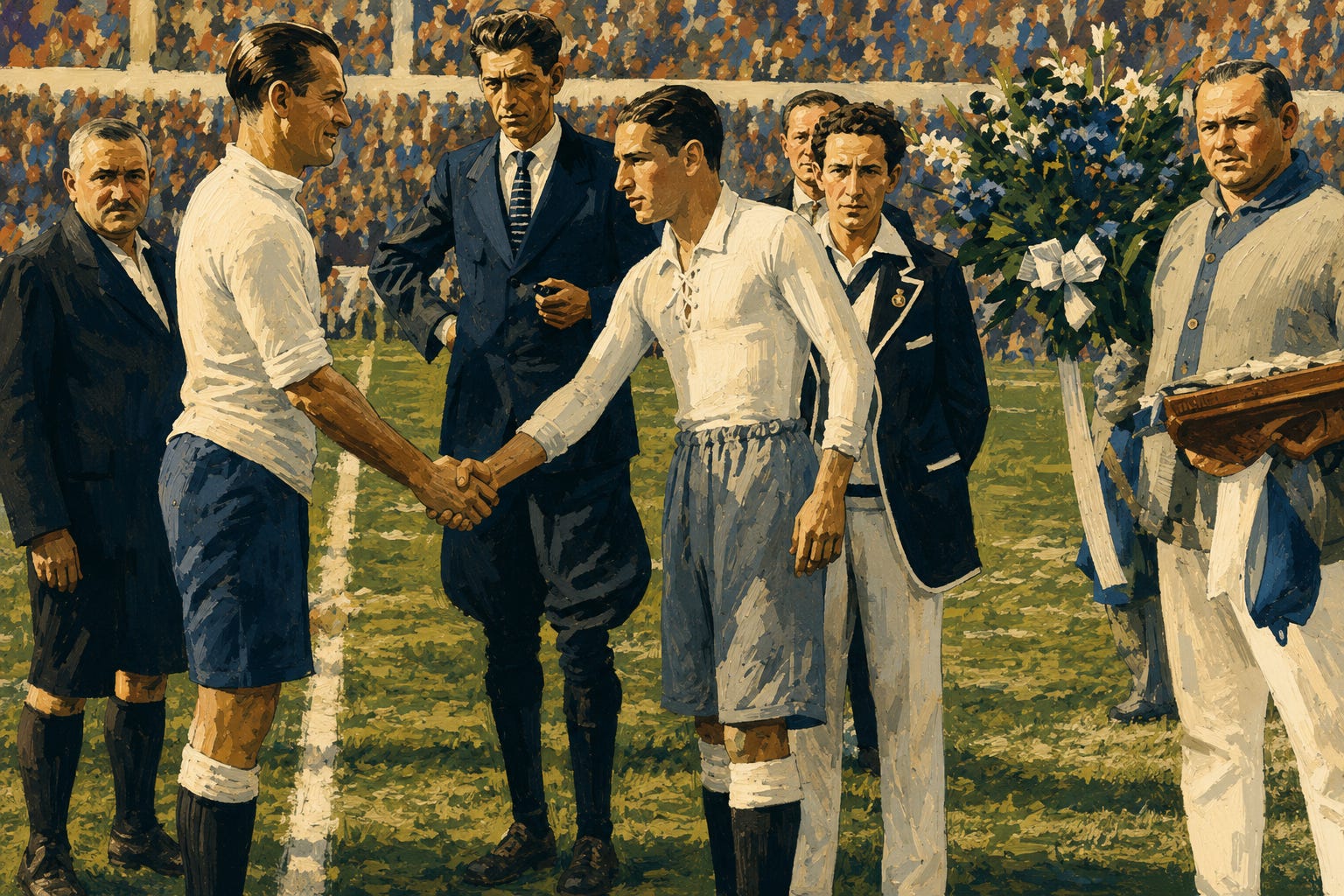
The reason a USA 94 kit could cement itself into my identity at age five is the same reason cited in Empire State of Mind: the World Cup is the concrete jungle where dreams are made of. Ricky Martin called it the Cup of Life, and he wasn’t being hyperbolic.
The World Cup is the ultimate goal not just of top-level athletes, but of entire nations, and its strength is built on national pride, on a century of storytelling, on a mythology so powerful it eventually surpassed the Olympic Games — an institution that had a century’s head start.
That mythology had to start somewhere, and when it did, there was no mascot, no kit deal, no global sponsor, and no television — barely even a plan.
This is Part 1 of a 5-part series on the commercial history of the FIFA World Cup. I want to understand how a sporting event became the most commercially powerful property in the world — and to do that, we need to go back to when it was nothing of the sort.
Before starting, think of two layers:
the emotional job to be done — what it means to win, or even just to watch — and
the functional job to be done — the shirts, the balls, the stickers, the mascots, the $1.5 billion in licensed merchandise that a modern World Cup generates.
Both layers matter. But Era 1 — spanning from 1930 to 1966 — was almost entirely the first, with almost none of the second.
Why the World Cup Exists at All
To understand where football’s commercial ecosystem started, you need to understand the tension that created it. FIFA was founded in 1904, in Paris, by a group of European football associations that wanted something the sport — still very young at the time — didn’t yet have: international governance. For the first two decades of the 20th century, the closest thing to a global football competition was the Olympic tournament — FIFA recognized it as the unofficial world championship in 1914, and the arrangement held, until it didn’t.
The 1920s were defined by a simmering conflict between the IOC and FIFA over a single, seemingly philosophical question: can footballers be professionals? For the IOC, operating under the rigidly aristocratic ideology of amateurism, the answer was no: athletes who received payment for playing their sport were barred from the Olympic Games, and the entire moral framework of the early Olympic movement rested on the idea that sport was an end in itself, not a livelihood.
Football, especially in Europe, was moving in the exact opposite direction. The sport was professionalizing fast — clubs were paying players, leagues were formalizing — and the working-class roots of the game were fundamentally incompatible with the Olympic ideal. That tension finally broke in 1928, when Jules Rimet, then FIFA president, and Dutch administrator Carl Hirschmann — who had first floated the idea of a standalone football world championship to the FA back in 1902 — brought the proposal to the FIFA Congress in Amsterdam. Twenty-three voted in favor, five against, and football became the first sport with its own world tournament, completely outside the Olympic framework.
That structural decision matters more than it looks. From the moment the World Cup was born outside the IOC’s jurisdiction, it was free — free from the amateur ideology, free from the multi-sport format, and eventually free to build a commercial infrastructure the Olympics would take another fifty years to even begin constructing.
A Trophy Before a Brand
The first World Cup was not a global event and, truth be told, it was barely an international one.
Uruguay was awarded hosting rights for reasons that had nothing to do with television markets or infrastructure capacity: they had won Olympic gold in 1924 and 1928, and July 18, 1930 marked the centennial of their constitution. Therefore, the tournament coincided with a national celebration, and that was pitch enough.
What followed was a 13-team tournament in which only four European nations made the transatlantic journey, citing the cost and length of the trip during a global economic depression — played in a purpose-built stadium, the Estadio Centenario, that was positioned as a gift to the nation as much as a football venue. The organizing budget came largely from government support, there was no global commercial partner, and revenue came from gate receipts alone.
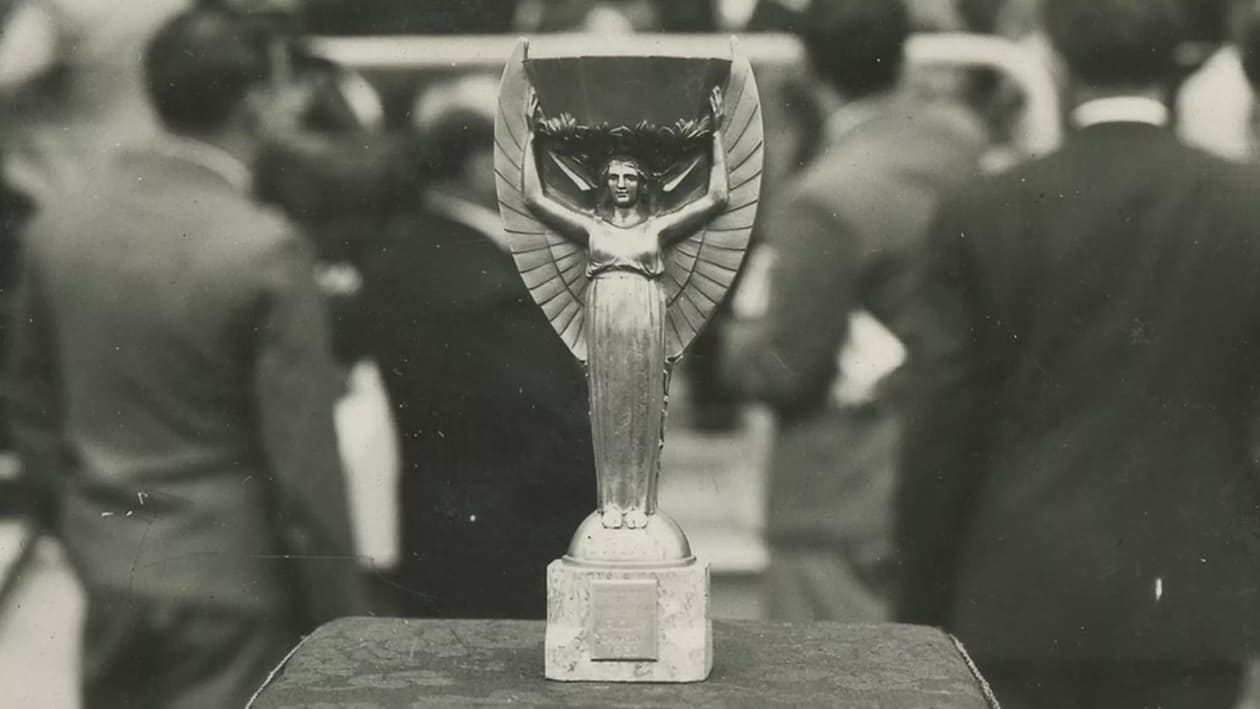
The trophy itself tells you everything about the era’s priorities. Created by French sculptor Abel Lafleur and made of gold-plated sterling silver on a lapis lazuli base, it depicted Nike — not the brand but the goddess of victory that inspired the US-based sports behemoth — with arms outstretched.
And it was named after Jules Rimet — not “The World Cup Trophy,” not “The FIFA Cup,” but the Jules Rimet Trophy, a tribute to a man rather than a symbol of a competition.
Having said all of this, it’s clear that the 1930 tournament was not yet a brand, but an event with an identity tied to its founders and its host, not to itself as a concept — and the commercial and symbolic transformation, the moment the World Cup became the World Cup, would take decades.
The Marketing Stack of Era 1, 1930–1966
There’s a reason I’m cutting this era at 1966 — covering it in detail in the next edition. England’s tournament is the inflection point: not because the inventor of the game hosted and won, but because it was the first World Cup to feature an official mascot (World Cup Willie) and the first to be broadcast commercially on television alongside the BBC — reaching a mass live audience across Europe for the first time. Those two facts aren’t coincidental — they signal the same shift: the tournament was beginning to understand it had an audience beyond the stadium, and that audience had commercial value.
But first, let’s look at what that first era actually looked like.
🏆Radio and graphic print were the pillars. There was no television coverage before 1954, and even then it was limited to a handful of European markets — the 1954 World Cup in Switzerland reached roughly 90,000 television sets in Germany. For most of the world, the World Cup arrived through the radio commentator’s voice and the printed page. Newspapers like Gazzetta dello Sport, L’Équipe, and Mundo Deportivo weren’t just covering the World Cup but, at the sam time, they were constructing it. The match reports, the illustrated previews, the post-game analysis: print media was where the narrative lived.
🏆Players were documented by witnesses, not cameras. The visual record of the early World Cups is largely illustrative precisely because photographic coverage was so limited — players were literally sketched by artists and illustrators working for newspapers and magazines, and these drawings were the primary way fans encountered the players they couldn’t see in person. The aesthetic of the era was shaped entirely by the constraints of the medium.
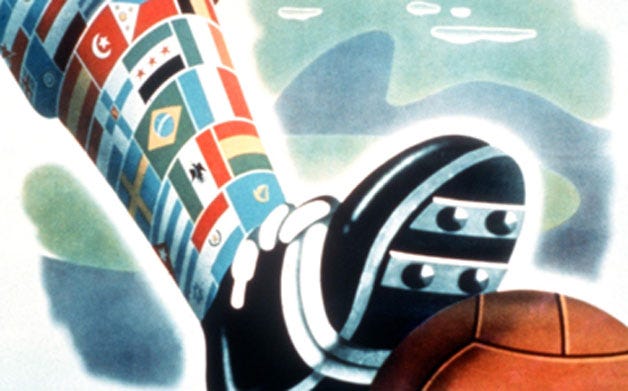
🏆The posters were the brand identity. From 1930 to 1966, each host country designed its own, and those designs were essentially the only unified visual identity each edition had. They were detailed, expressive, pictorial, and deeply local — flags, landmarks, native typography, players woven into national imagery, and the visual style tracked the aesthetic conventions of their moment. There was no global platform to standardize around, so all of them are cultural artifacts as much as promotional tools. When a printed poster distributed locally is your entire marketing reach, the image has to carry everything: where the tournament is, what it represents, why it matters.
🏆There were no mascots until Willie. World Cup Willie in 1966 was the first official mascot, and this is a milestone worth noting — though I want to go deeper on what mascots actually mean for a sporting event’s commercial and emotional architecture in a dedicated post coming soon. For now, the absence of mascots through 1962 is a marker of how narrowly the World Cup conceived of its own audience. Mascots are a product for children and families, and their introduction signals the moment an event starts thinking about intergenerational reach.
🏆Kit branding didn’t exist. Manufacturers were forbidden from displaying their logos on national team kits at the World Cup until 1974, which meant players wore shirts that were, in commercial terms, anonymous. Some brands like Adidas started to be present but none of it was visible on the pitch.
🏆Jerseys were beginning to mean something, but not as merchandise. The shift began with Brazil after 1950 — following the Maracanazo, the white home kit was abandoned and a national design competition was held, giving birth to the canary yellow with green trim. When Pelé wore it in 1958 and Brazil won their first World Cup, the shirt became something else entirely, and by 1970, on color television, it had become one of the most iconic visual assets in global sports history. But in this era, it was still a symbol, not a product.
🏆Host countries controlled everything. There was no centralized FIFA commercial operation — each organizing committee designed its own identity, sold its own local sponsorships, and managed its own ticketing. The World Cup was a federated event in every sense, host-defined and locally activated, with FIFA playing the role of sporting authority rather than brand owner. Coca-Cola first appeared at a World Cup through stadium advertising at Brazil 1950, but informally and transactionally, not as a global partner. The formal FIFA sponsorship program wouldn’t exist for another twenty-eight years.
What’s easy to miss, when you map Era 1 as a set of channels and constraints, is that those channels were operated by specific people who built the mythology without equity, without credit, and without any commercial stake in what they were constructing. The journalist filing from Montevideo in 1930, describing a match to readers who would never see footage of it. The illustrators who created a visual vocabulary from secondhand descriptions and rough prints. The radio commentators who understood, without precedent, that their job wasn’t to report on a match but to make you experience one you couldn’t attend.
The World Cup’s emotional infrastructure was not a byproduct of FIFA’s vision; it was the output of a creative and journalistic labor force that received none of the upside when the commercial era arrived. The business story of Era 1 is also their story — it just wasn’t recorded that way.
The First Great Story
The 1950 World Cup produced the tournament’s first piece of genuine mythology, and it came from a loss. The Maracanazo — Uruguay’s 2-1 victory over Brazil in the deciding match, in front of what remains the largest crowd ever to attend a football match (officially 173,850 at the Maracanã, though the actual number was likely higher), represented the birth of World Cup storytelling.
Brazil had built the Maracanã specifically for the tournament. The host nation was so heavily favored that a local newspaper had already printed the headline declaring them champions before the match was played, and the Brazilian Football Federation had already commissioned a song for the victory parade. The narrative was settled — and then Alcides Ghiggia scored in the 79th minute, and almost 200,000 people fell silent.
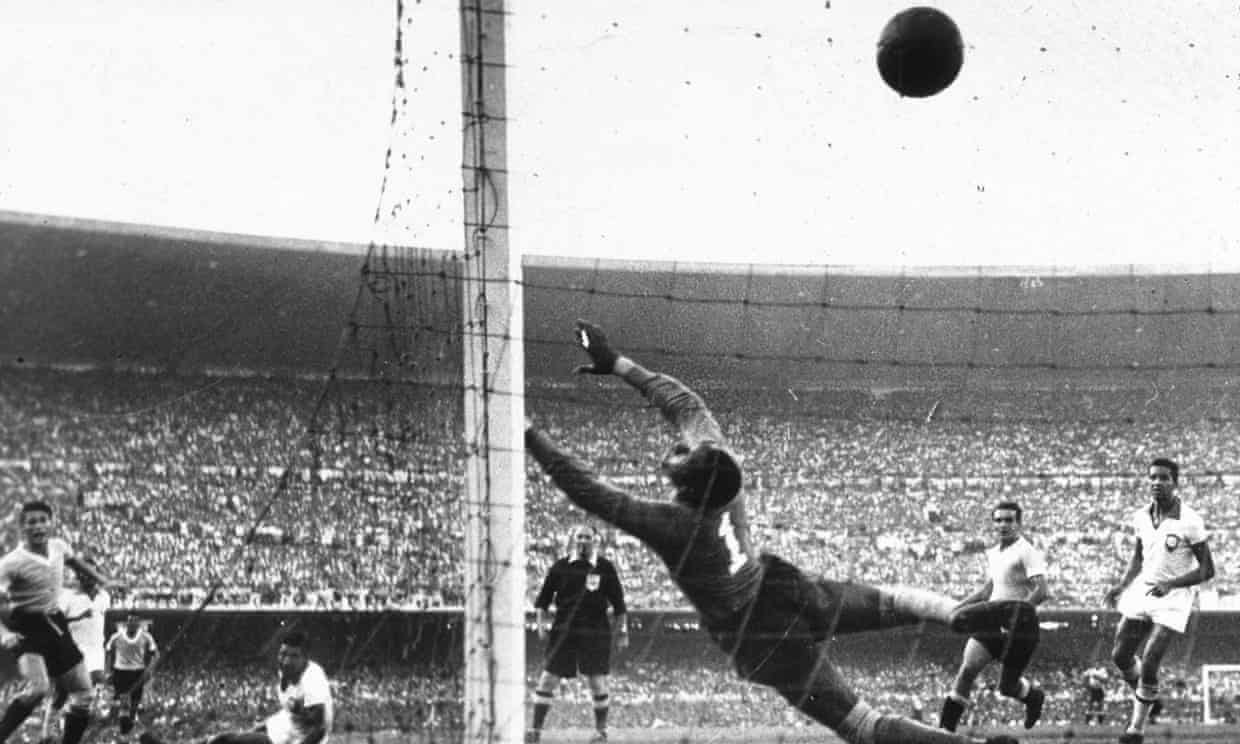
What the Maracanazo did for the World Cup was establish its narrative grammar. This was David and Goliath, a story older than modern civilization and proof that the tournament could deliver something no script could have written — the overturning of every expectation, the humbling of the enormous by the small. It also established that the World Cup’s emotional architecture was rooted in national pride and regional rivalry, particularly between South American and European countries. The early decades of the tournament were defined by this axis: Uruguay and Argentina from one continent, Italy and Hungary from the other, with the World Cup as the stage for a confrontation that was as much geopolitical as it was sporting.
Those rivalries weren’t manufactured by a marketing department — they were real, emerging from genuine ideological and cultural differences about how football should be played, and by whom. Print media amplified them because it had to. Radio dramatized them because that was its nature.
The storytelling was a consequence of what the game produced, captured and retold by writers and broadcasters who understood they were witnessing something that mattered — and because people who couldn’t attend or watch had to construct the tournament in their minds, the narrative had more space to grow.
Politics, War, and the Tournament That Had to Restart
Before we accept the founding myth of the World Cup, it’s worth asking who built it and why.
The idea that Era 1 produced purely organic, spontaneous storytelling deserves some scrutiny. The emotional foundation of the early World Cup wasn’t entirely unplanned — it was, in significant part, shaped by state actors with political objectives, and that context has been softened over decades of nostalgic retelling into something that feels more natural than it perhaps was. Uruguay 1930 was a government-funded centenary project, designed to coincide with national celebrations and built on public money. Brazil 1950 produced the Maracanã as a national infrastructure exercise before it produced a tournament. The World Cup’s mythology wasn’t purely the organic output of a sport that meant something — it was also the output of governments that needed the sport to mean something, for reasons that extended well beyond football.
The clearest proof is Italy 1934, which was not a complication in the tournament’s history but a confirmation of its essential nature. Mussolini personally intervened in the hosting rights process, funded the infrastructure, and used the event as a showcase for fascist modernism and national virility. The Azzurri won — in circumstances that left enough questions to fill several books — and the trophy was received in a ceremony laden with political symbolism. It was the first, but not the last, time a nation would use the World Cup as soft power.
Afer France 1938, again with European political tension as backdrop, the tournament simply stopped, due to World War II cancelling the 1942 and 1946 editions, and for eight years the World Cup didn’t exist — the sport continued in fragments, domestic leagues and regional competitions and friendlies between whoever was available.
When the World Cup returned in Brazil in 1950, it wasn’t the same event, since the war reshaped the world’s political map entirely. The hiatus had broken the rhythm of the competition — Germany was banned from competing due to its role in the war, several other nations declined to participate for various reasons, and England, which had spent decades refusing to enter a competition it felt was beneath its footballing authority, finally participated for the first time. In commercial terms, 1950 was a restart from near-zero: the organizing structures, the local relationships, the nascent print networks — all of it had to be rebuilt.
What made 1950 historically significant was less what it launched commercially and more what it generated narratively — the Maracanazo did more for the World Cup’s long-term storytelling power than any sponsorship deal could have, and the tournament couldn’t buy that story; it lived it.
Heroes Without Names on Shirts
In Era 1, the World Cup’s narrative heroes were nations, not individuals.
Uruguay won the first two tournaments they entered — 1930 and 1950 — and their identity was built around collective grit, defensive organization, and a fighting spirit that was explicitly framed as an expression of national character. The Garra Charrúa — named after the indigenous Charrúa people, with “garra” meaning grit and strength (even if the literal translation is “claw”) — represented a cultural narrative deeply embedded in Uruguayan identity that print journalists amplified across the continent.
Italy’s back-to-back wins in 1934 and 1938 were built around Vittorio Pozzo’s generation. Hungary’s Mighty Magyars — Puskás, Kocsis, the core of what many historians consider the greatest international team never to win a World Cup — defined the 1954 tournament through a style so distinctive that is still discussed as a tactical rupture in football history. Austria’s Wunderteam of the early 1930s. Brazil’s emergence through 1958 and 1962, winning back-to-back behind a collective philosophy that was in many ways the exact opposite of European defensive organization. And then England in 1966 — hosts, winners, and the anchor of a tournament that would be the last of its kind before the commercial structure of the game began to shift irreversibly.
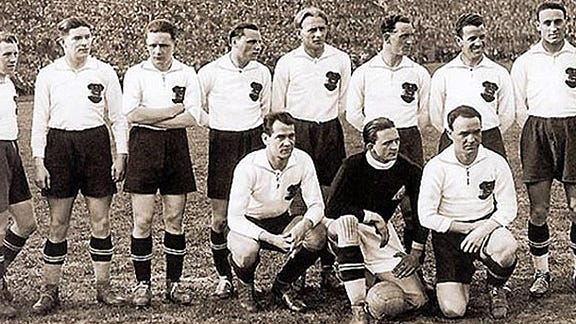
What this collective structure produced, accidentally and without strategic intent, was a tournament that had no rival for its own attention. Because no single player was large enough to own the World Cup’s narrative, the World Cup owned it — the tournament became the star, which meant FIFA became the exclusive owner of the most valuable attention unit in global sport, without ever having to compete with its own players for it.
Every other major property in this era that built around individual athletes gave commercial value to those athletes; FIFA, by constraint rather than design, retained it all. By the time the individual star system arrived — and it was coming regardless — the World Cup’s gravitational center was already too established to be pulled away from the institution. Pelé would add to the property, but he would not replace it.
These were teams, not brands built around individuals. There were star players, and Pelé appeared in 1958 as a 17-year-old and was immediately exceptional, but the hero export mechanism of this era was the match commentary and the newspaper column, not the endorsement deal, not the sponsored boot, not the post carved from a personal brand.
Relationships both tactical and spiritual were important for commentary. The athlete as a commercial entity was not yet a structural category — and that would define everything about how the next era unfolded.
What Era 1 Built
It’s tempting to frame this first era as primitive — the before-times, the commercial void that would eventually be filled by television money and global sponsorship programs — but that framing misses the point entirely.
What Era 1 built was the emotional infrastructure that made everything else possible. The storytelling gave the World Cup a depth of meaning that no commercial operation could have manufactured from scratch. The tournament spent its first three and a half decades accumulating narrative capital, and by 1966, when the first mascot arrived and the first commercial broadcast deal landed, there was already something real and powerful to commercialize:
The poster economy established that the World Cup had visual language worth protecting and developing.
The radio broadcasts built a global audience that had never seen a match but could tell you exactly what happened.
The regional rivalries between South America and Europe gave the competition a geopolitical dimension that transcended sport.
And the Jules Rimet Trophy — a tribute to one man’s vision — was already acquiring the weight of collective mythology.
The unified brand, the global sponsors, the kit deals, the licensed merchandise — the apparatus that would eventually make a five-year-old in Argentina obsess over a USA 94 bag — were still decades away. But the reason that apparatus would eventually work, the reason people would pay for it and feel something about it, was already in place.
The concrete jungle where dreams are made of took thirty-six years to build its commercial foundation — it had to mean something first.
What do you think? Let’s discuss below.
Thank you for being part of this journey!
Carla | Off-Ball Logic
Next in the series: the arrival of television, the Pelé era, and the moment the World Cup stopped being a tribute to virtuosity and became something closer to a product.
Really enjoyed this. I’ve always found it fascinating how geography heavily shaped the early World Cups, several European nations didn’t even attend Uruguay 1930 because the boat journey was considered too long and expensive.
This point — “What Era 1 built was the emotional infrastructure that made everything else possible. The storytelling gave the World Cup a depth of meaning that no commercial operation could have manufactured from scratch.” In a world that’s in a rush for everything, we forget that to build a monument, you need foundations. Thanks for the reminder. 🙌🏽