

The “Drive to Survive” Effect
How storytelling, star-building, and emotional hooks turned Formula 1 into a global marketing machine

Hi everyone!
Welcome back to Off-Ball Logic.
Before we dive into today’s topic, I want to say a massive thank you to all of you. The growth of this channel over the last few weeks has been incredible. It’s great to see such strong engagement with the “Off-Ball” deep dives. Whether you’re here for the marketing strategy or the sports culture, I’m glad you’re part of this.
Today we are going even more “off-ball”, as we’re going to talk about cars. I’ve been thinking about this topic a lot lately, even though the direction for this post was already settled. This exploration began with an informal chat among friends, where we lamented the scarcity of truly “epic” football films we could confidently suggest. Despite my deep passion for the sport, most movies fail to capture the intense narrative drama that a series like Drive to Survive (DTS) successfully delivered.
Watching Marty Supreme reinforced a specific idea for me: compelling sports narratives use character archetypes and stereotypes to draw the audience into deeper life issues, moving beyond a focus merely on the sport itself. The best examples emphasize the search for belonging and community, making the final score (the resolution) secondary to the emotional tension of the journey.
Now, let’s explore the core subject of this edition:
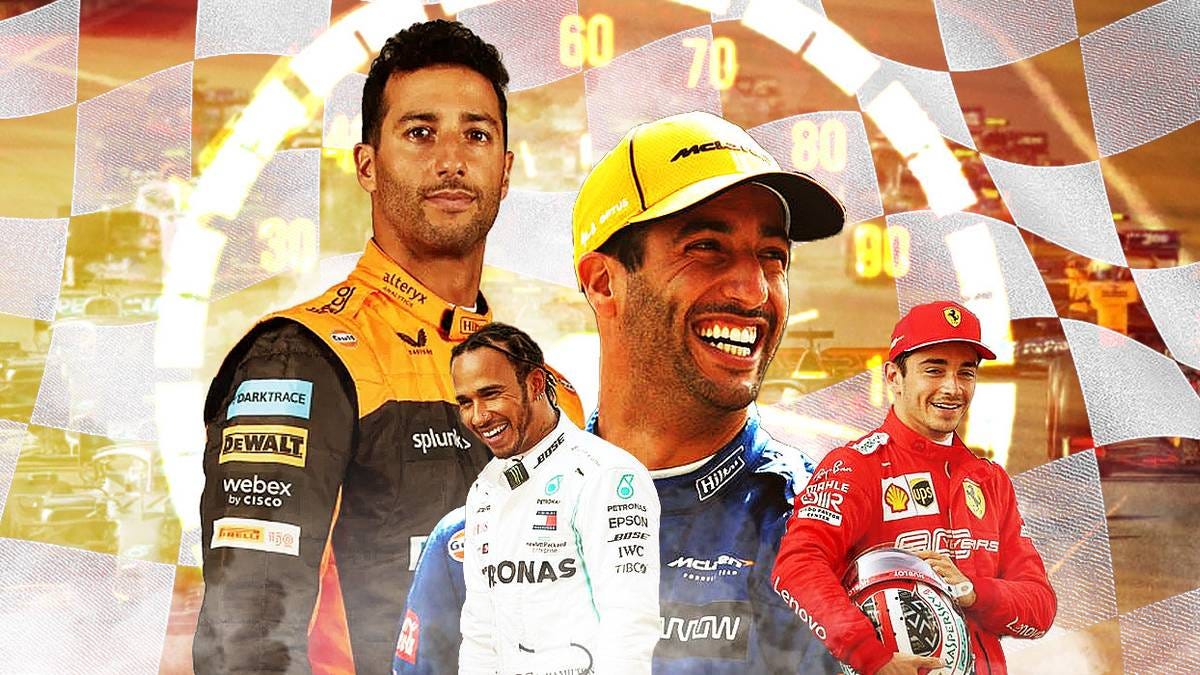
The Context
For decades, FIA bosses wrestled with how to engage a younger audience and break into the largely untapped US market. These were seen as keys to the very survival of the sport1.
While F1 was always popular, it struggled to attract new fans outside of Europe because the races could seem complicated and predictable.
Everything changed in 2016 when Liberty Media purchased F1 for $4.4bn. New management implemented strategies to rejuvenate the sport, targeting a younger demographic through initiatives like F1TV and increased social media accessibility2.
Note: For a more in-depth understanding of statistics and impact, this Substack post is highly recommended, it’s an excellent read. Kudos to Alessandro Oehy.

The most notable move was the 2018 partnership with Netflix for Drive to Survive. Originally intended to focus only on Red Bull Racing, the scope was broadened after negotiations with production company Box To Box.
They brought in co-producers James Gay-Rees (known for the documentary Senna) and Paul Martin, ensuring the series had the right creative expertise to balance history with modern drama.
The Pillars of the Narrative: Power of Personality and Drama
Storytelling plays the central role in turning what was once a very closed community into an open group of people whose passions and emotions are laid bare on screen3.
This was achieved through two main pillars: the power of personality and deliberate drama.
From the start, the series sought to humanize F1 drivers, team principals, and those working in the paddock. DTS succeeded in profiling every team and clearly explaining the chasms that exist in both budgets and expectations. Newcomers quickly learned what constitutes a “successful season” for Mercedes compared to Williams.
With journalists like Will Buxton offering context, the show built a narrative arc for the entire season rather than just reporting race results.
The constant presence of high stakes (financial, political, and life-threatening) inherently structures Formula 1. The show’s producers demonstrated skill in leveraging these elements:
“Formula One is an extremely bitchy world,” says James Gay-Rees. “That’s why it’s such a great place to make a show. There are heroes and villains. People are out to win at any price and will do whatever it takes.”
“I found F1 to be an incredibly unique sport in that your teammate is also your, in many ways, greatest competition. That makes for a great drama,” recalls F1 director Joseph Kosinski.4
When Season 1 launched in March 2019, this behind-the-scenes approach was an instant hit, breaking into Netflix’s top 25 ranked series within the first fortnight.

The Impact
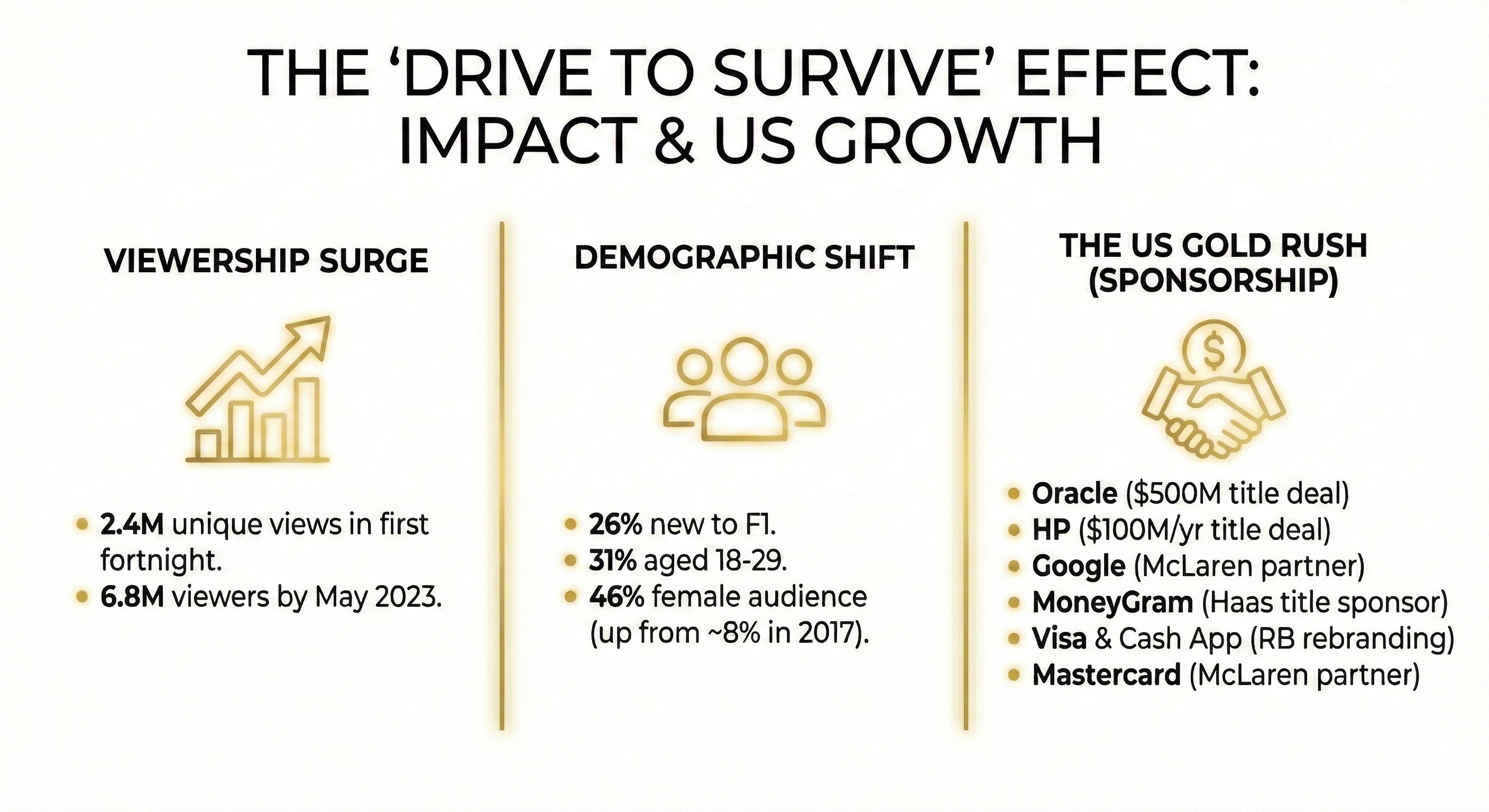
Over those first two weeks, an estimated 2.4 million unique views (UV)5 were recorded, numbers usually reserved for True Crime series like Making A Murderer.
By May 2023, the series had been watched by 6.8 million people. The breakdown showed its transformative effect:
26% of viewers had no real interest in F1 before
31% were aged between 18 and 29
and 46% of the viewership were women6.
This shift has usher in massive sponsorship from the US, with average viewership up 70% over the last few years. According to Tanay Jaipuria, the downstream effect has seen companies like Google, Coca-Cola, and Oracle upping their investment7.

Specific recent deals highlight this “Netflix effect”:
Oracle (Red Bull): A five-year deal estimated at $500 million ($100M/season), widely cited as one of the largest in F1 history [RacingNews365].
HP (Ferrari): A multi-year title partnership estimated at $100 million per season, matching the Oracle/Red Bull deal [Motorsport Week].
Mastercard (McLaren): A massive title sponsorship set to begin in 2026, estimated by The Athletic to be worth $100 million per season—potentially the largest on the grid [Mastercard Official].
Google (McLaren): A multi-year primary partnership that recently shifted its visual focus from Chrome to Gemini AI branding [McLaren Racing].
MoneyGram (Haas): A multi-year title deal for the only US-owned team, estimated at roughly $20 million per year [BlackBook Motorsport].
Visa & Cash App (RB): A groundbreaking title partnership that rebranded the former AlphaTauri team starting in the 2024 season [Autosport].
As Toni Cowan-Brown told CNBC, “Drive-to-Survive sparked this interest in F1 during lockdown, which people then took online, creating this community of content creators who were able to show people a totally new side of the sport”8.
Controversies
Success brought its share of skeptics. Those closest to the sport argued that Netflix sought to over-dramatize events to invent storylines. While no creative license was required to fan the flames between Christian Horner and Mercedes rival Toto Wolff, certain subplots were helped along. Many also pointed to the emphasis placed on practice sessions, which were often framed as incredibly important when, in truth, they are mostly experimental.
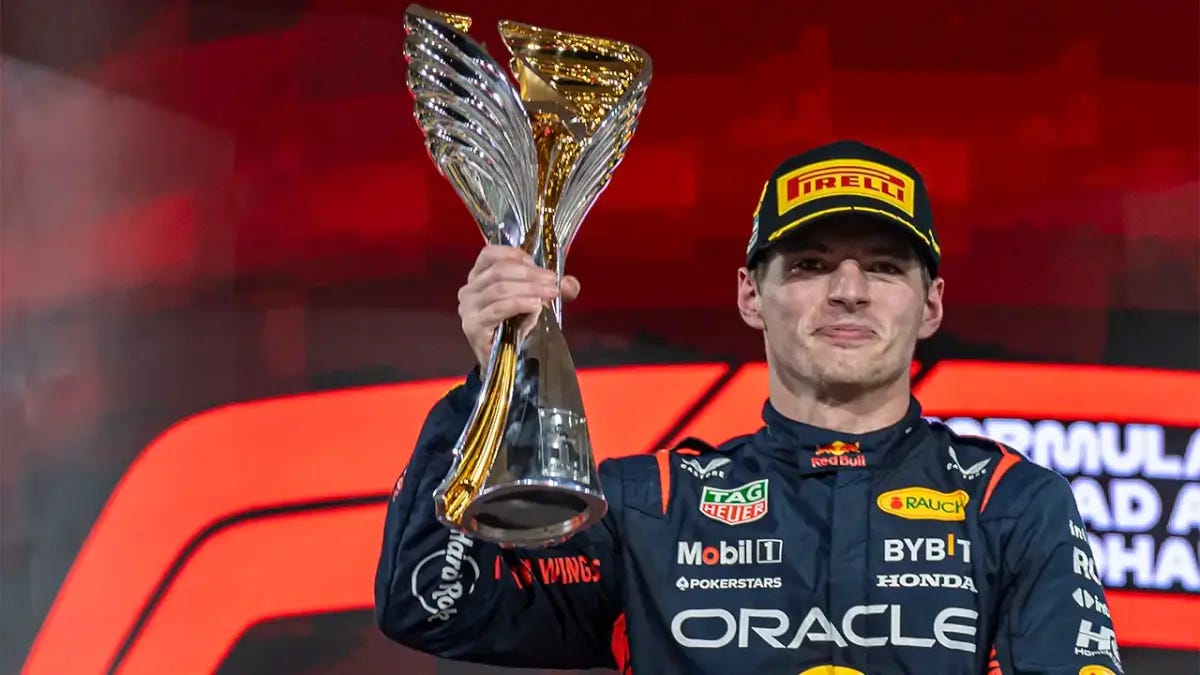
Among the skeptics were several drivers, including world champion Max Verstappen, who refused to be interviewed for seasons 2, 3, and 4. Even the critics, however, accepted that Drive to Survive had brought fans closer to the action, some of which didn’t require Hollywood treatment. As YouGov numbers underline, the show exceeded the expectations of those who conceived it.

Replicating the Model in Football
Tennis has Break Point, Golf has Full Swing, and Rugby has Full Contact9.
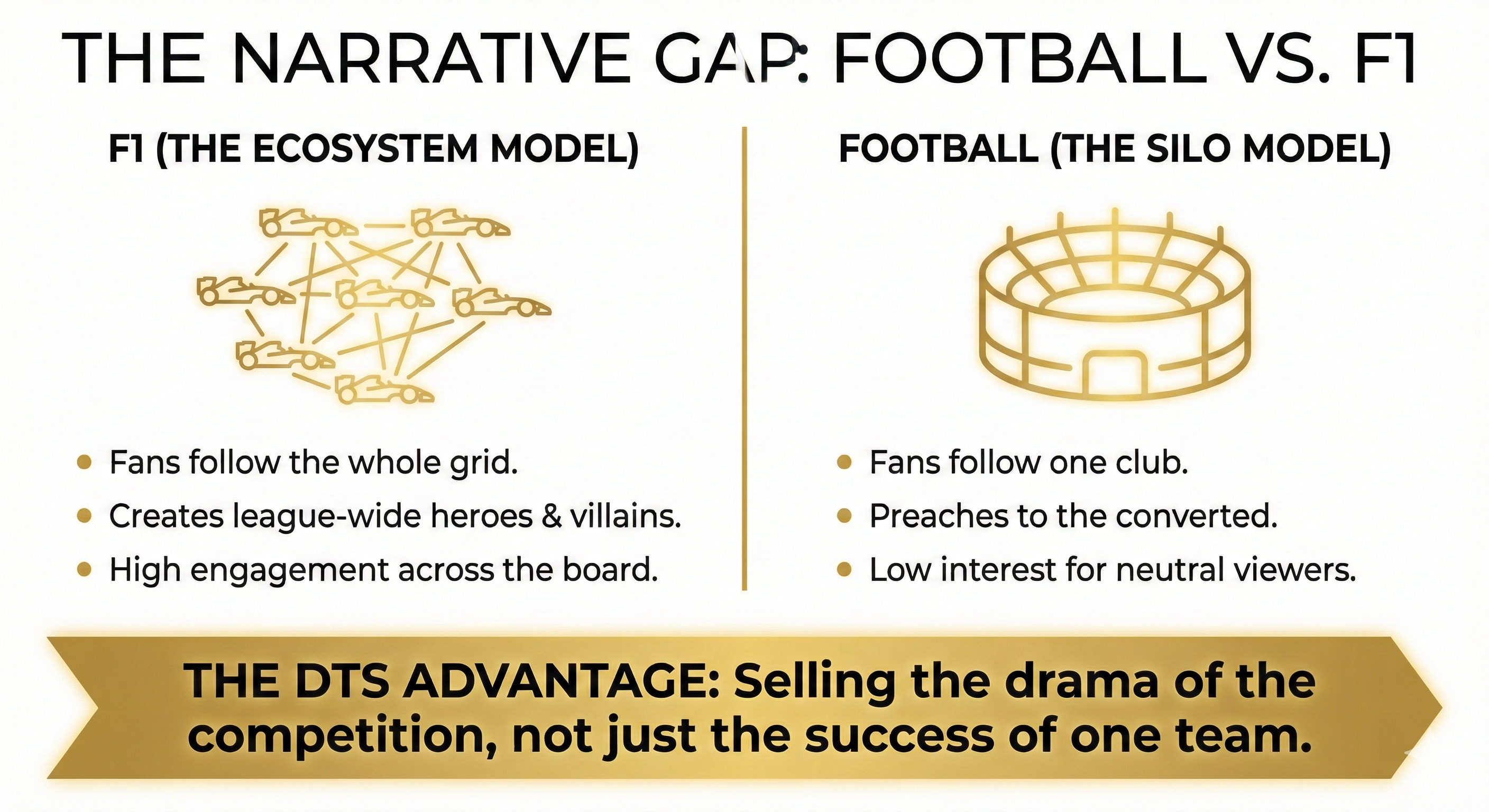
In football, the closest examples like Prime Video’s All or Nothing focus on a different team each year, which is a problem if you’re not a fan of that team. Football exercises have often failed in polarizing the audience or letting them choose a side.
I think about the docuseries Becoming Champions, which narrates how the eight World Cup champions made it. I recall watching it at Fiumicino Airport, after our month-long trip to Italy.
One episode, titled “Argentina: The Hand of Fate?”, explores the “Hand of God”, which remains one of the most controversial moments in football history. As an Argentine, I aim to be as objective as possible, acknowledging that everyone is entitled to their own perspective. However, the docuseries made a conscious “moral effort” to underline that the behavior was wrong.
To me, the key to captivating football storytelling is crafting narratives that prompt analysis and encourage engagement, allowing the audience to choose a side or not, even when the situation is ambiguous or transcends the strict rules of the game.10
This is what the movie F1 did with the character Sonny Hayes (Brad Pitt). He tries to beat the system by playing near the rules constantly, and his mates don’t agree. But he does what he feels needs to be done, and it’s on us to empathize or not.
Football has become more and more “friendly.” Truth be told, the game experienced huge issues with violence, leading to enormous changes like the Premier League and stadium renovations. Hence there might be a reason why football as a “friendly” sports wants to be associated with it.
But rivalries and tension will always exist (just look at the AFCON final) and that is what makes the sport attractive. Even in feel-good content like Ted Lasso, the narrative changed to show how rivalries and tension play out in matches.
Final Thoughts
Welcome to Wrexham looks like a experiment that had a good feedback because it played on the effect of a team’s ups and downs on a fragile working-class community. But whether it can keep its underdog charm as the team rises is debatable. I believe a team in the top three English leagues won’t be seen as an underdog anymore.
One of the greatest hits in DTS was how small teams became famous. For football, perhaps focusing on rivalries of teams outside the mainstream, but big enough to gain traction, could be the next topic.
It’s related to what I’m going to talk about next. I’ll only say it involves African football, but I don’t want to spoil it.
More updates coming soon.
Carla | Off-Ball Logic
https://www.matfoundrygroup.com/blog/the-drive-to-survive-phenomenon-how-a-docuseries-transformed-f1
https://theao.substack.com/p/drive-to-survives-economic-and-popularity
https://www.toaststudio.com/en/articles/drive-to-survive-is-the-ultimate-branded-content/
https://www.thenationalnews.com/arts-culture/film-tv/2025/03/14/f1-drive-to-survive-netflix-james-gay-rees/
On Netflix, “unique viewers” represents an estimate of the number of individual, distinct accounts that have watched a specific piece of content (a movie or a TV show) within a certain timeframe. This metric distinguishes people from total views, meaning that if one account watches a movie five times, it is counted as only one unique viewer.
https://www.matfoundrygroup.com/blog/the-drive-to-survive-phenomenon-how-a-docuseries-transformed-f1
https://www.tanayj.com/p/drive-to-survive-and-content-marketing
https://www.cnbc.com/2024/04/30/f1s-fanbase-is-shifting-and-the-netflix-effect-is-only-part-of-that.html
https://www.theguardian.com/tv-and-radio/2025/mar/12/formula-1-drive-to-survive-netfllix-apex-of-tv-documentaries
Note: excluding serious or illegal matters that are not up for debate.
This is beautiful! Love seeing some interest in F1 on this app!
Great read! F1 was also incredibly lucky that the Drive to Survive breakthrough happened right as COVID hit, and then got turbo‑charged by the drama‑filled 2021 season, which let new fans experience DTS in real time.