

When Passion Goes Global: How Boca Juniors Outgrew its Geography
Is the "TikTok-ification" of La Bombonera a loss of identity, or the ultimate Product-Market Fit?
Hi everyone! Happy New Year.
Welcome to the inaugural edition of Off-Ball Logic.
In sports media, the vast majority of attention follows the ball (the highlights, the scores, and the weekly drama).
But the defining moves of the industry, the ones involving billion-dollar valuations, global tech shifts, and strategic brand positioning, happen almost entirely “off-ball.”
My name is Carla. By day, I am a Product Marketing professional, with years of experience scaling global HR Tech and SaaS platforms, I’ve spent my career deconstructing how products find their edge and dominate markets.
Off-Ball Logic is where these two worlds collide. I am applying the same frameworks I use in tech (Product-Market Fit, Outsider Brand, and Go-To Market) to decode the business of sport. We aren’t here to report the news; we are here to analyze the mechanics behind it. We are here to see the entire field.
For our first deep dive, we are looking at a phenomenon that perfectly illustrates the tension between local tradition and global scale: The "Gentrification" of Boca Juniors.
In the post-pandemic era, a polarizing debate has taken center stage in Argentine football. Skeptics argue that the increasing presence of international tourists and social media influencers in the stands is a sign that the club is trading its historic working-class identity for global commercial appeal.
But if we look broader we see a different story. This isn’t just about rising ticket prices and trendy jerseys; it’s a masterclass in how a local identity was transformed into a global, high-equity product.
The Urban Blueprint: From Neighborhood to “Turistificación”
To understand the club, we must first understand the soil. Gentrification is typically an urban process: infrastructure improves, property values rise, and the original working class is displaced by a wealthier demographic.
In Buenos Aires, we saw this in neighborhoods such as Villa Crespo, Villa Urquiza and San Telmo. But in La Boca, the process was specialized. Scholars call it “Touristification.”
Unlike residents, tourists don’t want to stay; they want to consume an “authentic” experience. By renovating Caminito (one of the top spots in Argentine tourism) and the Paseo de la Ribera, the city turned a living neighborhood into a curated stage.
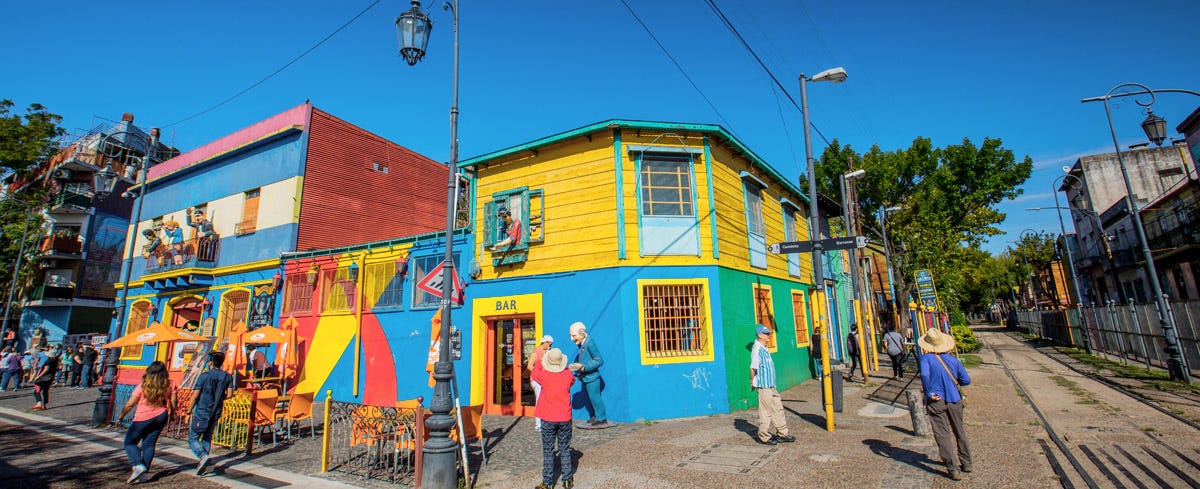
This raises a question: Does urban gentrification inevitably dilute the brand identity of the club it surrounds?
A Brand Built on Displacement
To understand the brand, we have to go back to 1905 when Boca Juniors was founded, not to a boardroom, but to a bench in a rigger’s neighborhood. Five boys, mostly the sons of Italian immigrants (Oriundi), decided to build something of their own.
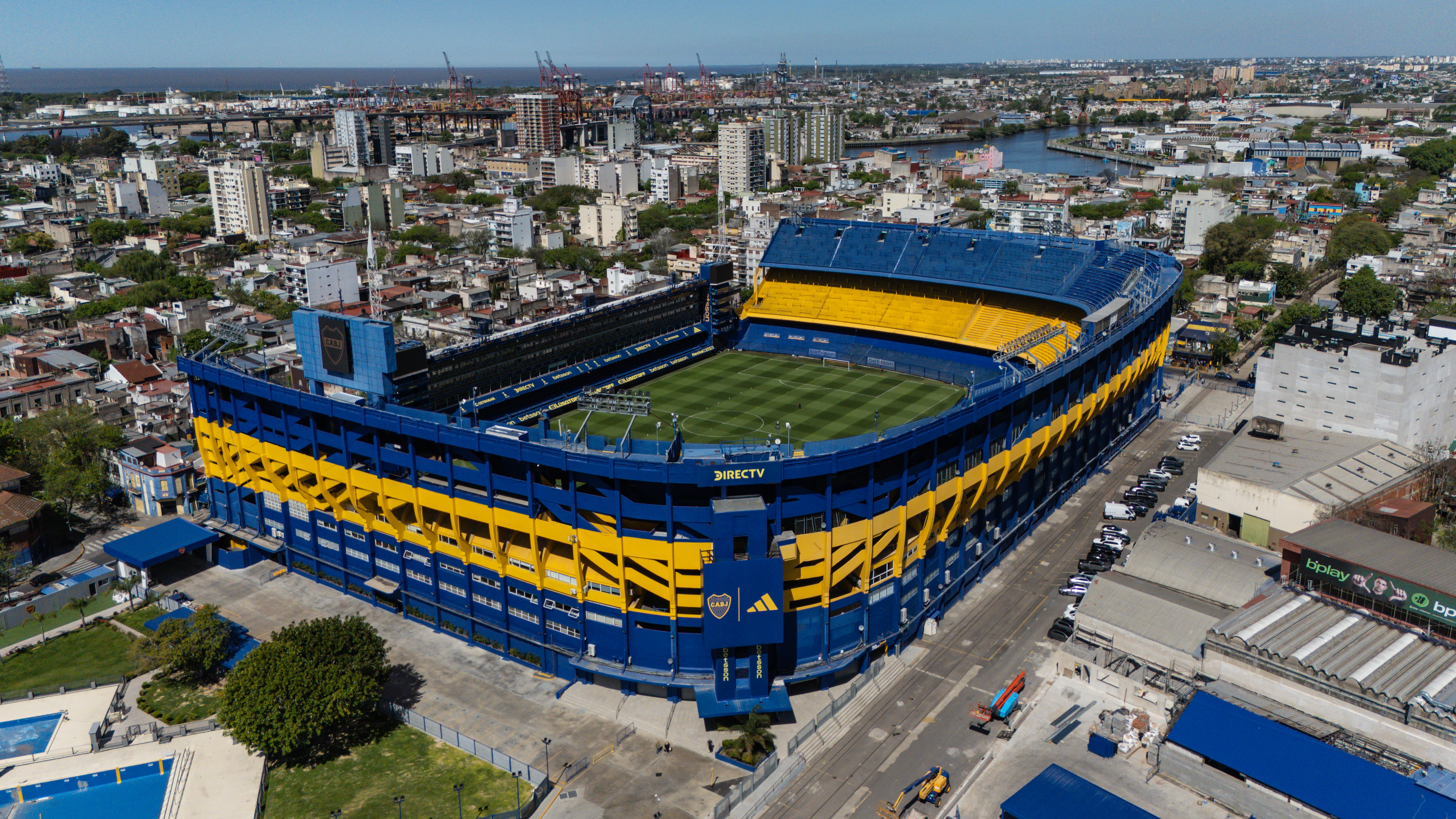
In marketing terms, this was an “Outsider Brand.” While the “establishment” was British-influenced and elite, Boca Juniors was built on the grit of the port.
Their product identity—if we think of clubs as “products,” and I won’t lie to you, this comparison will happen frequently—was accidental but brilliant:
The colors: Borrowed from a Swedish ship (an early example of a visual identity born of necessity).
The roots: The Genoese (Xeneize) dialect spoken by the founders’ parents, which gave Boca Juniors fans the nickname “Xeneizes.”
The DNA: The brand didn’t just reflect its humble origins; it embodied resilience. It represented the immigrant’s struggle: a narrative that carries universal appeal.
The Great Divergence: Market Segmentation in the 1930s
As Buenos Aires professionalized, the city’s two giants made a strategic choice that would define the next century.
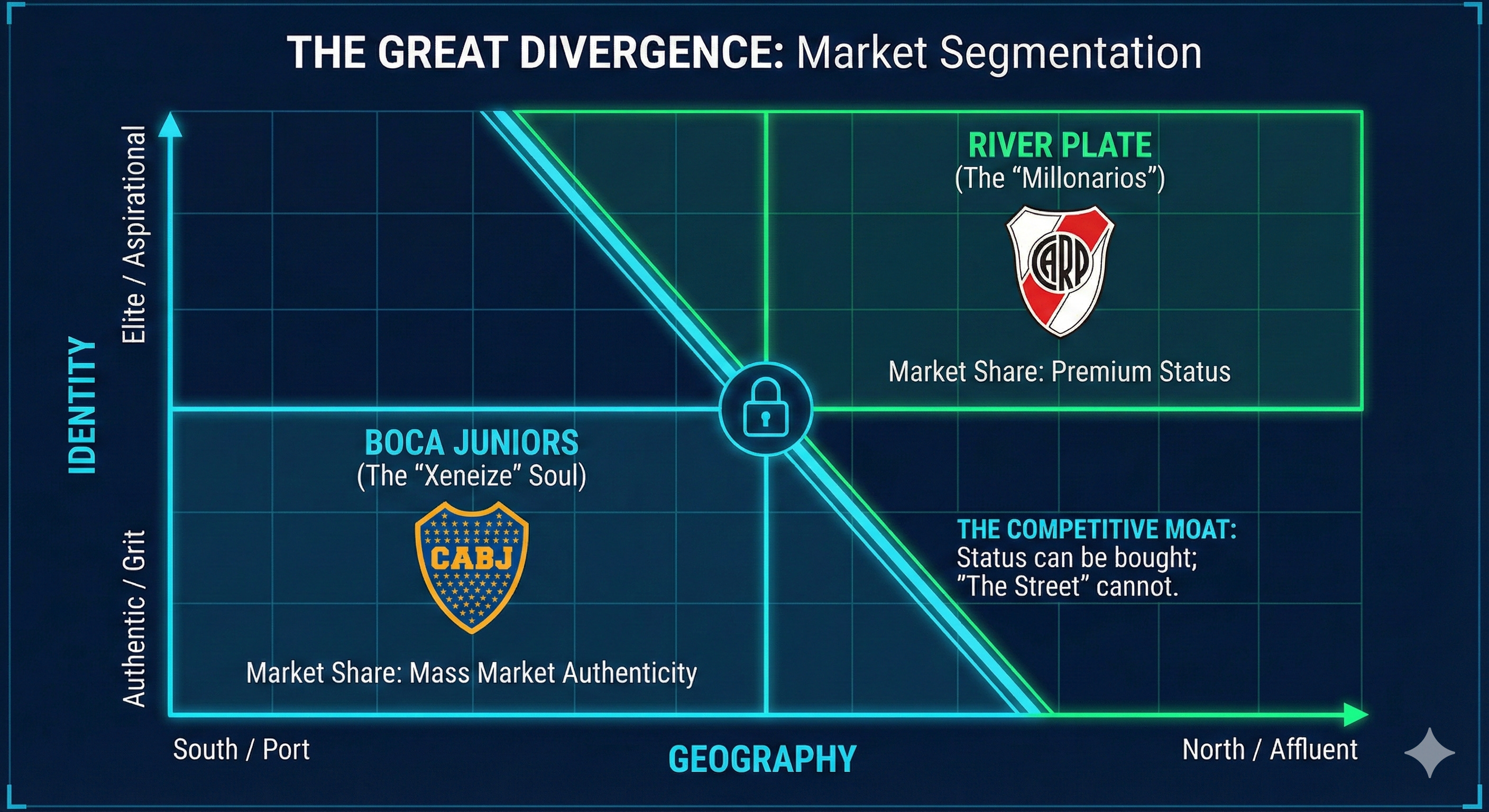
River Plate moved to the affluent north, adopting the “Millonarios” persona. They chose “Premium Aspirational”—the club of hats, suits, and refinement.
Boca Juniors stayed in the port. They doubled down on authentic heritage. This wasn’t just about geography; it was a Market Split. By staying in the neighborhood, Boca claimed the emotional monopoly on the working class. While River sought the “Elite” user, Boca captured the “Mass Market” soul. This created an untouchable Competitive Edge: you can buy status, but you can’t buy “the street”.
“The street” translates directly to “la calle”, but it’s more related to the idiom “tener calle” (to have street), that describes someone street-smart, resourceful, tough, and experienced in life’s challenges, someone who knows how to handle tough situations or “the streets”.
The Berlusconi of the South: Institutionalizing “La Pasión”
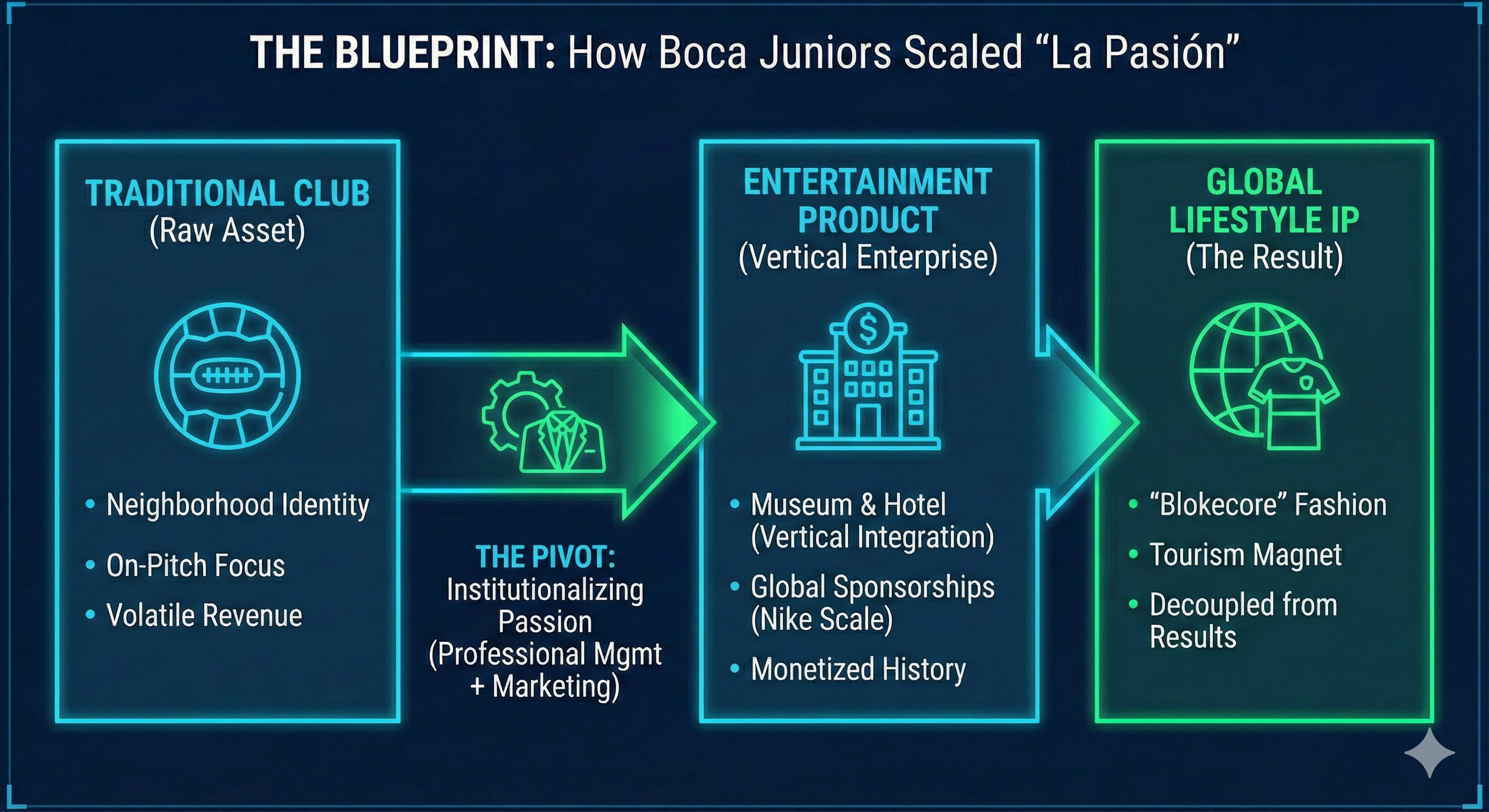
The real “pivot point” for Boca Juniors’ brand didn’t happen completely on the pitch; it happened in the front office during the 1990s under Mauricio Macri.
Note: To clarify, most clubs in the Primera División work under the classic (and in some regions, legacy) system of fan-based management known as “socios.” In this system, a single executive (a president) is elected for a set term, normally four years. This was the case for Mauricio Macri, who served as president of both Boca Juniors and later the Argentine Republic.
Macri looked at Silvio Berlusconi’s AC Milan and saw a blueprint (not only at a sports management level, since both have been presidentes of their own countries). He didn’t just want to win trophies; he wanted to build a Global Entertainment Product.
Professional management: He introduced professional marketing departments.
Vertical integration: He created the “Museum of Boquense Passion” (Museo de la Pasión Boquense) and even the world’s first football-themed hotel.
Monetization: Boca was a pioneer in sponsorship in Argentina (Vino Maravilla in ’83 was the start, but Nike in the ’90s was the scale).
Larger-than-life figures: From Diego Maradona to Juan Román Riquelme, these icons represented the deep connection between the club and the fans who love the game and want to be close to their idols.
Furthermore, Boca’s global profile skyrocketed during the 2000s. Their success in the Intercontinental Cups in Japan, where they defeated giants like AC Milan, brought the club unprecedented international fame.
Macri realized that “Passion” was his primary commodity and the top attribute that would be later used for international brand positioning. By linking the club’s history with the aesthetic of the neighborhood, and realizing that the colors, the tango, and the conventillo were product features that could be sold to the world.
This created a Product-Market Fit (PMF) that appealed to a global audience—fans who were eager to identify with a foreign club that offered the ‘core essence’ of what football culture truly means.
In tech, Product-Market Fit (PMF) is the moment a product perfectly satisfies a market demand. In Sports: It’s the alignment between a club’s unique cultural identity and the global audience’s hunger for “authentic” football.
The “Blokecore” Phenomenon: Football as a Fashion Statement
Today, we are living in the era of “Football as a Lifestyle.” None of this would happen without David Beckham, who, in the 2000s, turned the footballer into a fashion icon.
Then it came the streetwear integration, where today, 19-year-olds in London or Tokyo wear a 1981 Maradona-era Boca shirt because it fits an aesthetic, not because they know the score of the last match.
Boca Juniors has moved beyond the stadium and the Blue and Gold color palette is now lifestyle IP. It sells in urban fashion boutiques as much as it does in sports shops. This is something we can see in international platforms such as Classic Football Shirts.
The final proof of this decoupling is the recent explosion of A-list pilgrimages. In just the last few months, La Bombonera has hosted global icons like Dua Lipa, Noel Gallagher, and Johnny Depp.
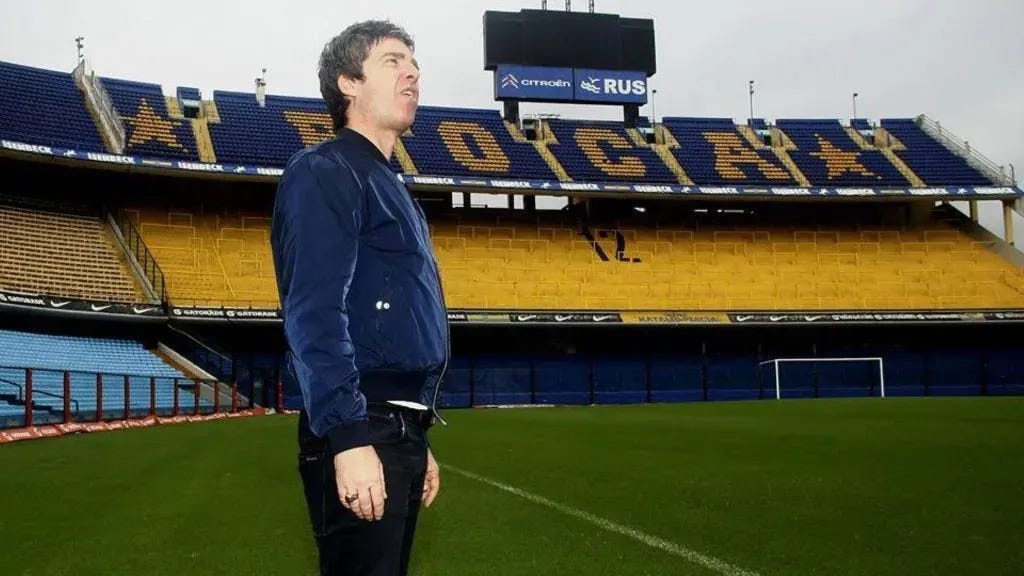
They are there because La Bombonera has transitioned from a sports venue into a global cultural stage: a bucket-list “experience” that aligns with their own personal brands. When a global pop star posts a story in the stands, it confirms that the club is no longer just selling football; it is selling cultural relevance.
This is the ultimate win in sports marketing: the brand is now decoupled from the team’s weekly performance.
Conclusion: Productization, Not Gentrification
Is it “gentrification” when a person fancies a cigar in La Bombonera for a TikTok video?
When a tourist takes a TikTok in La Bombonera, they aren’t “gentrifying” the club;
No. That is Productization. What we are witnessing is the result of a 30-year GTM (Go-to-Market) strategy that was too successful. By acting (and winning) at the right time, with the explosion of the Premier League and Champions League as TV products, Boca Juniors positioned itself as the “authentic” soul of the sport.
Go-to-Market (GTM) Strategy: A plan that details how a brand reaches its customers and achieves a competitive advantage. In Sports: This is the long-term blueprint to move from a local neighborhood hero to a global entertainment giant.
Boca Juniors didn’t lose its identity; it turned that identity into a global language and became a sports brand that has achieved 100% global market awareness.
If you found this analysis valuable, subscribe to Off-Ball Logic. Every 2 weeks, we’ll continue to deconstruct the hidden business mechanics behind the world’s most iconic sports brands.
Coming Next Week: We’re moving from the port of Buenos Aires to the digital pitches of London. We’ll be analyzing the unconventional GTM (Go-To-Market) strategy of YouTube-born clubs like Hashtag United and SE Dons. Why are they outperforming traditional pro clubs in audience retention?
Speak soon,
Carla | Off-Ball Logic
It will be interesting to understand Boca’s plans to modernize their stadium without losing the characteristics that make it so special. River’s average attendance, with its new stadium, is truly impressive.
In Brazil, the renovations for the 2014 World Cup essentially killed much of the soul of several stadiums, most notably the Maracanã (which is home to the team with the highest average attendance today, Flamengo). It lost much of the identity that made it such a legendary stadium.