

The Fragile Economics of the 2026 World Cup
FIFA is projecting record revenues. But what happens to brand equity if the ultimate marketing juggernaut faces suspension, relocation, or postponement?

Hi everyone! I’m Carla, and this is Off-Ball Logic, the weekly newsletter where we step away from the 90 minutes on the pitch to dissect the business strategies, marketing mechanics, and economic engines that are really driving the modern sports world.
Subscribe to get it in your inbox:

The 2026 FIFA World Cup represents a seismic shift in the business of global sports. While past tournaments relied on traditional commercial models, 2026 was conceived from day one to be a marketing juggernaut, leveraging the immense buying power of the North American market. With a completely restructured partnership hierarchy and an unprecedented scale of investment, FIFA is laying down the future blueprint for how host cities, teams, and global brands position themselves. Spanning 104 matches across three countries, it is poised to become the most valuable commercial property football has ever seen.1
However, the current political climate has raised a lot of unanswered questions. Everyone is analyzing the situation from geopolitical, societal, and purely sporting perspectives, but I am going to tackle the marketing side.
Think of today’s breakdown as a sneak peek. I’m currently working on a deep dive for my upcoming paid edition covering the complete history of World Cup marketing—how we got here, what worked, and what failed. But before we look back, we need to tackle the massive stakes of 2026.
What We Know So Far
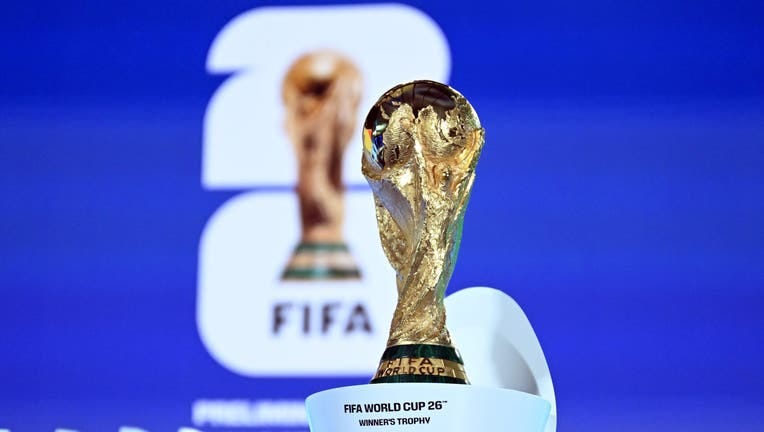
FIFA anticipates a record-breaking $11 billion for the 2023-2026 commercial cycle, with the 2026 tournament alone driving nearly $8.9 billion. This boom is fueled by a targeted sponsorship strategy projected to hit up to $3 billion—a massive jump from Qatar’s $1.8 billion.
Brands are leaning hard into the “Super Bowl Effect” of the tournament to tap into the highly lucrative North American market. Because so much value is concentrated here, any disruption to the event’s schedule or location would trigger multi-billion-dollar losses in media and retail.2
Global Partnership Tiers and Investment Specifics
The 2026 World Cup’s strong commercial appeal is anchored by its three-tiered global partnership structure: Tier 1 (FIFA Partners), Tier 2 (FIFA World Cup Sponsors), and Tier 3 (Regional Supporters).
Tier 1 Partners enjoy the most comprehensive rights, granting them global association across all FIFA competitions and organizational activities3. Tier 2 Sponsors hold global rights specifically for the 2026 Men’s World Cup, while Tier 3 entities focus strictly on regional markets.
By the end of 2024, FIFA had already secured about 62% of its cycle revenue budget, confirming massive market confidence in the North American host model4.
As I mentioned in my recent F1 post, sponsors are shifting away from pure product placement and focusing heavily on community impact and human connection. This is perfectly illustrated by Bank of America (the first-ever global sponsor in the banking category) and Verizon’s entry as the Official Telecommunication Services Sponsor.
The bank’s $100 million investment—the largest in its sports marketing history—signals a shift toward utilizing the World Cup as a vehicle to connect across its massive U.S. retail footprint5. Similarly, Verizon is emphasizing the critical role of state-of-the-art connectivity in modern stadium experiences, positioning the brand right at the center of the “connected fan” narrative6.
For these heavyweight partners, 2026 is not merely a branding exercise but a strategic inflection point. Ultimately, any threat of suspension or relocation would be a systemic shock to the global sports economy.
Revenue Projections and Growth Drivers
The total revenue projected for the 2026 World Cup year is nearly double that of the 2018 cycle, reflecting both the expansion in match inventory (from 64 to 104 games) and the increased premium on North American advertising and hospitality.
Ticketing and Hospitality is the most dramatically expanding sector, projected at USD 3.1 billion. This growth is fueled by using state-of-the-art NFL stadiums and On Location’s appointment as the exclusive hospitality provider, offering premium corporate packages costing thousands to tens of thousands of dollars per match. This reflects a trend toward “premiumization”, mirroring high-net-worth American sporting franchise revenue models.
How We Got Here: The Road to 2026
To truly grasp the scale of the 2026 projections, we have to look at the trajectory of the last three tournaments.
The 2014 Brazil cycle generated record-breaking revenues for the time7 and brought in about $1.4 billion in marketing rights8, though it was marked by the social protests we discussed in a previous post. Russia 2018 faced severe commercial headwinds following the 2015 FIFA scandals, causing sponsorships to dip to $1.45 billion9. Qatar 2022 delivered a massive financial recovery, pushing marketing revenue to nearly $1.8 billion, fueled by record-breaking retail and hospitality numbers10.
Now, the projected jump to $3 billion for 2026 proves that sponsors view the North American market as the ultimate catalyst for ROI.
Interestingly, while historical ROI for host nations is often negative (averaging -31% across the last three tournaments), FIFA’s commercial revenue continues to skyrocket11. To help offset the massive logistical and security costs—which run between $100 million and $200 million per location—FIFA is doing something unprecedented for 2026: allowing host cities to sell their own corporate sponsorships.
Through this new “supporters program,” local organizers can sign up to 10 companies. While brands can’t use official FIFA logos, they get exclusive city-specific marks. Cities are aggressively shopping these packages for around $5 million each, with high-demand hubs like Houston aiming to raise up to $90 million from local backers alone.
From Projections to Pitfalls
Regarding what could happen if the current political and logistical conflicts escalate, I want to evaluate the risks using the SRP Framework: looking at the commercial fallout if the tournament is Suspended, Relocated, or Postponed.
There are many ways this broader situation could play out. If you want to deep dive into the geopolitical and societal possibilities, I highly recommend checking out this excellent post by GeoSport for further context:

Scenario 1: Tournament Suspension
A complete suspension of the 2026 World Cup would create a commercial vacuum unparalleled in sports history. We aren’t just talking about the immediate loss of the projected $11 billion in cycle revenue; the ripple effects would collapse quadrennial advertising cycles and erase years of brand equity.
Consider the insurance gap: FIFA held a $900 million policy for Qatar 2022 covering cancellation and postponement12. However, the financial exposure for 2026 is astronomically higher. A suspension would immediately jeopardize up to $3 billion in marketing rights and $4.8 billion in broadcasting rights —meaning any existing coverage wouldn’t even scratch the surface.
Diving into the business losses, the impact is staggering:
Global Partners: Brands like Adidas and Nike would lose the primary vehicle for their 2026 campaigns, facing massive inventory write-downs13.
Broadcasters: Networks like Fox and Telemundo, who paid approximately USD 1 billion for the 2018-2022 rights and a subsequent extension for 2026, would bleed hundreds of millions in committed primetime ad revenue14.
Football Associations (FAs): With a record $727 million prize purse on the line, national federations that rely on these funds for local development could face financial ruin just from covering their organizational costs15.
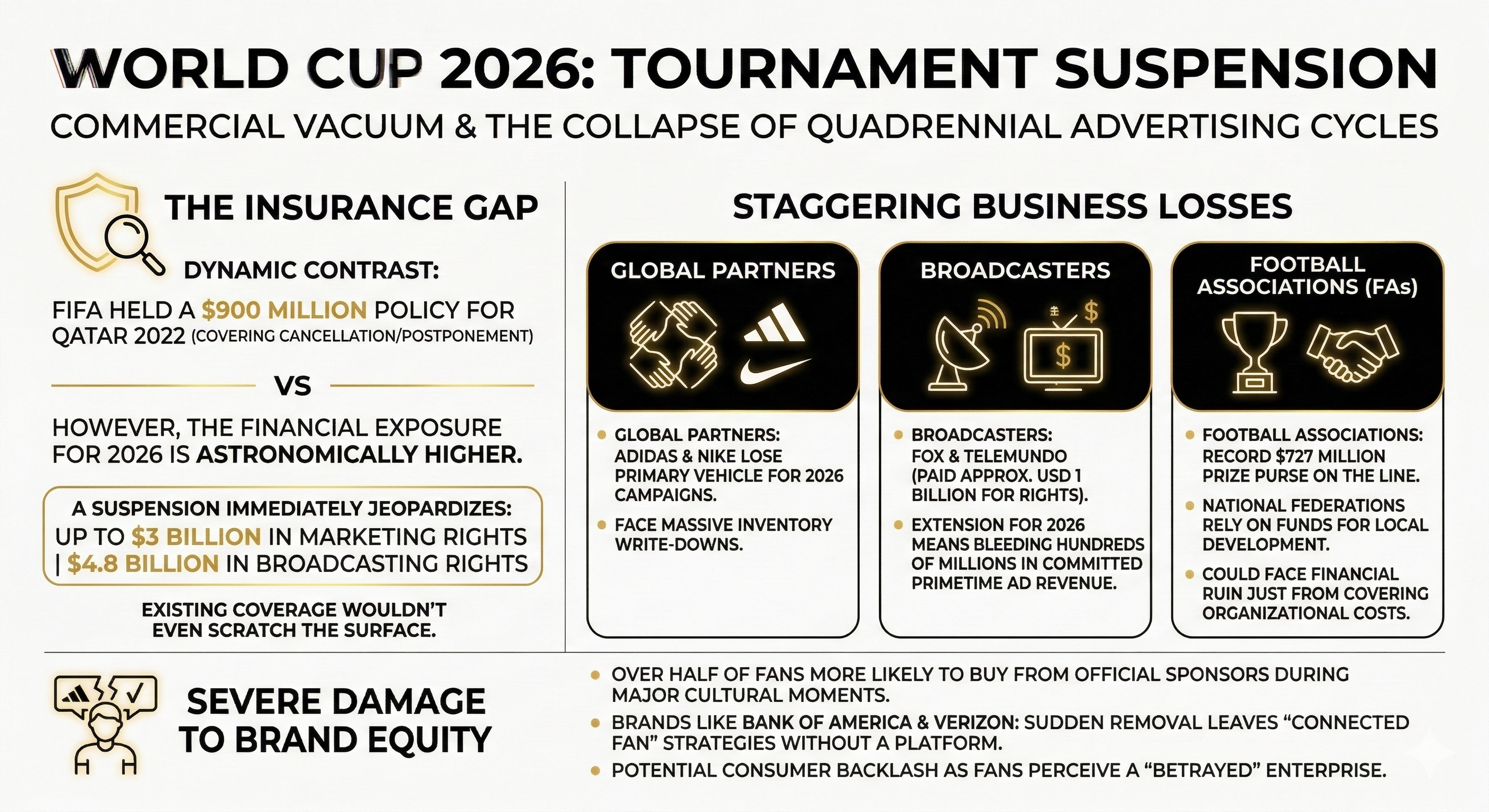
Beyond the direct financial hit, the damage to brand equity would be severe. Over half of fans are more likely to buy from official sponsors during major cultural moments16. For brands investing in fan engagement, the sudden removal of this event leaves their “connected fan” strategies without a platform, potentially causing a consumer backlash as fans perceive a “betrayed” enterprise17.
Finally, there is the issue of sunken costs on a short timeline. Most brands already have their marketing campaigns in place. A sudden suspension means the millions of dollars and countless labor hours already poured into these projects would simply go down the drain, unable to be repurposed.
Scenario 2: The Relocation Risk
Moving the World Cup out of North America—or even just shifting specific venues due to political or security concerns—would massively devalue the tournament. The entire commercial strategy for 2026 is inherently U.S.-centric, built specifically to unlock the world’s most lucrative sports market.
As mentioned earlier, the biggest winners of the North American bid were broadcasters like Fox and Telemundo, who banked on airing 40 primetime matches. In our era of fragmented streaming, live primetime sports are invaluable18. If the tournament shifts to a European or Middle Eastern time zone, those 40 primetime slots drop to near zero for the U.S. market19. Broadcasters would face a catastrophic drop in ad rates, as morning matches simply can’t command “Super Bowl-style” premiums. Furthermore, a time zone shift kills the “second-screen” social engagement that drives digital ROI for the 43% of fans planning to stream the games20.
At the local level, the Host City Supporters program relies entirely on matches actually happening in those specific markets. If games are forced out of hubs like Atlanta or Dallas, local sponsors lose clear value, triggering a nightmare of refunds and broken contracts for tickets, parking, and hospitality21.
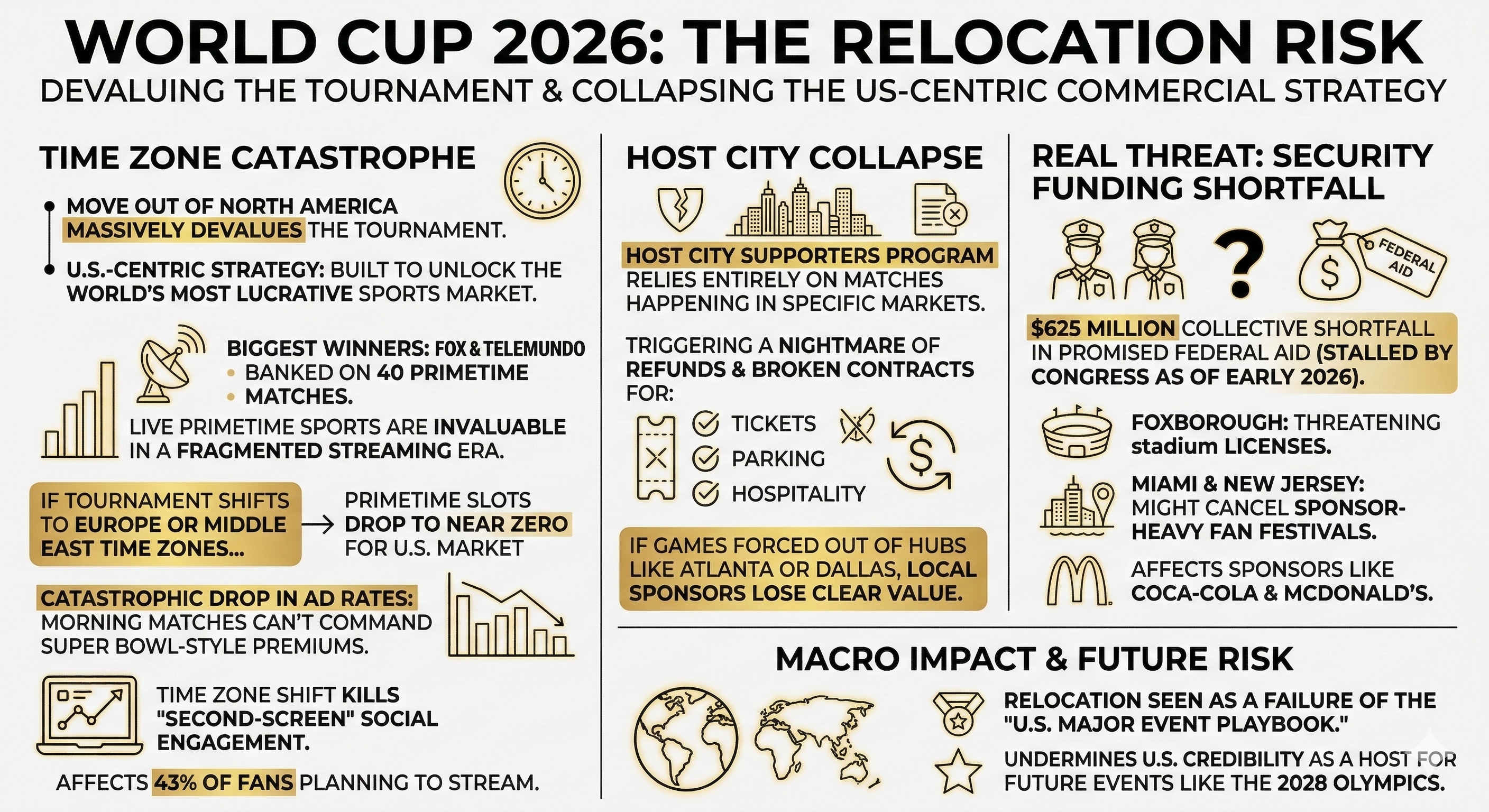
This threat is very real. As of early 2026, U.S. host cities are facing a collective shortfall of up to $625 million in promised federal security aid, stalled by Congressional disputes. Cities like Foxborough are threatening to withhold stadium licenses without this funding22, while Miami and New Jersey might cancel sponsor-heavy fan festivals —a key activation point for sponsors like Coca-Cola and McDonald’s— altogether23.
A relocation under these circumstances would be seen as a failure of the “U.S. major event playbook,” undermining the credibility of the United States as a host for future events like the 2028 Olympics24.
Scenario 3: Postponement Disruption
A postponement of the 2026 World Cup would wreck the meticulously planned retail and advertising cycles of global brands. For the sportswear giants, the World Cup kit cycle is a multi-year process peaking right before June.
Moving the event to a different season (e.g., winter) would leave retailers with massive dead inventory, as “summer lifestyle” apparel loses its relevance. It would also extend the expensive anti-counterfeiting enforcement window, inflating costs and eroding original marketing narratives.
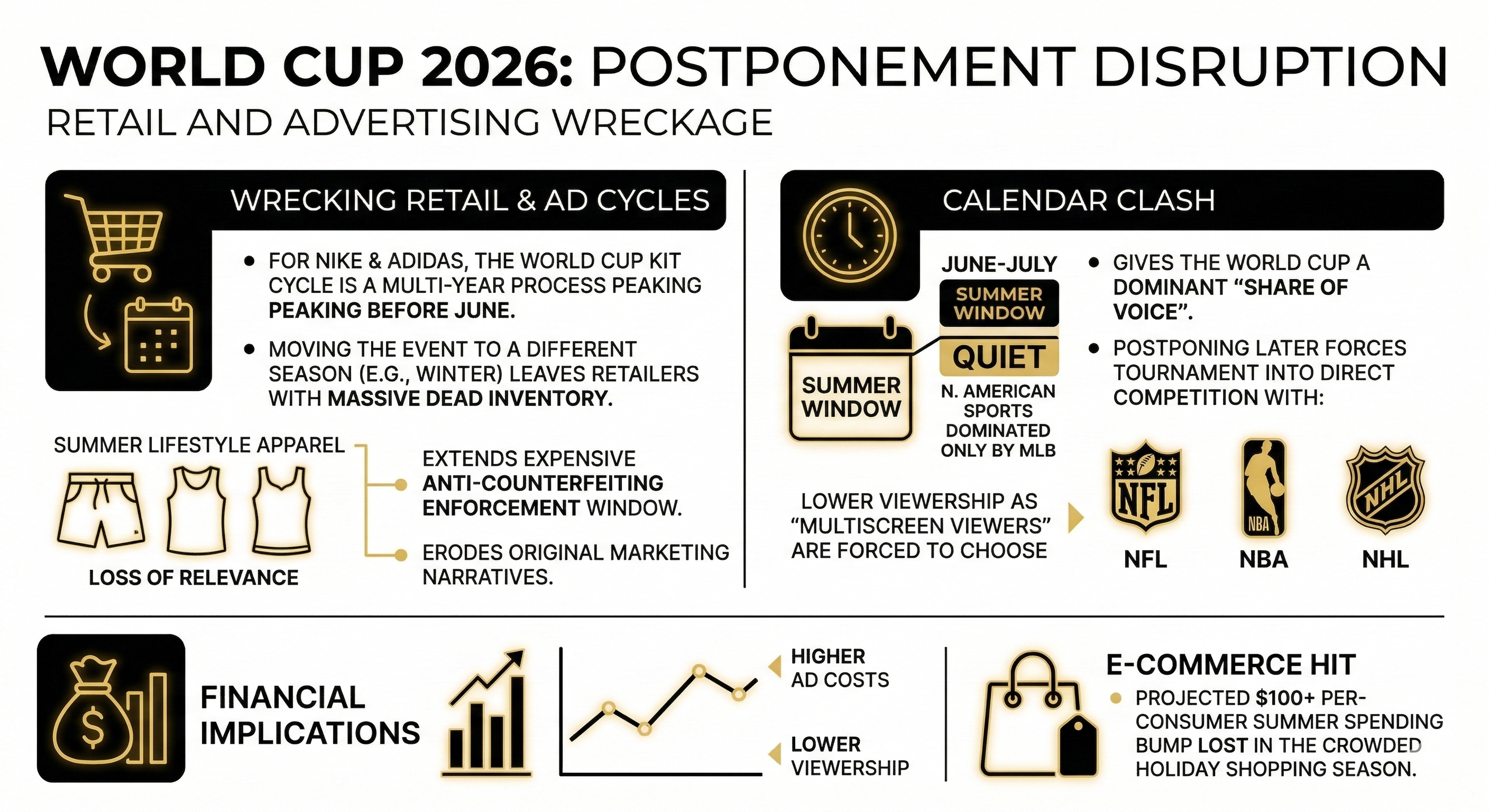
Then there is the calendar clash. The June-July summer window is a traditionally “quiet” period in North American sports, dominated only by MLB. This gives the World Cup a dominant “share of voice.” Postponing to later in the year forces the tournament into direct competition with the NFL, NBA, and NHL. This means higher ad costs and lower viewership as the “multiscreen viewer” is forced to choose between the World Cup and massive domestic leagues. E-commerce would also take a hit, as the projected $100+ per-consumer summer spending bump would get lost in the crowded holiday shopping season25.
The Legal Fallout
While I’m not a sports lawyer (and I highly recommend checking out Astor Henriquez Cooper’s Substack to dive deeper into FIFA regulations!), it is clear that the financial fallout of any suspension or relocation would trigger massive legal battles over “force majeure” (unforeseen, unavoidable circumstances) clauses. Proving that a contract is truly “impossible” to fulfill is highly litigious. Ultimately, if an event is canceled and organizers are forced to reimburse sponsors, FIFA could face multi-billion-dollar liabilities that severely threaten its $3.9 billion cash reserves26.
The Bottom Line:
The 2026 FIFA World Cup is poised to be the most lucrative sporting event in history, but its massive scale creates unique vulnerabilities. Sponsors’ $3 billion investment relies entirely on a stable, summer-based, primetime North American tournament.
The potential for suspension, relocation, or postponement represents not just a loss of revenue, but a catastrophic disruption of global marketing lifecycles, local municipal budgets, and long-term brand equity.
To summarize the primary risks:
Systemic Financial Shock: A suspension would jeopardize USD 11 billion in cycle revenue, far exceeding the existing insurance covers of approximately USD 900 million.
Devaluation of U.S. Market Entry: Relocating kills the primetime broadcast advantage and local host city deals, devaluing the “American Dream” of soccer commercialization.
Retail and Seasonal Disruption: Postponement would displace a projected multibillion-dollar summer surge in consumer spending and disrupt the product lifecycles of sportswear and electronics giants.
Reputational Fragility: Any perceived betrayal of the fans—whether through exorbitant pricing or political chaos—erodes the brand equity of sponsors who invested heavily in human connection.
The 2026 World Cup is the ultimate stress test for the modern “mega-event” model. Success requires not only commercial access but also a resilient commitment to the World Cup’s enduring authenticity and cultural relevance. If the tournament loses its soul to corporate interests—or gets derailed by logistical failures—the financial and reputational fallout will echo for decades.
The stakes have never been higher. The only question left is: how much risk are these mega-brands actually taking on?
What’s your take? Is the 2026 World Cup simply too big to fail, or are we staring down the barrel of a multi-billion-dollar logistical nightmare? Let’s discuss in the comments below!
Quick heads-up: I’m officially on vacation for the rest of the week! ⛰️
What to expect on schedule:
This post (check ✅)
“Marketing Paradox of the Day” on Monday, Wednesday, and Friday
“Sunday Recommendations” (coming shortly)
Notes linked to this post
What I’m taking a break from:
Quoting, restacking, or commenting on posts/notes
Commenting on recent news
Dropping news or updates in threads
(Please note: Because I’m away, there will be a delay in my replies to your comments and messages! Thanks for your patience.)
Thank you for being part of this journey!
Carla | Off-Ball Logic
FOOTBALL: FIFA World Cup 2026 host cities worried on costs; independent observer says $100-200 million costs come with being a 2026 U.S. host city - The Sports Examiner / Link
One thread worth isolating is the concentration risk created by the North American market. Much of the projected value for 2026 depends not just on the World Cup happening, but on it happening there and in that summer window.
Primetime U.S. broadcasts, hospitality pricing and sponsor activations all hinge on that assumption. Once the commercial model is built so tightly around a single market and calendar slot, it leaves no space for flexibility.
That is the real fragility here. The tournament may be bigger than ever, but its economics are also more exposed than previous editions that relied on a more globally distributed value base.
https://substack.com/@nikolavukovic/note/c-224262825?r=ou7nh&utm_source=notes-share-action&utm_medium=web