

What Opening Ceremonies Are Actually For
How World Cup opening ceremonies went from diplomatic tribute to FIFA brand vehicle — and what gets lost in that shift

Hi everyone! I’m Carla, and this is Off-Ball Logic, the weekly newsletter where we step away from the 90 minutes on the pitch to dissect the business strategies, marketing mechanics, and economic engines that are really driving the modern sports world.
Subscribe to get it in your inbox:

There is a moment, in every World Cup, where the football hasn’t started yet and something else is happening — something that is supposed to tell you what kind of tournament this is going to be, what country you’re about to spend a month (or a month and a half) inside, why any of this matters beyond the result. That’s what the opening ceremony serves, and in some form, it has been trying to do exactly that since 1930.
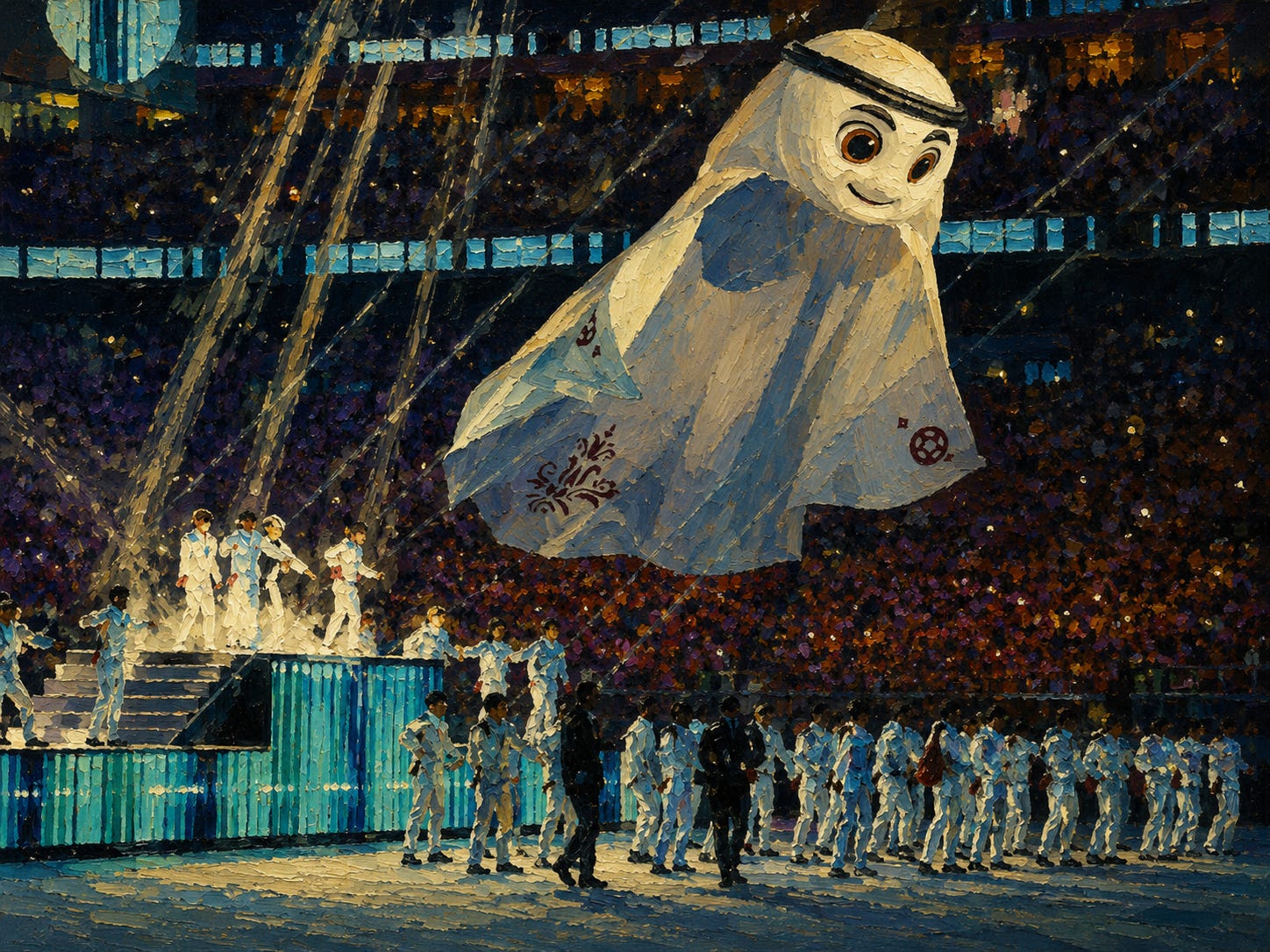
What it has been used to say has changed so completely across that span that the 2026 edition, with three simultaneous ceremonies across three countries, the first halftime show at a World Cup final, represents essentially a different event, one that conveys a different message than anything that preceded it. Understanding how it got here requires going back to when nobody had thought about it at all.
Phase 1: Opening a Tournament (1930–1980)
The World Cup opening ceremony didn’t start as a ceremony in any artistic sense, but rather as a protocol: delegations presented, officials addressed the crowd, national anthems were played, and the first match began. The spectacle was the football, not the preamble.
This format held from 1930 through most of the following decades — with the 1966 England edition marking the first attempt at something approaching a structured opening event, and 1970 in Mexico introducing a more festive, televisual register.
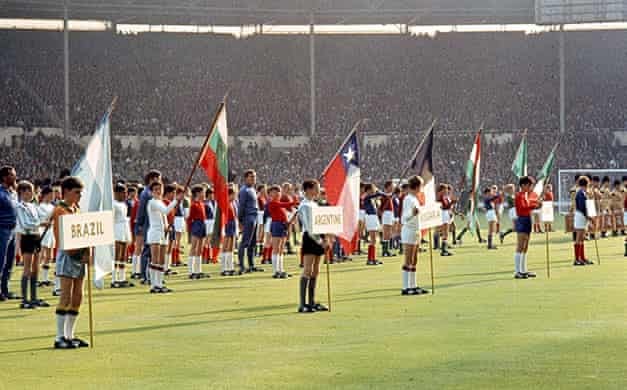
The most revealing edition of Phase 1, Argentina 1978, wasn’t the most elaborate: the ceremony itself was modest. What was notable was that all 24 teams actually arrived, several squads having faced internal pressure not to travel to a country under military dictatorship since 1976. The ceremony worked as a diplomatic gesture precisely because of that: the message it sent had nothing to do with staging — it was the message of presence, of continuation, of the tournament happening at all.
And that is what the opening ceremony was for in Phase 1: a tribute to the sport and to the host nation, with the implicit understanding that showing up was itself the statement.
Phase 2: Showing the World Who You Are (1990–2022)
(Or as the 2014 Brazil World Cup official song put it: “Show the world we are one”).
The inflection point arrived with the United States in 1994, when Hollywood logic entered the opening ceremony for the first time. Diana Ross performed at the Rose Bowl in Pasadena, and the production scale was mass, the register was pop spectacle, but the image most people remember is her missing a symbolic penalty kick and reacting with pure theatrical delight.
It didn’t matter that she missed. The ceremony had stopped being a diplomatic gesture and become a performance.
Needless to say, and as posters, jerseys and mascots do, the aesthetics of the opening ceremonies also dialogue with the trends of the moment: the edgy ‘90s, the futuristic 2000s, and so forth.
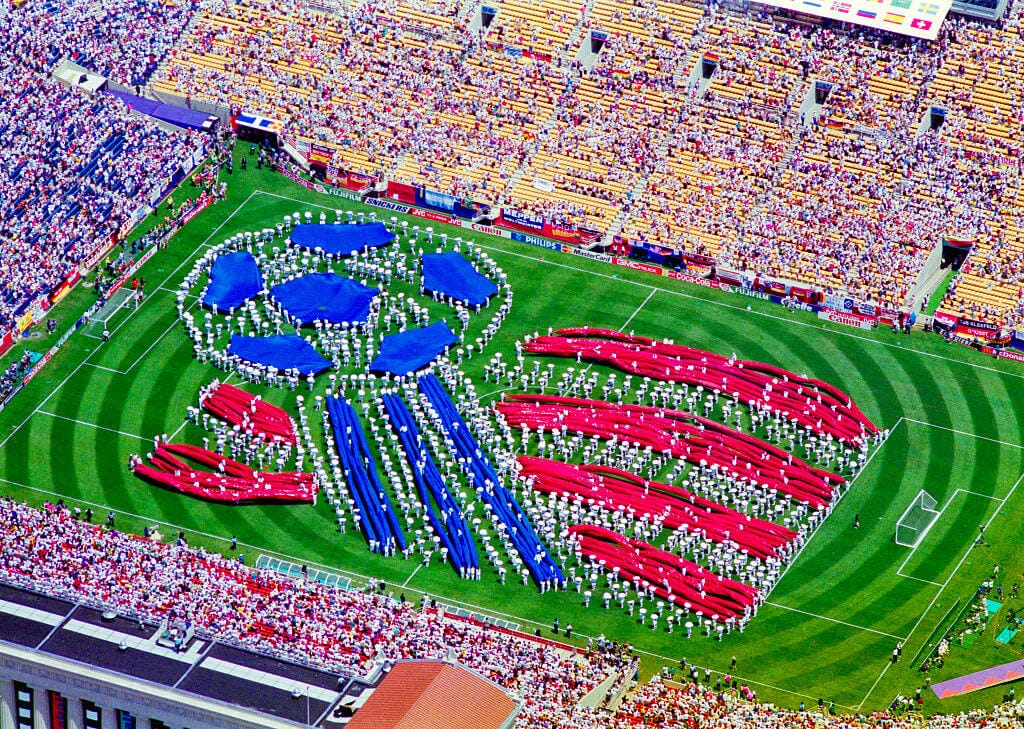
France 1998 emphasised unity and inclusion, though the ceremony itself was a riot of colour and action — anything but subtle. Korea and Japan in 2002 showcased a spectacular display of traditional dance, music, and the symbolic merging of the South Korean and Japanese flags to represent cooperation. Germany 2006 opened with Claudia Schiffer and Pelé but also leaned into cultural heritage — traditional costumes, folk dances, precision over excess. The pattern across all of them is consistent: the host nation is using the ceremony to show the world who it is.
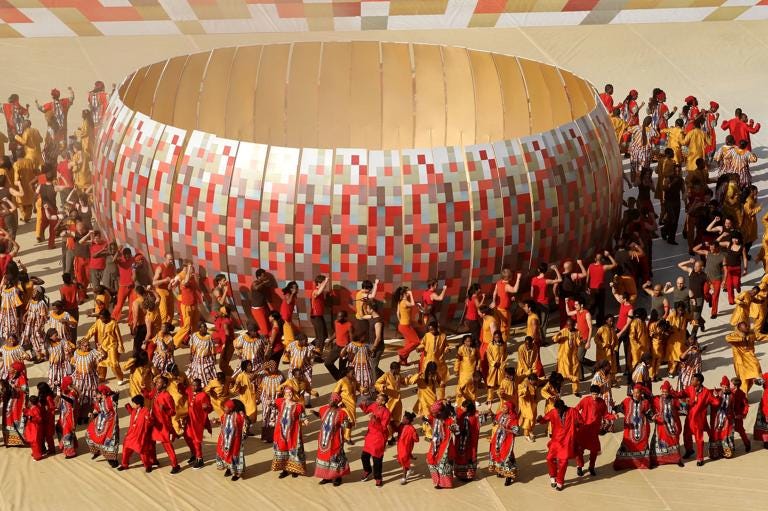
The peak of this logic, and the most emotionally coherent opening ceremony in World Cup history, was South Africa 2010. The first World Cup on African soil carried a weight no other edition before or since has carried in quite the same way. Shakira’s “Waka Waka” became not just the tournament’s anthem but one of the few World Cup songs that genuinely outlasted the tournament itself.
A giant beetle served as a central visual motif — a symbol of life, renewal, and tireless dedication drawn from African cultural tradition. Local artists shared the stage with global stars in a way that felt integrated rather than decorative. The ceremony overflowed with pride and hope in a way that was inseparable from the political and historical significance of the moment — a continent that had waited decades, and a tournament that finally came.
It is the clearest expression of what a World Cup opening ceremony can do when the host nation is the full protagonist and the sport is the frame.
Moving forward, they became a platform for official songs from 1998 onwards — though in some cases these were performed at the closing ceremony instead.
Brazil 2014 had 660 dancers in a performance paying tribute to Brazil’s nature, people and football, with a “living ball” at the centre of the pitch, and Pitbull, Jennifer Lopez and Claudia Leitte performing the official song. Qatar 2022 had Morgan Freeman and Jungkook of BTS and a retrospective of World Cup history — more controlled in its narrative, the host identity was still present but already sharing space with global entertainment logic.
Why FIFA and the Olympics Diverged
The Olympics opening ceremony has a fixed architecture that has remained non-negotiable across its entire modern history: the parade of nations, the raising of the Olympic flag, the lighting of the cauldron. These elements cannot be removed without breaking the meaning of the Games. Every host country builds its artistic spectacle on top of these pillars.
When Paris 2024 moved the ceremony to the Seine, it was a radical departure in format (the first time in 128 years of the modern Games that the ceremony happened outside a stadium) and yet the parade still happened, the flame was still lit.
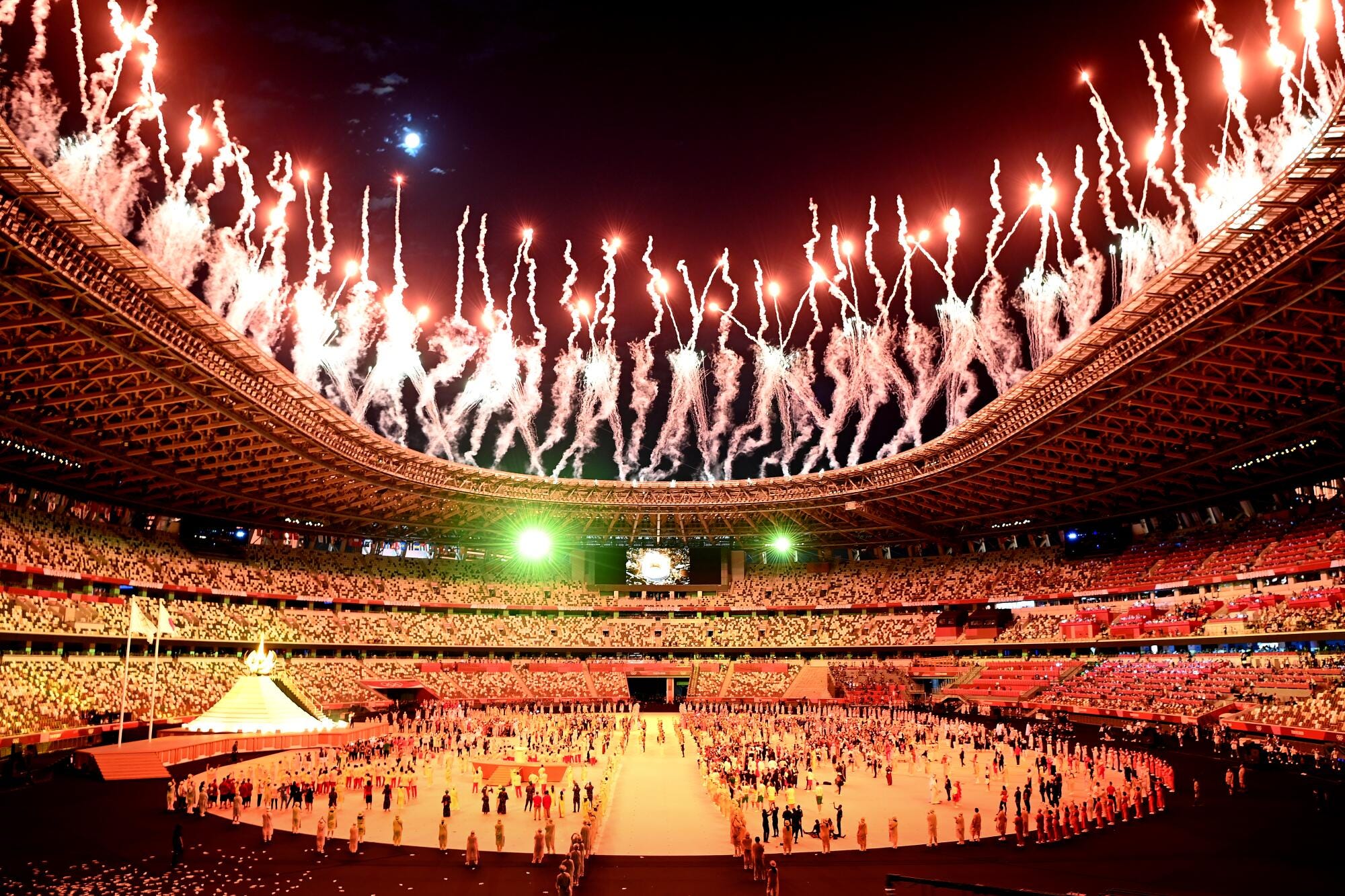
FIFA had no equivalent. Every host had complete freedom to define what the ceremony was and what it said. Without fixed pillars to anchor the event’s meaning, the ceremony became whatever the current priorities of the organizers dictated — and as those priorities shifted from host culture toward commercial scale, the ceremony shifted with them. FIFA’s ceremony, means whatever FIFA decides it should mean that cycle.
Now the Show Becomes the Product
The clearest signal of where the opening ceremony was heading didn’t come from a World Cup; it came from the 2025 FIFA Club World Cup at Hard Rock Stadium in Miami. The tournament—which your humble servant attended—featured an opening ceremony structured entirely around FIFA’s own brand identity. Decor spelled out “FIFA” right on the pitch, and the live performance culminated with the lyric “Que viva la FIFA” (long live FIFA) ringing out across the stadium.
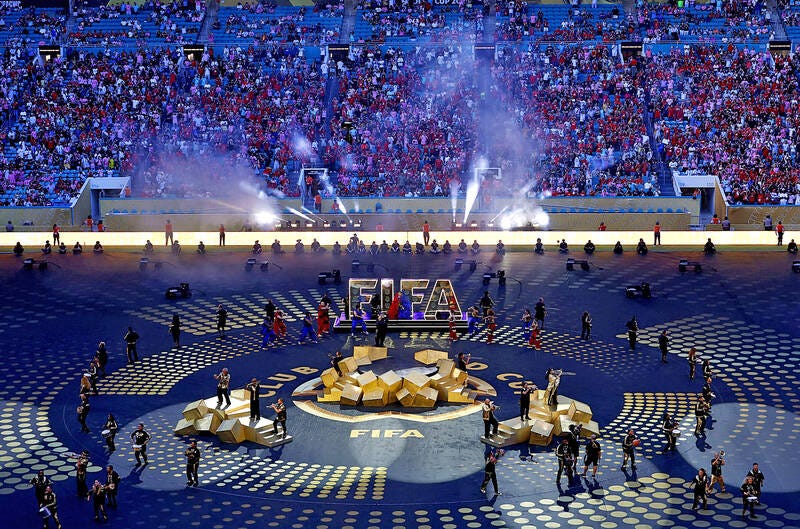
This is the endpoint of the drift that started in 1994: the institution has become the protagonist of its own opening ceremony. The 2026 World Cup applies this logic at full scale for the first time.
For the first time in World Cup history, there will be three separate opening ceremonies — one per host nation, each tied to that country’s inaugural match. Mexico opens on June 11 at the Estadio Azteca with the most culturally specific of the three: indigenous performers, folkloric acts, and a lineup spanning Alejandro Fernández, Belinda, J Balvin, Danny Ocean, Lila Downs, Los Ángeles Azules and Maná — before Shakira and Burna Boy perform “Dai Dai”, the official tournament song, live for the first time.
This is the one that most closely resembles Phase 2 logic: the host culture as protagonist, a genuine attempt to say something specific about the country and continent staging the event. It is also the ceremony attached to the match that opens the entire tournament.
Canada follows on June 12 in Toronto, built around the theme “Mosaico” — a celebration of Canadian multiculturalism, with Michael Bublé, Alanis Morissette, Alessia Cara, and Jessie Reyez — and carrying an additional significance as the first men’s World Cup match ever played on Canadian soil.
The United States also opens on June 12 in Los Angeles, with Katy Perry, LISA, Rema, Anitta, Tyla, and Future — LISA becoming the first female K-pop artist and first Thai artist to headline a World Cup opening ceremony.
All three ceremonies are produced by Marco Balich, the Italian producer who also designed the Milan-Cortina 2026 Winter Olympics opening ceremony.
The Half-Time Show Controvery
But there’s more adding to the conversation around the huge shifts in structure and, to say the least, legacy, culture and meaning.
The first halftime show at a World Cup final — Shakira, Madonna, and BTS at MetLife Stadium on July 19, curated by Chris Martin of Coldplay and produced with Global Citizen to raise $100 million for education access — is being framed as an important milestone that will entirely change the dynamics of a World Cup final. For many others, it reads as a burden: an interruption of the match for a spectacle that has no organic relationship to the football.
The organizers have already confirmed the performances will be “significantly shorter than 15 minutes” — a concession that reveals the underlying tension without resolving it.
The halftime show is FIFA declaring that the World Cup final is moving beyond the reach of a cultural phenomenon. Whether that reads as enrichment or substitution will depend entirely on what happens on the pitch before and after it.
Who Is This For?
The World Cup opening ceremony began as a diplomatic gesture — a formal acknowledgment that the tournament was beginning and that the nations of the world had gathered. It became, across decades, a cultural showcase — the host nation’s opportunity to tell its story to a global audience that would otherwise never encounter it. South Africa 2010 is the highest expression of that function: a ceremony inseparable from the history of the moment, that used the platform of the World Cup to say something about a continent that had waited decades to say it.
What it is becoming, and what the Club World Cup 2025 ceremony made visible with unusual clarity, is a branded entertainment product, curated by FIFA, in which the host nation is one element among many rather than the protagonist.
The three ceremonies of 2026 sit in an interesting tension within this shift: Mexico, Canada, and the United States are each being given space to express their own cultural identity, which is formally consistent with Phase 2 logic. But they are doing so within a framework designed and produced by a single production company, under FIFA’s commercial architecture, with an official tournament song recorded under the FIFA Sound label and a halftime show at the final that has more structural similarities to the Super Bowl than to anything the World Cup has historically been.
The most valuable thing the World Cup has ever had — more than the broadcast rights, more than the sponsorship packages, more than the prize money — is its ability to make people dream and to generate a sense of national belonging that no commercial arrangement can manufacture.
That asset doesn’t live in the ceremony alone. But the ceremony is where it is announced, where the tournament signals what it thinks it is.
When that signal shifts from “this is your country’s moment” to “this is FIFA’s product”, something changes in the foundation — and the production values, however extraordinary, cannot replace what was there before.
What do you think — let’s discuss below.
Carla | Off-Ball Logic
It’s interesting that opening ceremonies aren’t really designed to impress us as much as they are designed to orient us.
Before the competition begins, they remind us where we are, who is hosting, and what story this tournament wishes to tell about itself.
I like that kind of perspective because it reminds me that football can tell stories in a multitude of ways.
is a bird? Ais a plane? It looks like Casper ‘, lol