

Two Strategic Blueprints for Football Market Development in East Asia
Examining how Japan and China redefined sports business models in the Global East.

Hi everyone! I’m Carla, and this is Off-Ball Logic, the weekly newsletter where we step away from the 90 minutes on the pitch to dissect the business strategies, marketing mechanics, and economic engines that are really driving the modern sports world. We analyze the market shifts that turn clubs into global brands and the data points that define the industry’s future.
Subscribe to get it in your inbox:

Today’s deep dive examines a tale of two trajectories. We’re looking at the competing models of development in East Asia—two distinct approaches that have reshaped the business of sport across the region in very different ways.
Japan’s “Soft Power” Strategy: How a meticulous, community-first vision built a sustainable and resilient ecosystem.
China’s “Hard Money” Approach: Why a model driven by speculative capital and hyper-investment eventually buckled under macroeconomic pressure.
Note: I’m planning a follow-up post focused exclusively on the branding, marketing, and positioning mechanics of these leagues.
Would you like a Part 2, or are you ready for a new topic? Cast your vote in the survey at the end of this post!
The Global Shift Toward the East
In 1985, the commercial center of gravity in sports was firmly anchored in North America and Western Europe, defined by a nascent synergy between television broadcasters and corporate sponsors.
At that time, Asia (alongside Africa and Oceania) was largely viewed through the lens of talent extraction or peripheral engagement; regions that consumed Western content but offered limited infrastructure for sophisticated marketing ecosystems.
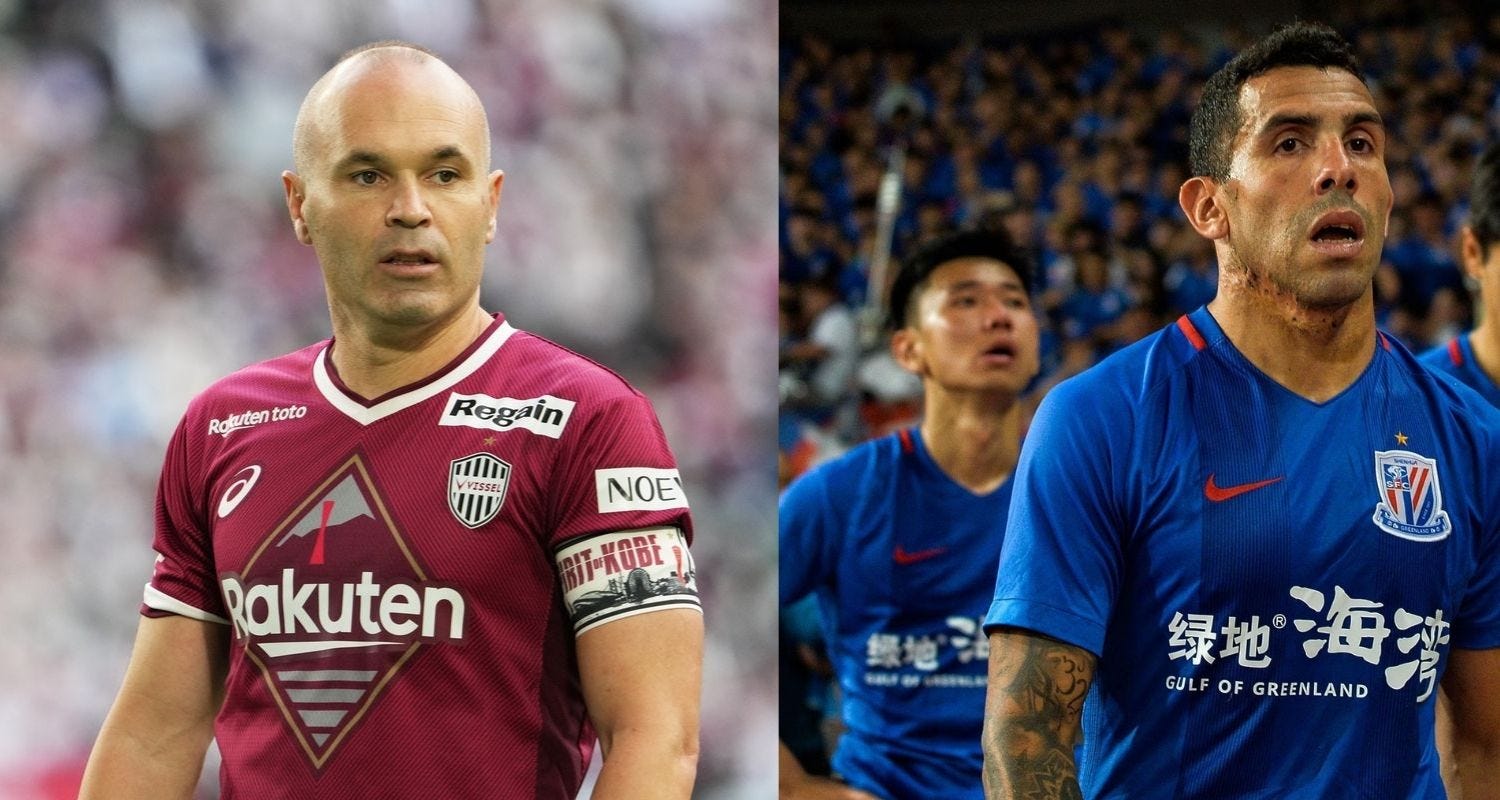
However, as we stand in the mid-2020s, this paradigm has been inverted. The last 40 years have witnessed the rise of the Global South and the East not merely as consumers, but as the primary engines of innovation, disruption, and valuation in the sports business world.
Sports marketing has evolved into a multi-faceted discipline encompassing nation branding, infrastructure diplomacy, digital ecosystem development, and the financialization of cultural assets. This point is already covered in my first post:

The Early Days of Sports Marketing in Asia
In the mid-1980s, sports advertising was predominantly an analog affair. The primary vehicles for marketing were physical assets: stadium hoardings, print media, and rudimentary jersey sponsorships. Although the industry has since evolved from wooden signs to today’s LED spectaculars, the 1985 landscape was far more modest.1
In Asia, the late 1980s marked a period of transition from amateurism and state-sponsored recreation toward professionalization. In many post-colonial nations, sport was viewed primarily as a tool for nation-building and social cohesion rather than a commercial enterprise. However, global currents were shifting.
How Global Broadcasts Created the "Remote Fan"
The pivotal moment arrived in the early 1990s with the proliferation of satellite television and the formation of the English Premier League (EPL) in 1992. The EPL’s marketing strategy was aggressively internationalist. By bundling broadcast rights and selling them to burgeoning satellite providers in Asia (such as Star TV), the EPL created a remote fan base that would eventually dwarf its domestic audience.2
This era established a consumption habit that marketers still grapple with today: the “long-distance fan.” This created a dual-speed marketing economy where global brands (Coca-Cola, Gillette) could reach Asian consumers through European broadcasts, while local leagues struggled for visibility and investment.
The Birth of the J.League: A Counter-Narrative
To set the mood for this era, I’ve chosen a playlist that captures the nostalgic, high-energy transition leading to the birth of the J.League.
While the rest of Asia was largely consuming imported content, Japan was engineering a domestic revolution.
Before the dawn of the J.League in 1993, Japanese football was organized under the Japan Soccer League (JSL).
This era was defined by a corporate welfare model where teams were not independent business entities but rather recreational departments of major industrial conglomerates. Powerhouses like Furukawa Electric, Mitsubishi Motors, and Nissan dominated the landscape.3
The structural limitation of the JSL was its insularity. Players were technically employees of these companies, obligated to clock in for office work in the morning before training in the afternoon.
While this system provided employment security and a post-retirement career path within the keiretsu (conglomerate), it stifled competitive growth and fan engagement. The stadiums were often company grounds, and the “fans” were primarily fellow employees whose attendance was encouraged or mandated by corporate culture.
Resilience Through Community
The “J.League 100 Year Plan” was a marketing masterstroke that prioritized “hometown” identity over corporate branding. Clubs were required to drop corporate names—Mitsubishi Motors FC became Urawa Red Diamonds—to foster deep emotional ties with local municipalities.4
This was a fundamental business shift: moving the value proposition from B2B corporate prestige to B2C community engagement. In a country where baseball was the dominant corporate sport, football offered something different: local pride.
As Andres Iniesta (Vissel Kobe Legend) mentioned:
“Winning matches is hard at any club, but in Japan it’s something really difficult. Every team is similar and very tough to play against... I wanted to keep feeling like a footballer. The scenario is different and the project is different, what hasn’t changed is the responsibility and passion that I have to play football.” 5
This “To-Consumer” strategy now involves sophisticated data usage.
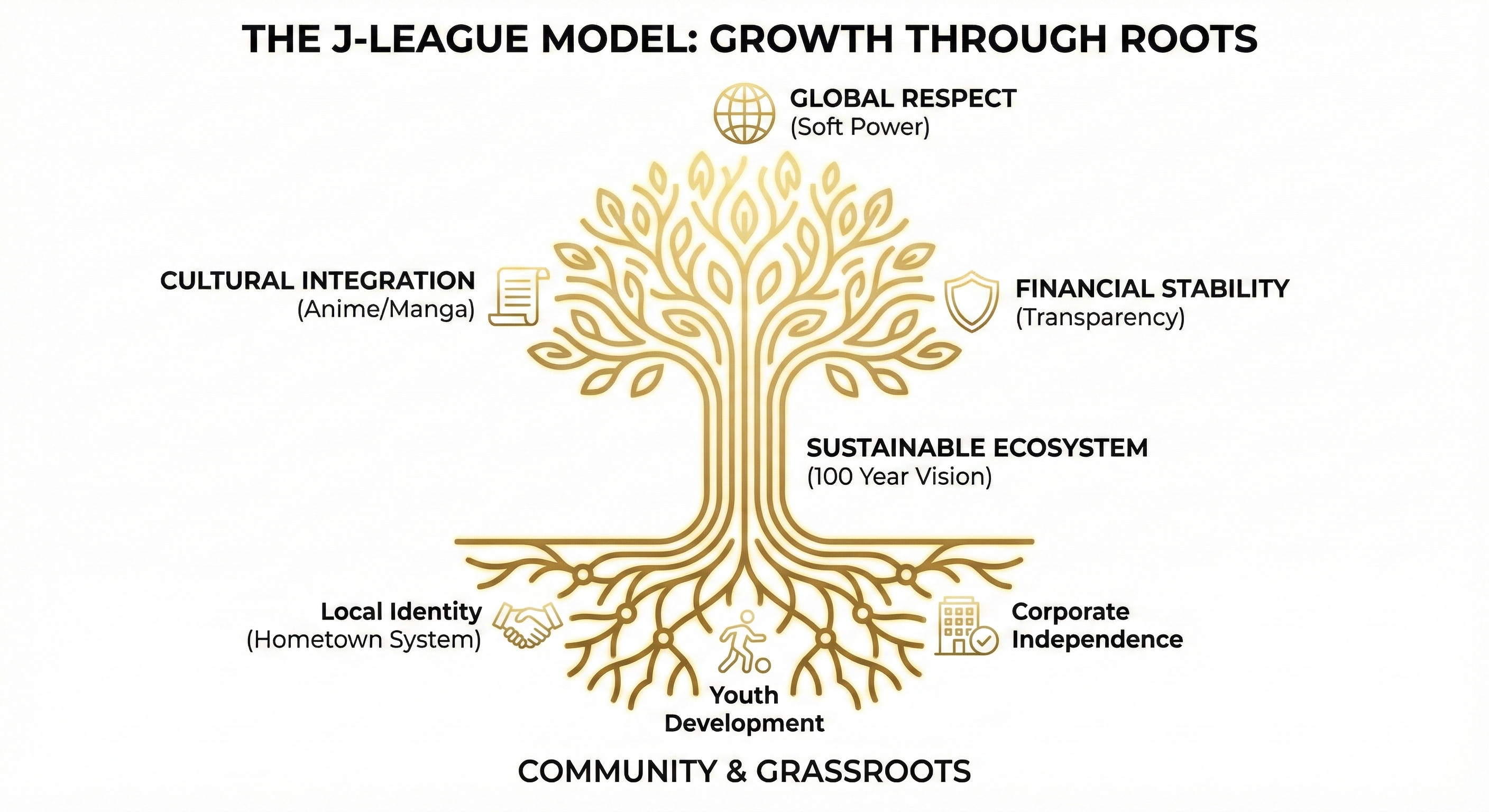
The J.LEAGUE ID system centralizes fan data across all clubs, allowing the league to track behavior from “awareness” to “regular attendance.”6 In 2024, this data-driven approach, combined with “The Kokuritsu Day” (hosting matches at the National Stadium) and anime/manga collaborations, drove attendance to a record 12.5 million.7
Also, as mentioned by John Duerden in How Football Explains Asia:
Clubs are rooted in their communities and the J.League has imposed financial regulations which mean financial transparency, balanced budgets and proof of long-term financial health.
Read more below:
Furthermore, the J.League’s commercial resilience is bolstered by a 12-year broadcast partnership with DAZN (extended to 2033). This deal includes a profit-sharing mechanism, incentivizing DAZN to actively market the league rather than acting as a passive rights holder.8
China’s Super League: A Capital-First Model
In stark contrast, the Chinese Super League (CSL) provides a cautionary tale of “marketing by decree.”
While organized play in China dates back to 1951, the professional era truly began with the 1994 Jia-A League. However, that era was plagued by gambling and corruption, creating a “troubled investment environment.” This led to the creation of the Chinese Super League, established in 2004 as a rebranding of the Jia-A, intended to introduce “truly commercial methods” and professionalize the market operation.9
However, unlike the J.League’s cultural reset, the CSL’s birth was more administrative.
In the mid-2010s, encouraged by state ambitions to turn China into a football superpower, real estate and insurance conglomerates poured billions into the league. Clubs like Guangzhou Evergrande and Jiangsu Suning broke transfer records for global stars like Oscar and Hulk, aiming to market the league through sheer star power.10
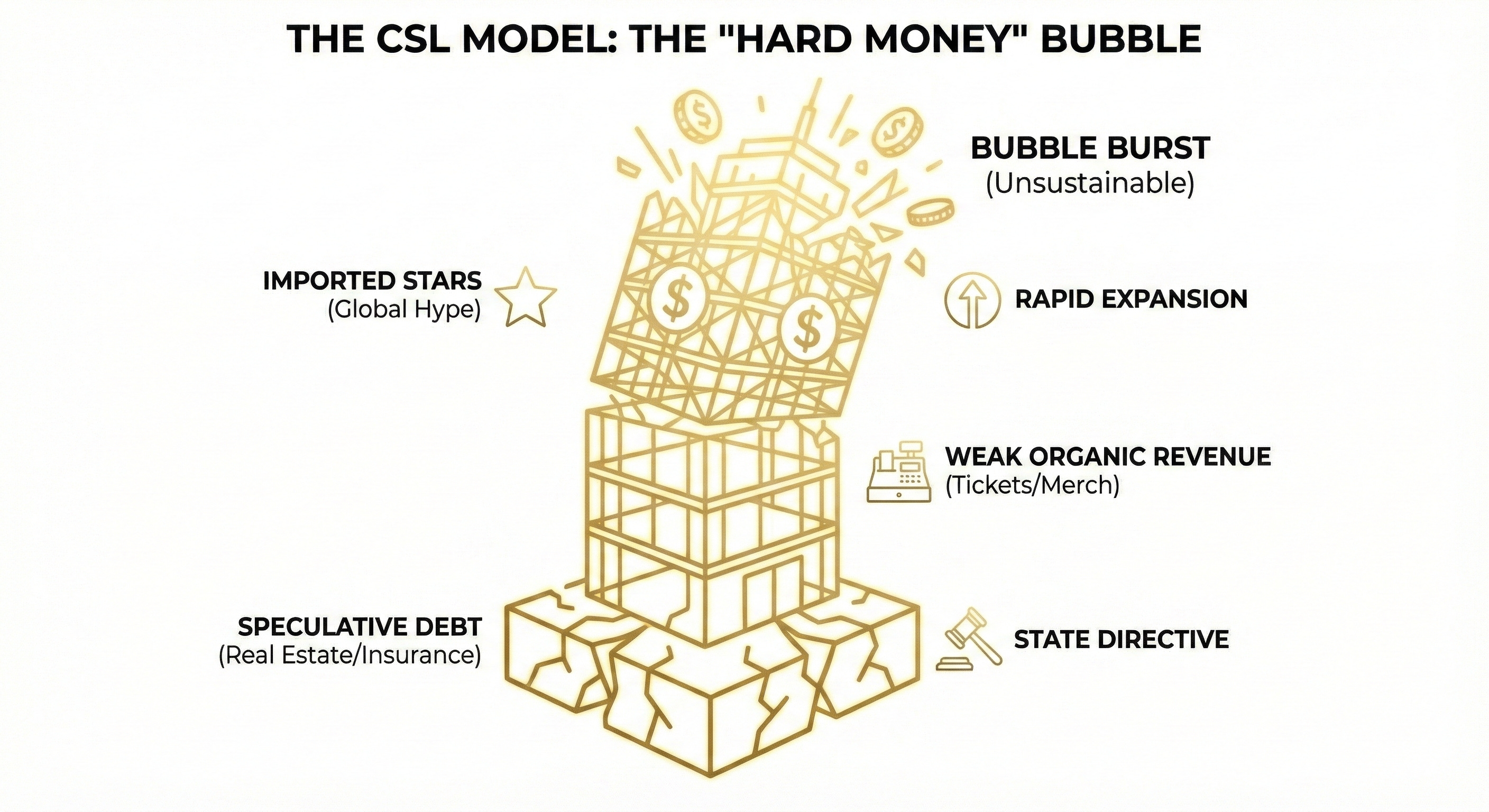
However, the business model was fundamentally flawed. The clubs were marketing vehicles for parent companies, not sustainable businesses. Revenue streams were dependent on corporate subsidies rather than organic growth (tickets, merchandise). When the Chinese real estate sector faced a liquidity crisis (epitomized by the Evergrande collapse11), the funding evaporated.
The impact was catastrophic. Jiangsu Suning ceased operations just months after winning the 2021 league title.12 While CSL broadcast rights were once sold for $1.7 billion, the value collapsed when the corporate bubble burst, proving that marketing hype cannot substitute for business fundamentals.13
The Market Gap: Global Fans vs. Local Revenue
This brings us to the “Asian Paradox”: the region contains the world’s largest population of football fans, yet the primary beneficiaries are European clubs. Global giants have executed sophisticated localization strategies to capture this value:
Esports Entry: Partnering with local teams (e.g., PSG with Talon) to insert the brand into the digital lives of Asian youth.14
Physical Presence: Permanent regional offices in Singapore and Hong Kong to manage partnerships directly.15
Cultural Marketing: High-production “Lunar New Year” campaigns featuring stars speaking Mandarin to drive engagement on Weibo and Douyin.16
Conclusion
To Recap:
The J.League, inaugurated in 1993, was born from a meticulous “100 Year Vision” rooted in community integration, grassroots development, and corporate independence.
It prioritized the creation of a “sports culture” over immediate commercial dominance, utilizing cultural exports like anime and a distinct “Hometown” system to embed clubs into the social fabric of Japanese cities.
Conversely, the CSL, particularly in its post-2010 iteration, represented a model of state-directed hyper-capitalism.
Fueled by the 2015 National Football Reform Plan and massive speculative investment from the real estate sector, the CSL sought to shortcut the developmental process through the acquisition of high-profile global talent and rapid infrastructure expansion.
The last 40 years have moved East Asia from the periphery to the center of the sports industry. The “Star Diplomacy” of China and the “Community Resilience” of Japan offer distinct alternatives to the Western playbook.
For global marketers, the lesson is clear: these are not merely markets to be sold to, but innovation hubs to be studied. The future of sports marketing—digital, mobile, and culturally integrated—is being written in Tokyo, Shanghai, and beyond.
Carla | Off-Ball Logic
Your Turn!
What’s Next for Off-Ball Logic? Should we go deeper into the branding mechanics of the CSL and J.League next week, or pivot to a new region? Vote below!
Note: If you selected “another topic” as an option, please leave your recommendation below.
Recommended Reading:
The NFL’s Global Strategy Is Coming Into Focus by Will Colahan: A detailed analysis of the NFL’s international commercial expansion and its roadmap for global growth.
The Battle for the Soul of Sports Broadcasting by Adam Firebaugh : An exploration of the shifting landscape in sports journalism, and the ongoing struggle to protect editorial quality in a challenging market.
If you have any recommendations related with today’s topic, please drop them in the comments!
FASTSIGNS: History of Sports Marketing & Advertising https://www.fastsigns.com/blog/miscellaneous-trending/sports/timeline-of-sports-marketing/
LUISS Guido Carli: “Game changers: Exploring Business Models of Premier League football” https://tesi.luiss.it/37960/1/248901_CALIENNO_LEONARDO.pdf
SportsPro: How J.League is widening its net https://www.sportspro.com/insights/interviews/j-league-dazn-iniesta-streaming-ott-growth-strategy-interview/
J.League Club Management Guide 2024 https://aboutj.jleague.jp/corporate/assets/pdf/en/MANAGEMENT_GUIDE_2024_WEBSITE_ENG.pdf
Iniesta: I’m back to feeling like a footballer in Japan https://m.allfootballapp.com/news/EPL/Iniesta-Im-back-to-feeling-like-a-footballer-in-Japan/1214404
J.LEAGUE SEASON REVIEW 2024 https://aboutj.jleague.jp/seasonreview2024/en/fanengagement/fa_1/
J League clubs score with fans as digital and cultural plays pay off | Press Release https://brandfinance.com/press-releases/j-league-clubs-score-with-fans-as-digital-and-cultural-plays-pay-off
SportsPro: DAZN extends J.League broadcast rights deal to 2033 https://www.sportspro.com/news/dazn-j-league-japan-soccer-domestic-broadcast-rights-extension-streaming-2033/
Wikipedia: Chinese Super League https://en.wikipedia.org/wiki/Chinese_Super_League
Frontiers: Association between evergrande FC’s club debt and Chinese super league’s profitability from 2014 to 2019 https://www.frontiersin.org/journals/sports-and-active-living/articles/10.3389/fspor.2023.1095250/full
Once Asia's most dominant club, the two-time Champions League winners became a casualty of their own funding model. Following the Chinese Football Association's 2021 mandate for "neutral" names—which stripped investors of their branding—and the subsequent Evergrande liquidity crisis, the club’s "vanity capital" evaporated. After suffering relegation in 2022 and failing to resolve mounting debts, the club officially disbanded in January 2025.
Tifosy Capital & Advisory: The Chinese Super League: servant to a World Cup dream https://www.tifosy.com/en/insights/the-chinese-super-league-servant-to-a-world-cup-dream-3475
Taylor & Francis Online: Demand for Chinese Super League Broadcast: An Analysis of Broadcasters’ Match Selection and TV Ratings https://www.tandfonline.com/doi/full/10.1080/16184742.2023.2283448
Hong Kong Cyberport Management Company Limited: Talon Esports teams up with Paris Saint-Germain for LoL victory https://www.cyberport.hk/enewsletter/v142/1420007.html
The FBA: How to Maximize Asian Market Potentials? https://the-fba.com/blog/scoring-in-asia-how-to-maximize-asian-market-potentials/
Teams use Chinese New Year to engage with Chinese fans https://www.scoreandchange.com/chinese-new-year-to-engage-chinese-fans/
Very interesting read
Hi! I recently wrote a piece about Chinese Football. If you have a few minutes, it would be amazing if you took a look!
https://fgpsports.substack.com/p/why-chinese-soccer-keeps-failing?r=7naprt&utm_campaign=post&utm_medium=web