

How Piracy is Quietly Killing Sponsorship Value
Broadcasters are counting their lost subscriptions. But the larger crisis belongs to the brands paying for a global audience that can no longer be measured.


Hi everyone! This is Off-Ball Logic, the weekly newsletter where we step away from the 90 minutes on the pitch to dissect the business strategies, marketing mechanics, and economic engines that are really driving the modern sports world.
Subscribe to get it in your inbox:

This week’s piece is a collaboration with Will Colahan, writer behind Any Given Monday — a newsletter about the money, power, and culture behind what you watch in sport. Will and I have been circling the same questions about piracy and sponsorship from different angles. His newsletter is excellent; worth adding to your stack.
Subscribe: Any Given Monday
The World Cup kicked off on June 11th, and the piracy conversation arrived with it.
That isn’t new. Piracy has followed paid sport since its inception, and the version we have now (grown from the torrent era of the early 2000s) is now professional, organized, and nearly impossible to dismantle.
What’s different is the response. In the days before kickoff, Operation Kratos 2 pulled more than 27,000 illegal streaming URLs offline across thirteen countries1. The warnings now go beyond lost revenue: illegal streams also expose viewers to malware, spyware, and data theft.

The enforcement numbers tell you how embedded the habit is. Arcom, France’s media regulator, found that almost two in ten French viewers watch TV illegally2. When it comes to football, that figure is one in ten. In Spain, LaLiga puts the annual cost of football piracy at more than €700 million3.
All of this gets filed under one heading: a media problem, counting the subscriptions and advertising that leak away from broadcasters. That loss is real, but it also narrows the story too early.
The more interesting question sits one layer down. What happens to sponsor value when the audience is still watching, but no one can prove it?
The Broadcaster's Problem
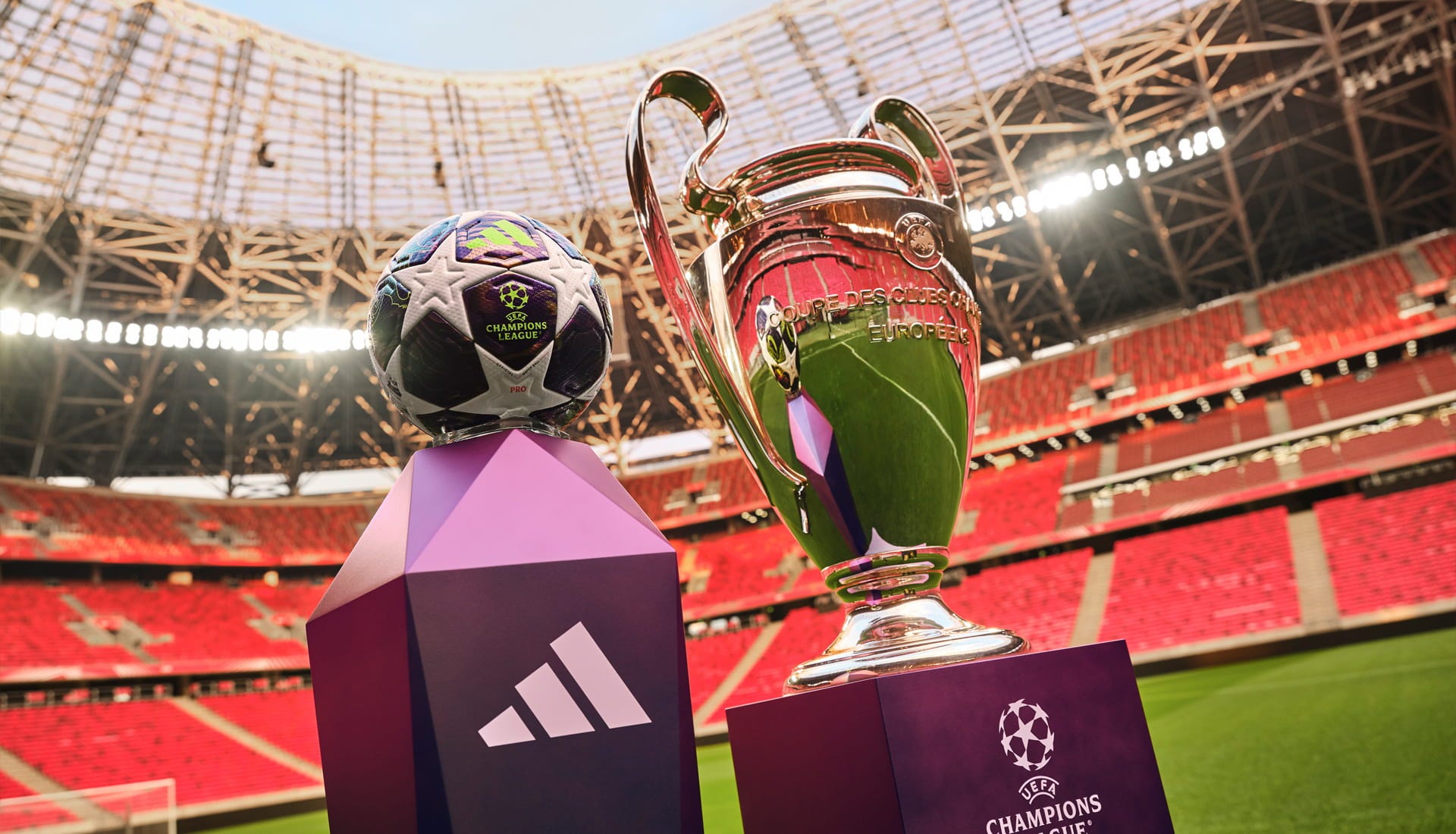
On 30th May 2026, the Champions League final disappeared from free-to-air television in the UK for the first time in thirty-four years. Arsenal met Paris Saint-Germain in Budapest. To watch, you needed a TNT Sports subscription at £32 a month, or HBO Max at £4.99. Every final before it, had been free.
The audience it reached was large, and the audience it lost was larger. Seven million watched legally, a 25.6% share, well short of the 12.6 million who saw the free-to-air 2022 final. Analysis by the Guardian recorded 16.2 million views of illegal streams from 3.7 million British IP addresses4, watching outside the system entirely.
Nothing obliged TNT to share it: the Champions League final does not sit among the “listed events” UK law protects, so the broadcaster could wall it off. The World Cup does, which is why all 104 matches are free on BBC and ITV. One market, two competitions, opposite outcomes. A regulatory list and a contract clock decide which fans pay — not demand.
And here the coverage reached for the wrong number.
The Real Loss: Sponsorship
The loss the coverage counted was broadcast revenue: lost subscriptions and lost advertising, which cost billions annually. Real money, but the wrong headline: the larger and quieter loss is sponsorship reach, and it behaves differently, because piracy treats the two kinds of value differently.
A pirate stream carries the host broadcaster’s pictures. The shirt sponsor, the boot deal, the pitchside LED, and the centre-circle badge all still appear. The brands paid for the pitch, and the pitch is on screen.
What does not survive is the broadcaster’s own inventory — the thirty-second spots it sold around the match. The pirate strips out the ad breaks or fills them with its own: XoilacTV charges its viewers nothing and runs betting ads instead. The rights-holder’s ad break dies; the pirate’s ad break lives.
Two problems, then, not one. The rights-holder loses revenue it can count to the penny. The sponsor loses something less visible: not the exposure itself, which continues, but the ability to prove who saw it, value that audience, and reach them again.
The Ghost Impression
Nobody prices sponsorship on guesswork. It runs on media value equivalency: the cost of buying the same exposure through conventional advertising. A logo’s worth is its quality of exposure — size, clarity, prominence, position — times the number of viewers who saw it, at the going rate per thousand viewers. Nielsen, Relo Metrics, and YouGov5 all measure it the same way: detect the logo, weight the exposure, attach a verified audience, return a number.
Every term in that equation needs a counted audience. Pirate viewers sit in no panel and no ratings sample, so nothing records their impressions. The exposure happens; the value does not. This is the meter breaking: not a figure of speech but the literal mechanism.
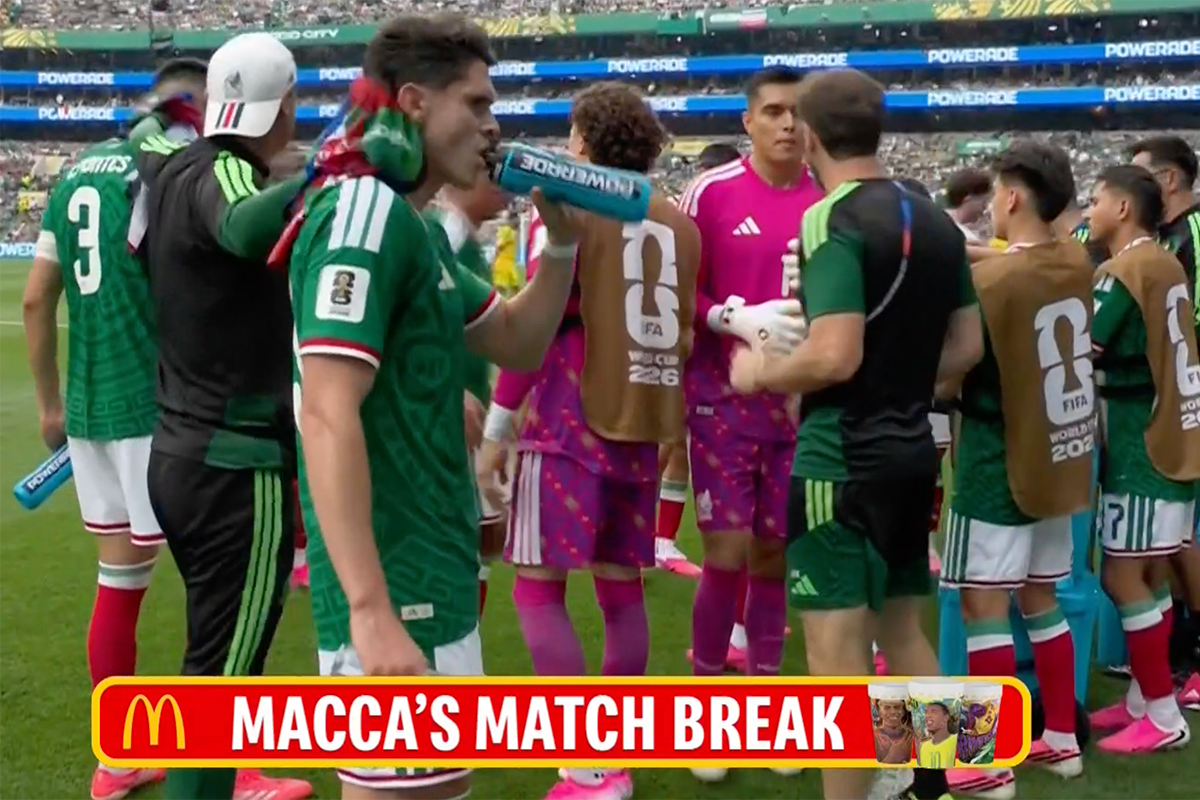
There is a second loss beneath the first. Pirate feeds are compressed and low-bitrate, often a phone pointed at a screen. Valuation models discount a logo they cannot read clearly; an unreadable mark scores near zero however long it holds. The industry calls these ghost impressions. The pirated audience does twice the damage: invisible where no one counts it, degraded where they can see it.
The Champions League final shows this in a market that measures everything —, yet 3.7 million of its audience went dark regardless. The consequence is heavier where the meter never existed.
The Paywall Effect
How did we get here? Part of the answer lies in the way the tournament is sold.
Football rights are licensed market by market, resulting in access that looks completely different depending on where you live. In the UK, the BBC and ITV share all 104 matches free-to-air. Most markets aren’t built that way.
In the US, matches are spread across Fox, FS1, and Peacock, and following the whole tournament legally can cost between $70 and $90 a month6. But price isn’t even the main hurdle: Nexxen found that 90% of intended viewers misidentify at least one platform carrying matches7, and 87% would switch to a free, ad-supported option the moment one appeared.
When the legal route is expensive and hard to find, part of the audience stops looking—and finds the match on a pirate feed instead. The same paywalls that protect the broadcast fee drive viewers onto those feeds, where the shirt sponsor still appears but nothing records who saw it. The broadcaster protects the revenue it can measure, while sponsorship value slips away unnoticed.
The Cost to the Fan
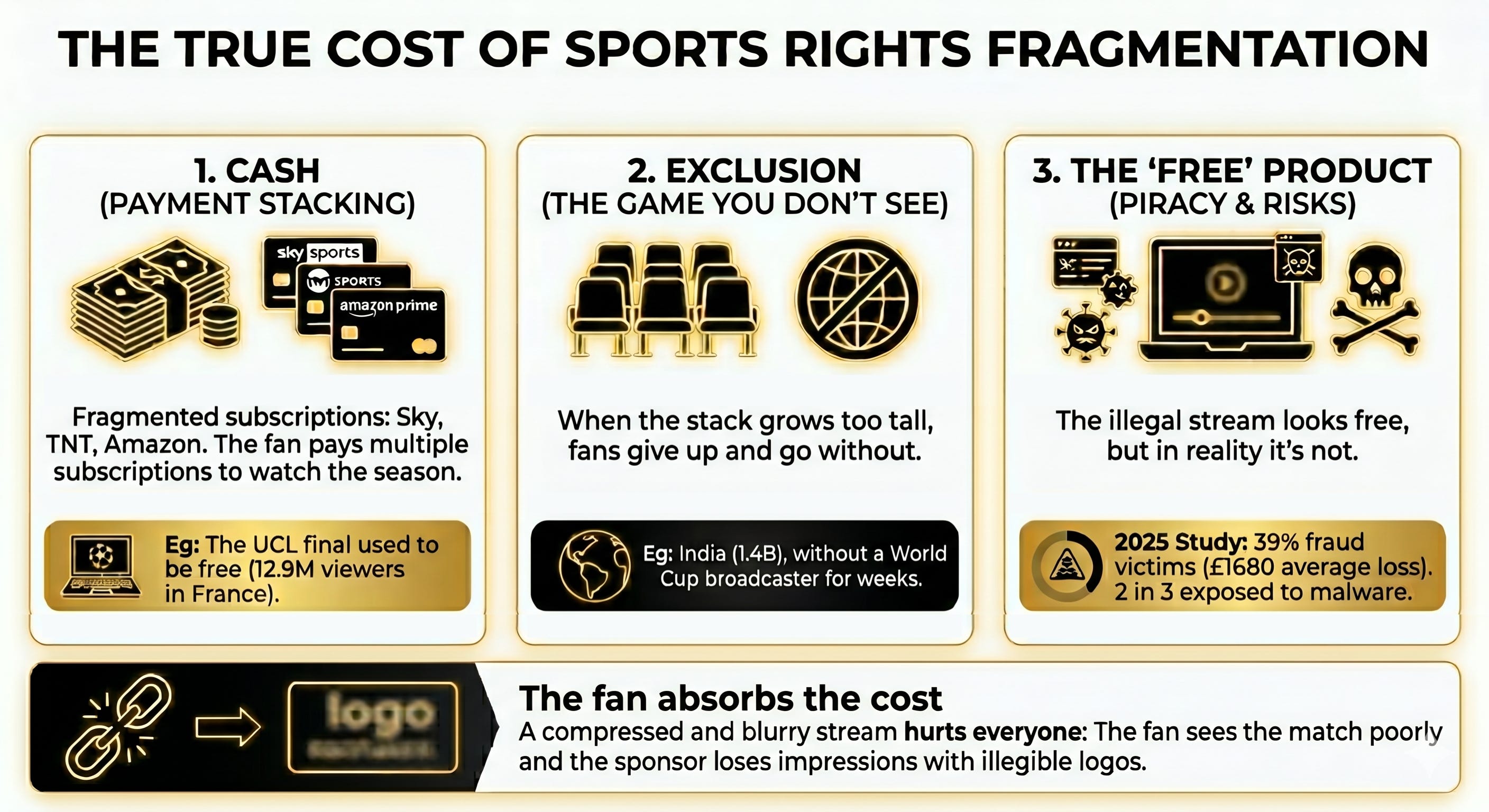
Someone absorbs the cost of fragmentation, and it is not the rights-holder. The fan pays it, in three currencies.
The first is cash, and it stacks. Sky Sports, TNT Sports, and Amazon Prime divide English and European football between them, so a fan who wants the full season already pays three subscriptions. The UCL final used to be the one night that asked nothing—free for everyone, subscriber or not. France watched the same match for nothing: 12.9 million viewers, 61% of the country’s households.
The second is exclusion. When the stack grows too tall, fans stop paying and go without. India, a market of 1.4 billion people that delivered 745 million viewers8 at Qatar 2022, had no confirmed World Cup broadcaster until days before kick-off. For weeks, there was no legal way to watch.
The third is the product itself. It looks free, but it’s not. A 2025 study by the anti-piracy group BeStreamWise found that 39% of people using illegal streams lost money to fraud, averaging £1,680 each9. Two in three experienced security scares — malware, scam pop-ups, or hacking attempts. The stream is the lure; the viewer is the product. And the picture is poor; compressed, buffering, breaking up.
That last cost closes the loop. The blurred logo a valuation model cannot read is the same blurred frame the fan squints at. One compressed stream carries both losses at once: the supporter’s worst match, and the sponsor’s ghost impression.
The Scale of the Problem
The World Cup’s own structure makes it an easy target. A tournament sold territory by territory leaves gaps — markets where the legal feed is expensive, late, or simply missing — and those gaps are exactly where industrial piracy moves in.
Russia 2018 gives a baseline. Viaccess-Orca tracked 40,713 piracy links over the 32-day competition, reaching more than 41 million viewers, with over 14,000 links on social media10. Some of that demand came directly from the rights map: a trade dispute between Saudi Arabia and Qatar left the country with no official broadcaster, so an entire football nation had no legal way to watch its own team.
By Qatar 2022, the behaviour had become surreal. More than 40,000 people in France watched what they assumed were live pirate streams11 — which turned out to be pixelated replays of FIFA 23, Vietnamese commentary and all. When fans will accept a video-game render rather than miss a match, price is no longer the issue. The habit runs deeper than that.
Streameast, the largest illegal sports operation of its era, was drawing 136 million monthly visits12 before it was shut down. And each tournament the machinery gets bigger.
The Geopolitics of Piracy
There’s one part of this story that almost never makes the analysis, and it’s the part where the numbers are largest.
Latin America is where football culture runs deepest and legal access runs thinnest. It’s also one of the regions FIFA sells to sponsors as the game’s growth frontier — and the place where the measurement sponsorship depends on breaks down most completely.
In Argentina, for example, the pirate platforms are not fringe. Fútbol Libre, Pelota Libre, Xuper TV, Magis TV, Roja Directa13 — traffic spikes the moment the Selección plays. Reaching for them isn’t about wanting something for free. The legal options exist — TyC Sports, DSports, DGO, Flow, Telecentro Play — but getting there usually means paying for a full cable plan plus a sports add-on, rather than buying the match you want. For anyone following a foreign league, the legal feed often doesn’t carry the game at all. The pirate portal isn’t the cheaper option: it’s the only one.
For a sponsor, this is the most frustrating version of the problem. A report by Ether City, cited by Smart Protection, estimates that converting just 15% of Latin America’s illegal viewers would be worth $5.28 billion14, according to pre-tournament estimates. That figure assumes there’s a legal product to convert them to. Across much of the region, there isn’t.
The enforcement keeps arriving — LaLiga has coordinated major anti-piracy operations in Argentina, including raids in Buenos Aires province15, Operation 404 has taken down apps with millions of downloads. None of it fixes the underlying gap. Where there’s no authorized stream, the audience was never FIFA’s to lose. It’s watching, it’s seeing every sponsor — and as far as anyone paying for that exposure is concerned, it doesn’t exist.
Where the Money Goes Next
If exposure that can’t be measured is worth less, then the money eventually moves toward exposure that can. That shift is already underway.
A brand that can’t prove who saw its logo on a pirate feed puts its next dollar somewhere the audience is countable — owned apps, social channels, athletes whose accounts it sponsors directly. Every impression there is logged and attributable. The pitchside board still carries value, but a growing share of that value depends on a broadcast audience that’s leaking.

The 2026 World Cup makes this unusually visible. Three co-hosts — the United States, Mexico, Canada — means three rights markets, three regulatory systems, three sets of paywalls and gaps inside one tournament. Where that map is most fragmented is exactly where the pirate feed operates most freely, and where the measured audience thins out most.
The question facing the next round of deals isn’t whether piracy can be stopped. Three decades of crackdowns say it can only be displaced. The real question is whether the logo on the broadcast still buys what it used to — or whether the smarter money has already started paying for an audience it can actually count.
The Bottom Line
Step back, and the 2026 World Cup tells one story in two entirely different registers. The broadcasters will continue to count what they lost, lobbying for faster takedowns and tighter geofences. But the sponsors are losing something far harder to recover: not the exposure itself but the data that justifies the spend.
The unprecedented fragmentation of this North American tournament—split across three host nations, three regulatory frameworks, and a labyrinth of shifting paywalls—has created the perfect petri dish for the modern pirate economy. As the tournament progresses toward its July finale, millions of fans will inevitably find the matches outside the system. They will see every shirt sponsor and pitchside logo, but they will exist only as ghost impressions—invisible to major analysts, unreadable by valuation models, and completely decoupled from ROI.
The tournament will crown a world champion on the pitch next month. The more grueling contest, however, belongs to the sports business ecosystem left in its wake. When the next multi-billion-dollar rights cycle is negotiated, the industry will have to stop pretending that an unmeasured audience doesn’t exist, and finally start pricing the game for a world where the screen belongs to the pirate, but the pitch still belongs to the brand.
What do you think? — let’s discuss below
https://www.dexerto.com/entertainment/over-27000-illegal-streaming-sites-shut-down-in-massive-piracy-crackdown-ahead-of-world-cup-3374217/
https://www.connexionfrance.com/news/france-finds-new-way-to-crackdown-on-illegal-sports-streaming/795876
https://www.advanced-television.com/2026/04/14/spain-launches-real-time-blocking-of-illegal-sports-streams/
https://www.theguardian.com/football/2026/jun/01/arsenal-psg-illegal-stream-views-tnt-champions-league-final
https://yougov.com/business/products/brandindex
https://sports.yahoo.com/articles/watch-2026-fifa-world-cup-134325227.html
https://finviz.com/news/269413/nexxens-2026-world-cup-forecast-helps-advertisers-plan-for-fragmented-tv-landscape
https://www.aljazeera.com/sports/2026/5/26/world-cup-broadcast-hopes-boosted-in-india-as-zee-entertainment-in-talks
https://bestreamwise.com/article/when-cheap-turns-costly-40-of-illegal-streamers-hit-by-financial-fraud
https://www.sportspro.com/news/fifa-world-cup-piracy-russia-social-media/
https://en.as.com/soccer/thousands-of-viewers-watch-world-cup-2022-in-qatar-on-illegal-streams-but-in-reality-it-is-pixelated-fifa-23-games-n/
https://www.aol.com/sports/streameast-largest-illegal-sports-streaming-154917546.html
https://www.eldestapeweb.com/mundial/ver-vivo-todos-partidos-mundial-2026-futbol-libre-pelota-libre-xuper-tv-ilegal-donde-hacerlo-manera-legal-202661115336
https://www.smartprotection.com/articles/how-anti-piracy-tech-tackles-copyright-infringements-in-football
https://www.laliga.com/en-GB/news/massive-operation-in-argentina-dismantles-global-piracy-network-with-over-8-million-users
 | A guest post by
|
There are some agencies, particularly Ripple (formerly Videocites) who track posts on social to demonstrate to RH the amount of additional $$$ their sponsors are getting because of infringing content. It's a really interesting way to look at it. Leave it up and get the exposure and views (and maybe monetize it via YT) or take it down and lose extra reach