

Argentina Built a Sponsorship Machine. Can It Survive Messi?
How the most commercially aggressive football federation in the world built its empire on a foundation that is still evolving—and remains vulnerable to future structural shifts.

Hi everyone! This is Off-Ball Logic, the weekly newsletter where we step away from the 90 minutes on the pitch to dissect the business strategies, marketing mechanics, and economic engines that are really driving the modern sports world.
Subscribe to get it in your inbox:

The history of football is built on top-tier differentiators. They are the kind of intellectual property you recognize the moment you hear them. Jogo bonito reminds you of Brazil. Uruguay has the garra charrúa. The Clockwork Orange brings back the old days of Dutch glory. Germany had the machine. Spain had the tiki-taka. Each of these is indivisible from the country attached to it.
From a marketing perspective, these are the holy grails of brand equity. They are concepts that work entirely without any particular player attached to them. A sponsor can buy into it, a broadcaster can sell it, a fan in Tokyo or Mumbai recognizes it without having watched a single qualifying match. These are brands in the full corporate sense: coherent, scalable, transferable, and bigger than whoever happens to embody them at a given moment.
Then there’s the glaring outlier.
Argentina, the reigning champion, has three stars on its shirt and ninety-six years of World Cup history—and across all of it, never a true, exportable differentiator to put on the table. But the absence of that differentiator didn’t stop the AFA1 from building the most aggressively monetized national team brand in global football after Qatar 2022.
In today’s analysis, we are examining an institution that has successfully commercialized its own folklore, transforming sporadic, chaotic greatness into a reliable corporate asset.
But can a brand truly sustain itself long-term when its foundation is made of generational talent instead of a scalable, systematic framework?
The Long Presence That Built No Foundation
To understand the AFA’s current commercial structure, you have to look at the historical failure to build an outstanding identity (and in its way, an IP).
Argentina’s close relationship with the World Cup begins at the very start of the tournament’s story. Reaching the 1930 final in Montevideo (a 4-2 loss to Uruguay) made the country a recurring fixture at the top of the international game: six finals, three titles, and a near-constant presence across almost a century of football.
But that presence rarely translated into a recognizable identity abroad, and the historical inconsistency between 1930 and 1978 is a direct reason why:
The 1958 tournament in Sweden ended with a 6-1 loss to Czechoslovakia—el desastre de Suecia, an event still remembered as one of the heaviest systemic failure in the country’s sporting history.
And we didn’t even qualify for 1970, ironically the exact tournament that cemented Brazil’s brand for the next fifty years.
Brazil’s trajectory was a masterclass in consistency. Three titles in four tournaments between 1958 and 1970, each one tied to the same recognizable rhythm and way of playing. They broadcasted this to a rapidly growing global television audience that learned to inextricably link the yellow shirt with a specific kind of footballing joy. By 1970, the CBF owned a concept that worked independently of any single player on the pitch.
More on this in this article:

What carried Argentina internationally, conversely, was never tied to a scalable system. The teams were often robust and highly competitive, but their performances were ultimately remembered because of individual saviors. Kempes in 1978. Maradona in 1986. Messi in 2022. We produced eras built around singular acts of genius, with long stretches of sporting and commercial wilderness in between.
And even when individuals were good enough to make the team remembered, from a marketing standpoint, they weren’t enough on their own.
Clashing Philosophies That Prevented Accumulation
Why did a framework never arrive? Because Argentine football spent five decades paralyzed by an ideological divide over its style of play.
On one side: Menottismo, the philosophy César Luis Menotti brought to the 1978 World Cup. It was idealism, aesthetics, La Nuestra2—individual expression, short passing, the romantic belief that the product must be beautiful as well as effective.
On the other side: Bilardismo, the framework Carlos Bilardo used to win in 1986. Ruthless pragmatism, obsessive defensive organization, and a willingness to compromise aesthetics for the bottom line3.

These two approaches were like competing forces that refused to blend into anything coherent. Menotti won with one, Bilardo won with the other, and the generation that came next had to pick a side in an ideological proxy conflict instead of inheriting a settled identity.
Marcelo Bielsa’s influence later pulled the tactical conversation toward positional play, culminating in Jorge Sampaoli’s 2018 campaign in Russia, where the system broke down completely. The team in Russia was so overloaded with tactical micro-management that it couldn’t execute the one thing Argentine players are historically raised to do: improvise.
The country spent the aftermath arguing, yet again, about what its football was supposed to be. Fifty years of competing with incompatible philosophies had produced trophies, but absolutely zero brand continuity.
La Scaloneta4: A Bespoke Mechanism
Lionel Scaloni—who took over in 2018 during one of the most turbulent chapters in Argentine football—bypassed the divide entirely by refusing to engage on either side’s terms.
His system—what tacticians are now calling “relationism”—is arguably the first true synthesis Argentine football has produced. Players aren’t assigned rigid, fixed zones the way modern European positional play demands. The structure emerges organically out of the relationships between specific players in tight spaces.
It relies on the spontaneous intelligence Argentine football has always produced in academies and street games (the potreros), the exact thing earlier, over-engineered systems kept trying to override.
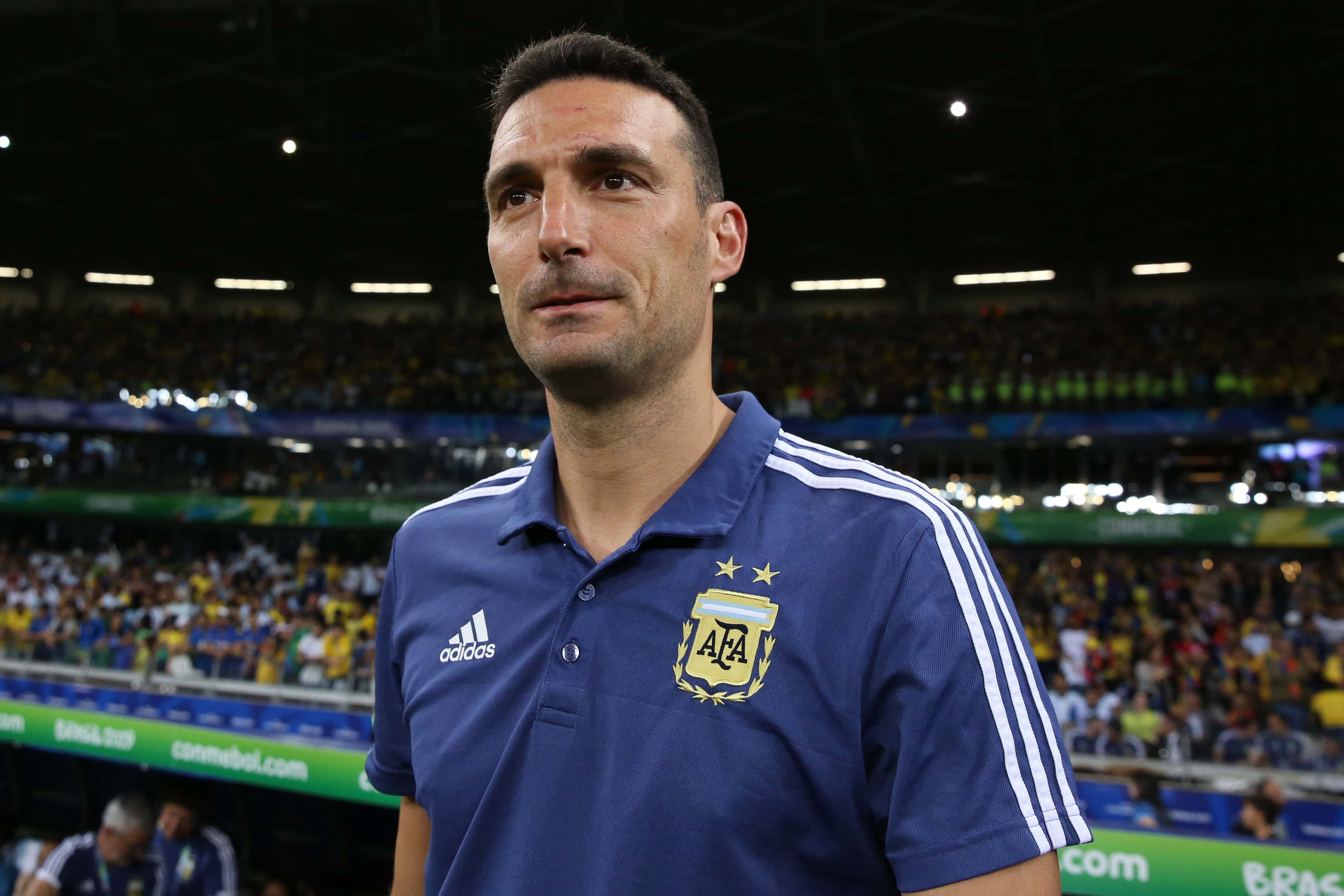
Scaloni has diagnosed the industry’s problem directly: modern football is losing its essence because players are given too much information and told exactly what to do.
But crucially, this return to the roots wasn’t just romantic; it provided a highly functional ecosystem around its biggest star.
And the philosophy feels bigger than that one mechanism. It is La Nuestra turned into a functional operating system: trust the player’s read of the space, let the chemistry set the shape, and build around what your assets can actually do.
Scaloni’s Argentina stopped claiming an identity, just played football that felt authentically Argentine, and accidentally captured the exact cultural alignment. But whether La Scaloneta is a foundational philosophy or simply a brilliant, functional era is the uncomfortable question Argentine football hasn’t been forced to answer yet.
Capitalizing on the Culture: The AFA’s Masterclass
The AFA, of course, didn’t wait for that answer before taking the product to market. Consequently, the commercial expansion after Qatar is unprecedented among national federations.
The anchor is Adidas. The relationship goes back to Argentina wearing Adidas at the 1974 World Cup, while the modern continuous partnership dates to 2001. In June 2024, AFA and Adidas extended the alliance through 2038, a deal that carries Argentina across the next four World Cup cycles.
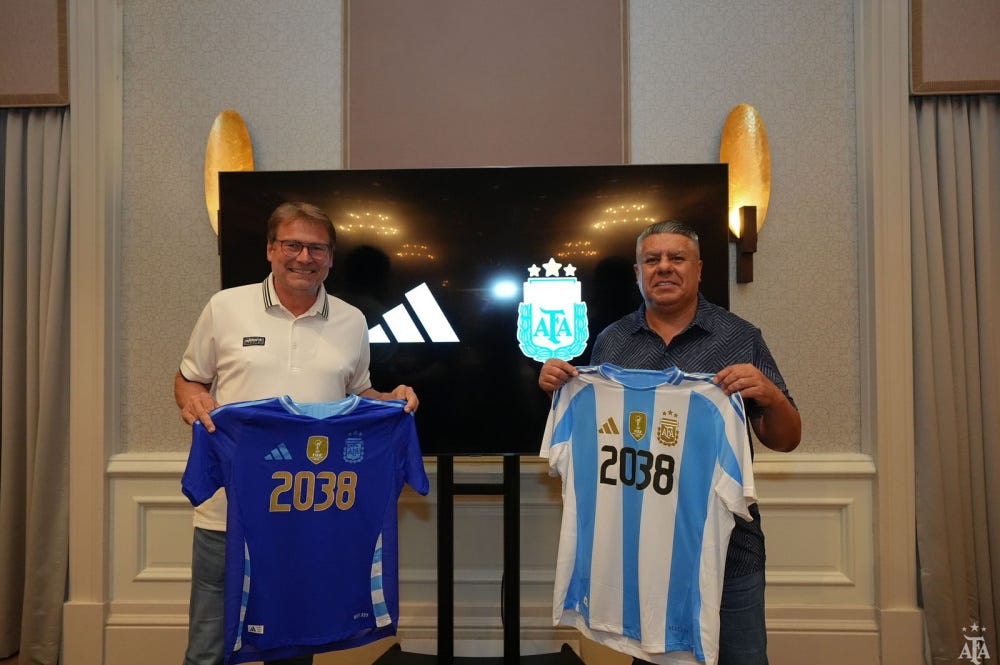
The timing mattered. Three months earlier, the German federation had announced it would leave Adidas for Nike from 2027, ending a partnership of more than seven decades. The value of that Nike deal was not officially disclosed, but it was reported at around €100 million a year, roughly double the €50 million Adidas had been paying. In that context, retaining Argentina (the reigning world champions, and the national team of Lionel Messi, Adidas’s reported lifetime athlete) became strategically important. It makes Argentina one of the clearest flagships in Adidas’s international football portfolio.
Under that anchor, AFA built a sponsorship portfolio few federations could match. Its domestic base was anchored by major Argentine brands:
YPF, the majority state-owned energy company, had a national-team agreement running through 2025
Banco Nación joined as an official sponsor of the national teams in late 2022.
Those were the local pillars.
What changed after the 2022 World Cup was the international layer. By December 2024, SponsorUnited counted 64 active AFA sponsorship deals, 15 added year over year, spanning 21 countries. That put Argentina well ahead of Spain’s federation, with 45 deals, and Brazil’s, with 40.
Seventy percent of AFA’s sponsorship portfolio now comes from outside Argentina, a deliberate shift away from dependence on the domestic market. Asia alone accounts for 30 percent of the portfolio, a level of penetration that SponsorUnited says is surpassed only by Manchester United among football properties.
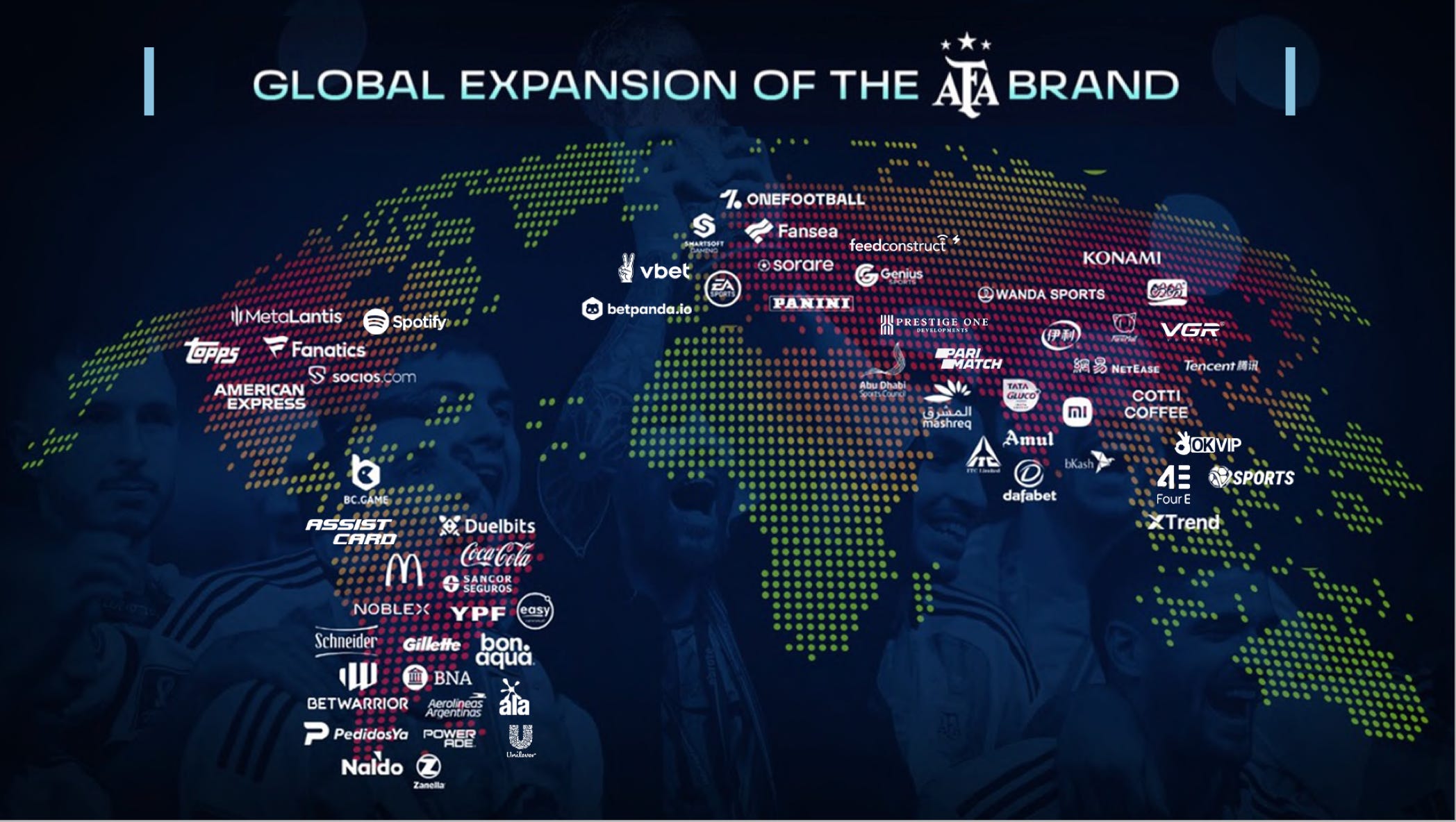
The strategy is not just logo placement. Xiaomi turned the Albiceleste identity into a special-edition Redmi phone for India. Cotti Coffee built fan experiences, exclusive products, prizes and activations around Argentina’s presence in China. In India, ITC brands like Bingo! and YiPPee! built campaigns around a fanbase that largely experiences the team from thousands of miles away.
The U.S. became the next layer. AFA announced its Miami move in July 2023 and later inaugurated offices in Wynwood, creating a working base for Copa América 2024 and the 2026 World Cup cycle. Around it, the federation has expanded academies, high-performance-center projects and commercial partnerships designed to deepen its American footprint.
In February 2026, Leandro Petersen, AFA’s Commercial and Marketing Director, returned to Harvard Business School to present the federation’s “AFA Global Brand Expansion” case for the second consecutive year. AFA says it became the only sports institution invited twice to present its management and international expansion model there.
What the AFA is selling through all of this isn’t a football tactic; it’s Argentine football culture. The shirt, the mate, the potrero, the sense that football is not weekend entertainment but a national emotional language. AFA has turned that intensity into a global sponsorship asset, offering brands access to a kind of sporting passion they cannot manufacture on their own.
The Man Inside the Machine
The risk inside AFA’s growth is that the portfolio looks unified, but the sponsors were not all buying the same value.
Some bought access to the reigning world champions. Some bought a foothold in AFA’s U.S. expansion, especially around Miami and the 2026 cycle. Some bought the broader Argentina brand: the shirt, the fanbase, the culture. And many, directly or indirectly, bought into the commercial gravity of Lionel Messi5.
They may sit inside the same commercial package, but they do not run on the same timeline. World-champion status is tied to a tournament cycle. The U.S. opportunity peaks around 2026. The Scaloni era depends on a coach, a generation and a style that cannot be guaranteed forever. Messi is the most valuable layer in the bundle, but also the least replaceable.
AFA’s model works by making these layers feel indivisible. The gap between them becomes the real business risk once the post-2026 cycle begins.
The clearest measure of what AFA is actually selling came in November 2025, when Angola reportedly paid around $12 million to host Argentina for a single friendly tied to its 50th independence celebrations. AFA’s reported take was about $12 million gross, or closer to $7 million net after taxes. The match was reported as one of the most expensive international friendlies ever staged.
The catch was the condition attached to the fee. Reports said Messi had to play at least some minutes. That number was not paid for Argentine football in the abstract. It was paid for Messi in an Argentina shirt.
The pattern runs deeper:
In 2019, Morocco reportedly agreed to pay around €1 million for a friendly if Messi played at least 70 minutes. When he did not feature, the fee reportedly fell to about €550,000.
In 2026, Miami-based promoter VID Music Group sued Messi and AFA over a $7 million contract tied to Argentina friendlies against Venezuela and Puerto Rico, alleging that Messi’s participation was the central commercial driver of the deal.
YPF, one of AFA’s key domestic partners, has also built major campaigns around Messi as the main image of its alliance with the national team.
None of this is irrational from AFA’s side. The risk begins when the commercial architecture depends too heavily on a revenue driver that cannot be renewed. The warning is clear: when the anchor carrying the premium starts to disappear, the business model has to prove what remains.
The Bottom Line
The AFA has built something that may outlast Messi, but for now its commercial logic remains deeply shaped by him. What comes next is something Argentine football has rarely had to test at this scale. It has produced icons before, but rarely a system this coherent around one player, one era and one global commercial machine. AFA may already have a plan in the works. But the question remains valid.
That is the multi-million-dollar question beneath everything AFA has built. Whether the next generation inherits a sustainable way of playing, or only the memory of one. Whether the sponsors who bought into this moment are also buying a brand that can survive beyond it.
Brazil has been trying to solve a related problem from the opposite direction, and with far less stability. Since the end of the 2022 World Cup cycle, the CBF has moved through different managers, each one carrying a different answer to the same question: how to make Brazil feel like Brazil again without simply recreating the past. The results have been uneven. And they serve as a warning. The jogo bonito is such a historically powerful idea that any change moving too far from its aesthetic promise can read as a betrayal.
The jogo bonito outlasted Pelé. What comes after Messi is the thing Argentine football — and the massive commercial machine AFA built around him — still has to define.
What do you think? Let’s discuss below.
Carla | Off-Ball Logic
PS: I really wanted to expand on alternative ways the AFA could sustain its commercial success after Messi retires from the national team, but this analysis was already getting long enough! If you’re interested in an exploration like that, please leave a comment and let me know.
Argentina’s FA
“La Nuestra” means “our own”: the moment Argentine football stopped being a British import and became a national language.
With the exception of Diego Maradona's unrepeatable genius, which made Carlos Bilardo's rigid system look beautiful.
This is a term coined during the Scaloni era, and it’s how we affectionately refer to the national team. I was struggling to explain it, but here’s how an AI would explain it (accurately, I must admit): “La Scaloneta is the affectionate and wildly popular nickname given to the Argentina men’s national football team managed by Lionel Scaloni. The term was born in 2021 after Argentina’s strong performance in the Copa América. It is a blend of Scaloni’s last name and -neta—a colloquial suffix in Argentine slang added to vehicles or movements, implying a sort of unstoppable momentum, like a van or a bus carrying the team to victory.”
Who in fact is turning 39 today
What AFA has done is remarkable because they've monetised emotion rather than just results. But the real test of any sports brand is whether it can transition from personality-led to institution-led value. Messi created the opportunity but it remains to be seen whether Argentina can turn that into enduring brand equity. How that turns out will determine if this becomes a case study in sustainable sports marketing or simply one of perfect timing.
This is an excellent angle you took here. I have never really thought about how Argentina does not have a footballing identity per se, like Brazil or Spain.
This is a good question to ask, what is the AFA going to do once Messi retires? The same question can be asked for MLS also.