

World Cup Recap #1: What FIFA owns now
The commercial decisions shaping the first week of the 2026 World Cup.

Hi everyone! I’m Carla, and this is Off-Ball Logic, the weekly newsletter where we step away from the 90 minutes on the pitch to dissect the business strategies, marketing mechanics, and economic engines really driving the modern sports world. Subscribe to get it in your inbox:

This week we got a first-hand look at what FIFA’s revenuemaxxing means in practice.
We’re barely half a week in, and a pattern is already showing: almost everything FIFA touches, it’s quietly converting into something it owns and can sell.
This is a new section that runs for the length of the tournament — every Monday, the storylines that shaped the week, read through the commercial layer underneath them.
Are cooling breaks actually cool?
FIFA announced its mandatory three-minute “hydration breaks” back in December 2025, framed entirely around player welfare for a tournament co-hosted by Canada, Mexico and the United States.1
But the same announcement let the real point slip: the breaks also make the broadcast schedule more predictable, because weather stoppages stop being a variable.
Six months on, that commercial logic isn’t a suspicion anymore — it’s on screen. Broadcasters are cutting to full-screen ads during the pauses, the in-game slot football never had before halftime.
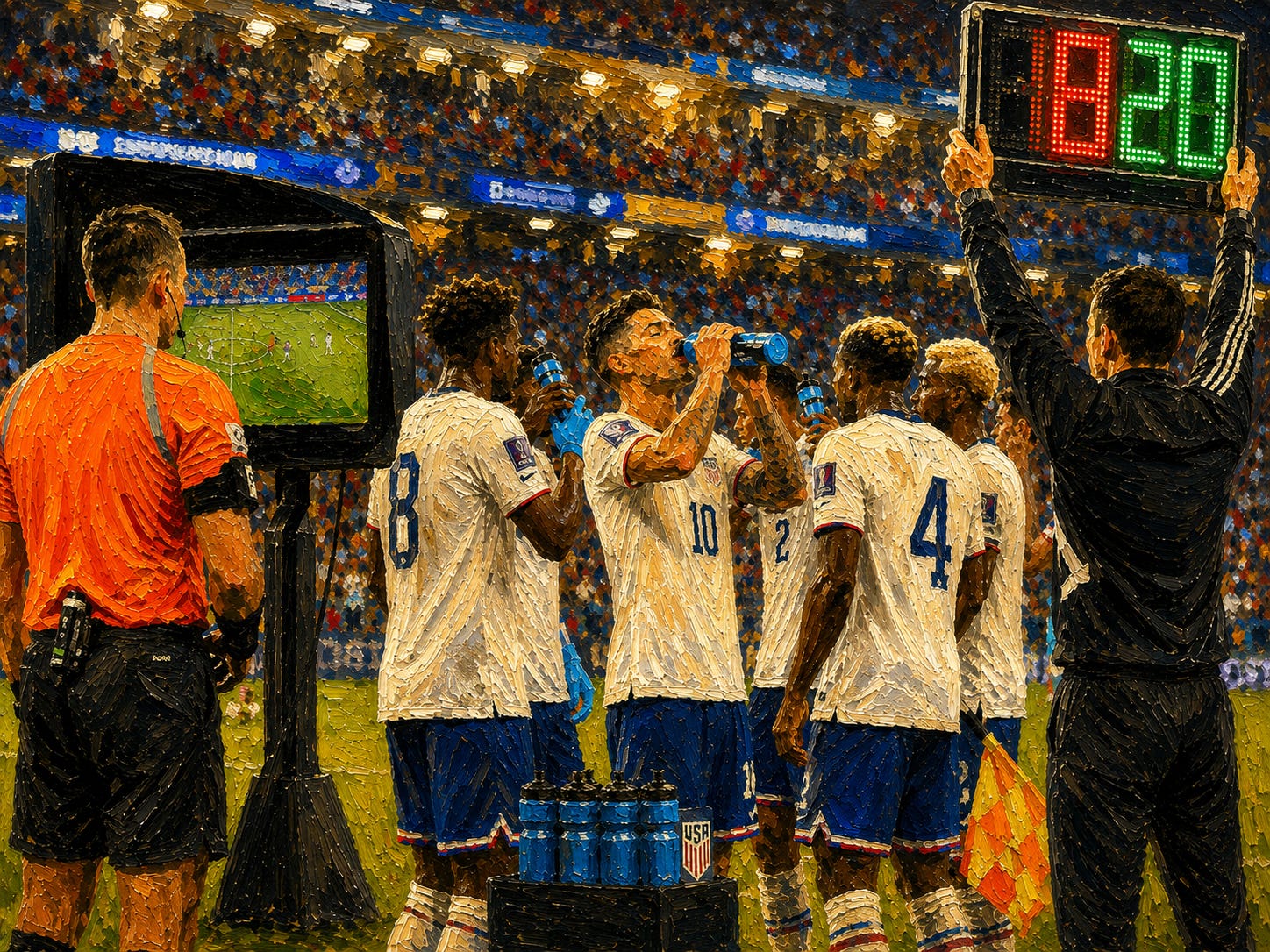
A few holdouts stay on the pitch — the ad-free BBC2, and Telemundo, which has committed to keeping its feed on the match — but several broadcasters, led by the US networks, are treating the break as inventory.
Two guaranteed stoppages across 104 matches is airtime FIFA didn’t have before.
ITV already calls the tournament a “six-week summer Super Bowl” and says its ad revenue is running 30% above Euro 20243.
And all of this without even selling the hydration breaks.
Which raises the question of whether the welfare case was ever the whole story.
Mauricio Pochettino, now coaching the USMNT, put the worry more bluntly4:
“But it’s like plenty of rules today […] rules that for sure I don’t like. They say that they’re going to help the spectacle, but we’re going in a direction that we’re going to change. Because if we add, add and add rules, then the soccer or the football that we know is going to stop existing. And it’s going to become another sport.”5.
How Levi’s picked up the ball (and left the blanket on)
The naming-rights story got attention when the Azteca (now “Estadio Banorte” for commercial reasons) became “Estadio Ciudad de México”, and venues were stripped back to generic, location-based names. But Levi’s Stadium is the cleaner illustration.
For the tournament it’s “San Francisco Bay Area Stadium,” and the red batwing logos are physically wrapped in white tarps to satisfy FIFA’s clean-venue rules — reportedly down to the Google and Apple Maps listings.6
What’s worth watching is the response. Rather than absorb the erasure quietly, Levi’s made its tarped-over logo its Instagram profile picture, turning a forced disappearance into a piece of brand content.
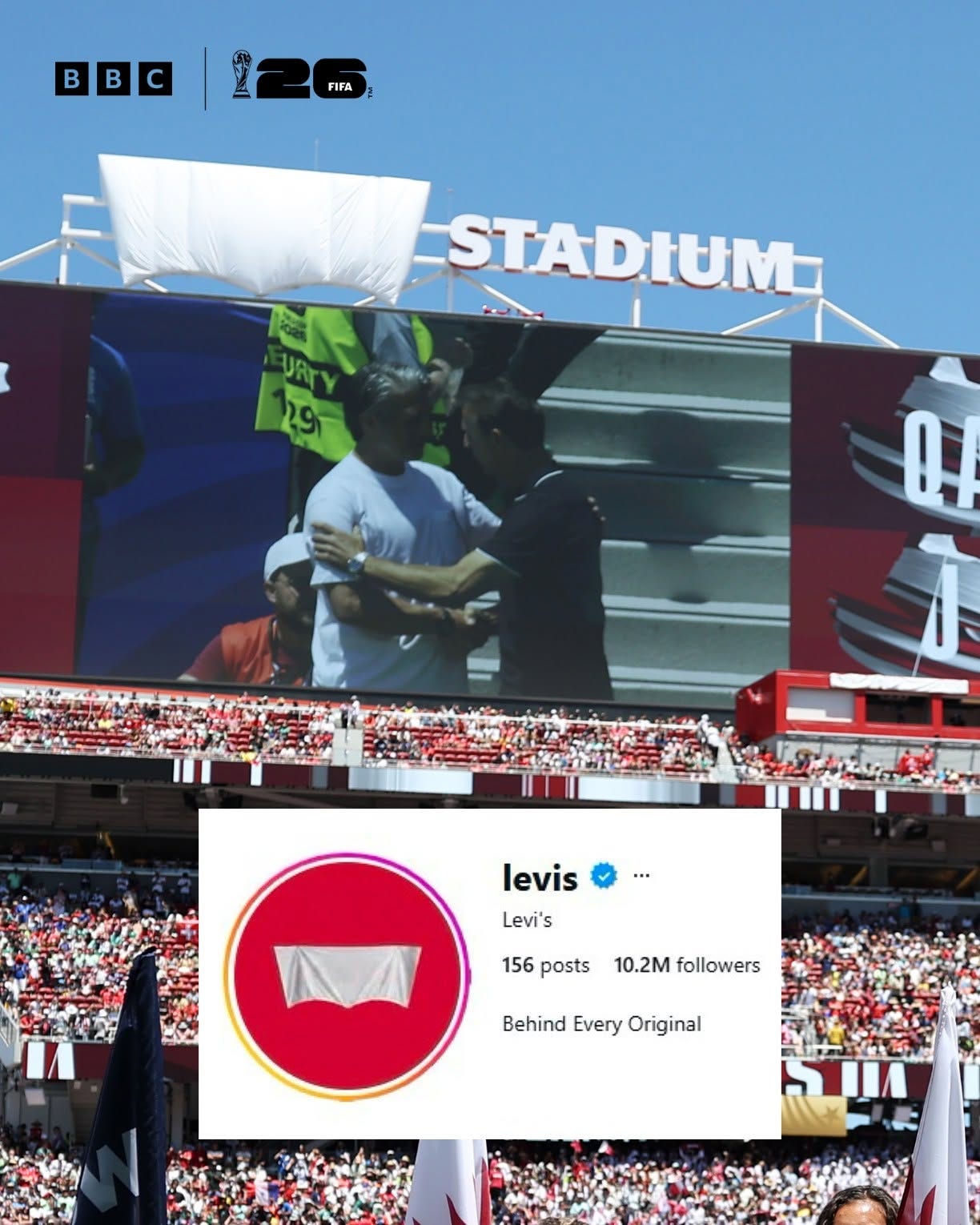
For context, Levi’s and the 49ers signed a combined $170M naming-and-sponsorship extension in 2024 that runs the name through 20437, so this isn’t a brand walking away from the stadium. It’s a brand refusing to be unseen in it, even when the rules say it has to be.
Is FIFA downgrading the World Cup brand?
Long before kickoff, this edition was already separating itself from past tournaments — three host countries instead of one, and a brand identity that struggled to land on a single idea.
FIFA calls the “26” logo a vessel for self-expression and built the WEARE26 campaign around it. But since kickoff, the more telling move has been on the pitch and in the broadcast: FIFA lettering dominates the team entrances, and replays carry the FIFA logo rather than the World Cup mark.
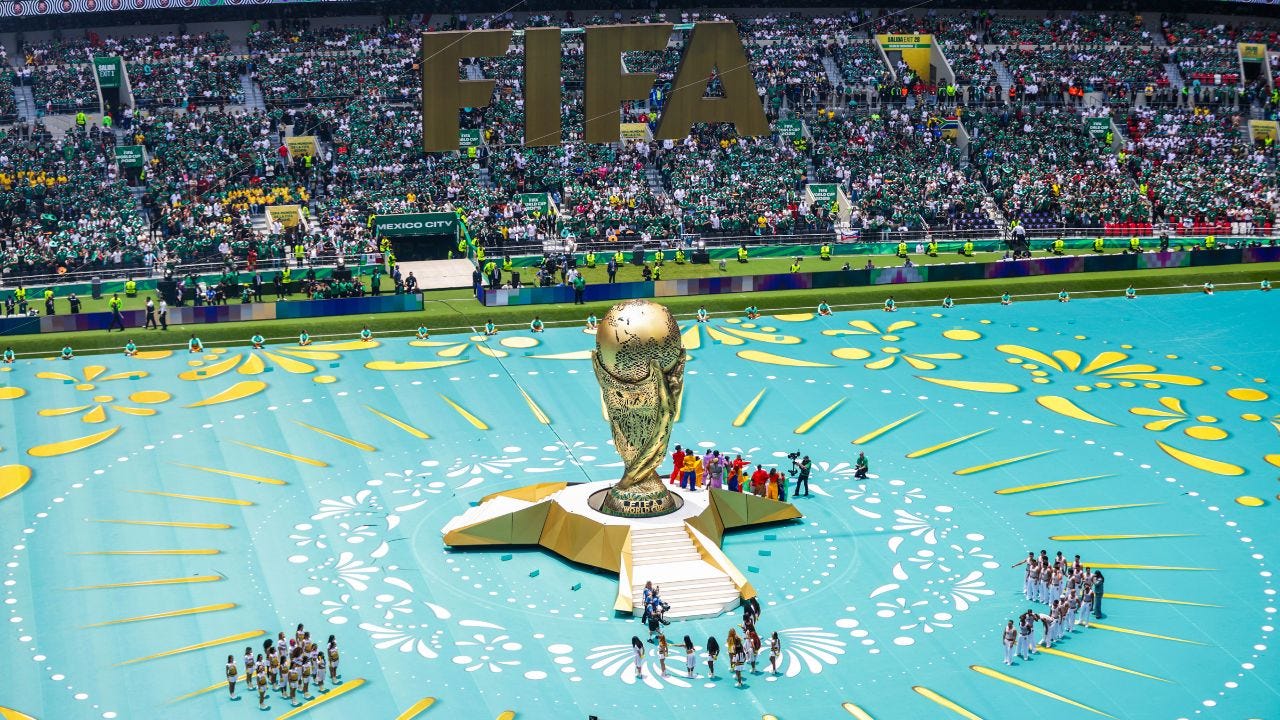
From a PMM seat, that reads as a deliberate architecture shift. FIFA is moving from a house of brands — where the World Cup, the Women’s World Cup and the Club World Cup each carry their own identity — toward a branded house, where everything resolves back to FIFA.
The risk is that brands hold meaning, narrative and identification, and “World Cup” carries far more of that equity than “FIFA” does. If the association quietly migrates from one to the other, the question is whether FIFA inspires anything close to what the World Cup always has.
Sleep deprivation (without the bias)
A map of which countries lose the most sleep to this World Cup circulated this week, and the data underneath it rewards a closer look.
The schedule traces straight back to the Club World Cup, where 5pm and 8pm BST kickoffs were built for European broadcasters but ran into peak American heat. The fix for 2026 was to push games later — which now means close to half of group-stage matches start between midnight and 5am UK time8.


Europe and Africa end up absorbing the cost of North America’s heat and broadcast windows by losing the live experience.
But the chart misses something, and here’s where I check my own bias: this isn’t pure sleep deprivation, it’s habits.
In most of Europe, life and football wrap up early. Here in Argentina, watching a game at 10 or 11pm is completely normal — anyone raised on the Copa Libertadores schedule barely registers it. At home we shifted our timetables to sleep a little later and still keep the 9-to-5. The disruption is real, but it’s unevenly felt, and not for the reasons the timezone math suggests.
Is DiCaprio better than Clutch?
Across the three opening matches, the official mascots — Maple, Zayu and Clutch — were barely visible (in Mexico, of all places, Labubus turned up instead). And that’s a strange asset to underuse.
Mascots are among the few World Cup assets inseparable from what the tournament means, and they’re the engine of FIFA’s licensing model. When a mascot lands, it becomes the tournament’s most-hugged revenue driver.
This time the cameras are finding celebrities instead — the famous faces in the crowd, not the characters meant to carry the brand to everyone, especially children.
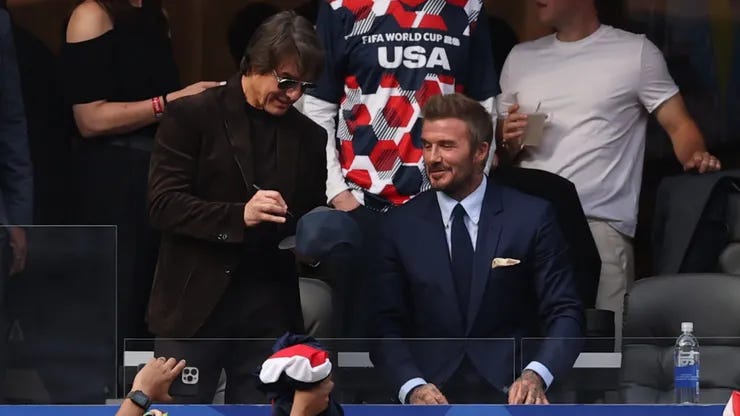
I’m not against star power; it’s standard for properties like the NBA. But football’s center of gravity has always been the people inside the game, and the figures who actually carry weight in it are its own legends.
The question is whether this celebrity-forward framing travels, or stays a distinctly American way of selling the show.
Half a week in, the pattern across these stories is consistent:
the cooling break becomes ad inventory,
the stadium name becomes a FIFA asset,
the World Cup mark gives way to the FIFA mark,
the schedule bends to heat and broadcast money,
and the mascots make way for celebrities.
FIFA keeps converting the tournament’s value into forms it controls — and the bill, whether it’s sleep or the rhythm of the game itself, lands somewhere else.
What do you think — let’s discuss below.
Carla | Off-Ball Logic
For context: Ad-free because it does not broadcast traditional commercial advertising.
https://www.nytimes.com/athletic/7353806/2026/06/12/world-cup-hydration-break-adverts/
Prior to the USMNT debut.
https://en.as.com/soccer/world-cup/mauricio-pochettino-usmnt-coach-on-the-world-cups-new-rules-the-soccer-we-know-is-going-to-stop-existing-f202606-n/
The World Cup brand question is really interesting. FIFA may be on track to break its revenue record, but that growth seems to be coming at a real cost to the World Cup brand itself.
The World Cup still occupies premium cultural space. However by, pushing everything back towards FIFA, they weaken the emotional value that makes the tournament so commercially powerful in the first place.
Interesting article, Carla. I like the Sleep Tax chart you presented. It baffles me why a brand name will be covered and "Stadium" uncovered.