

The Business of the World Cup, Part 4: The Empire Prices Itself
How FIFA turned the most emotionally powerful sporting event in history into a $13 billion enterprise — and what it's risking in the process
Hi everyone! I’m Carla, and this is Off-Ball Logic, the weekly newsletter where we step away from the 90 minutes on the pitch to dissect the business strategies, marketing mechanics, and economic engines that are really driving the modern sports world.
This is Part 4 of my series tracing the full commercial history of the FIFA World Cup — from its founding in 1930 to the $13 billion commercial cycle it is today.
Subscribe to get it in your inbox:

We are entering the final countdown — 14 days until the 2026 World Cup kick-off. And to start talking about what’s to come, keeping with the tradition of these editions, I’ll start with a personal anecdote.
There was the final between Argentina and France on the 18th of December 2022, on a hot evening in Buenos Aires. We were prepared with all kinds of cabalas — rituals — and appetizers, but we were not prepared for the third goal that tied the match in extra time. That was the last straw for me, and I decided to leave my house with the premise of “I just cannot stand the penalties.”1
So there I was, wandering around my neighbourhood — which you may imagine was completely empty, except for the remaining fellow Argentinians who had the same issue: whether it was being unable to watch the extra time, the penalties, or the match at all2.
So I started walking and that’s where I heard a scream being repeated simultaneously all around: “Vamos Dibu” (Go Dibu). At that point I didn’t understand what was happening, but with enough footage and coverage since, we can all agree that was the moment of Dibu Martínez covering Kolo Muani’s last attempt.
At one point I found a bar with at least 30 people watching the match, and this was my best chance to read the mood. The landscape was as follows: people crying, a man lying down on the asphalt covering his eyes (don’t worry, he was fine — if fine meant alive), families hugging. And so it went: I started walking the 100 metres back and forth, from and to the bar, until the last one.
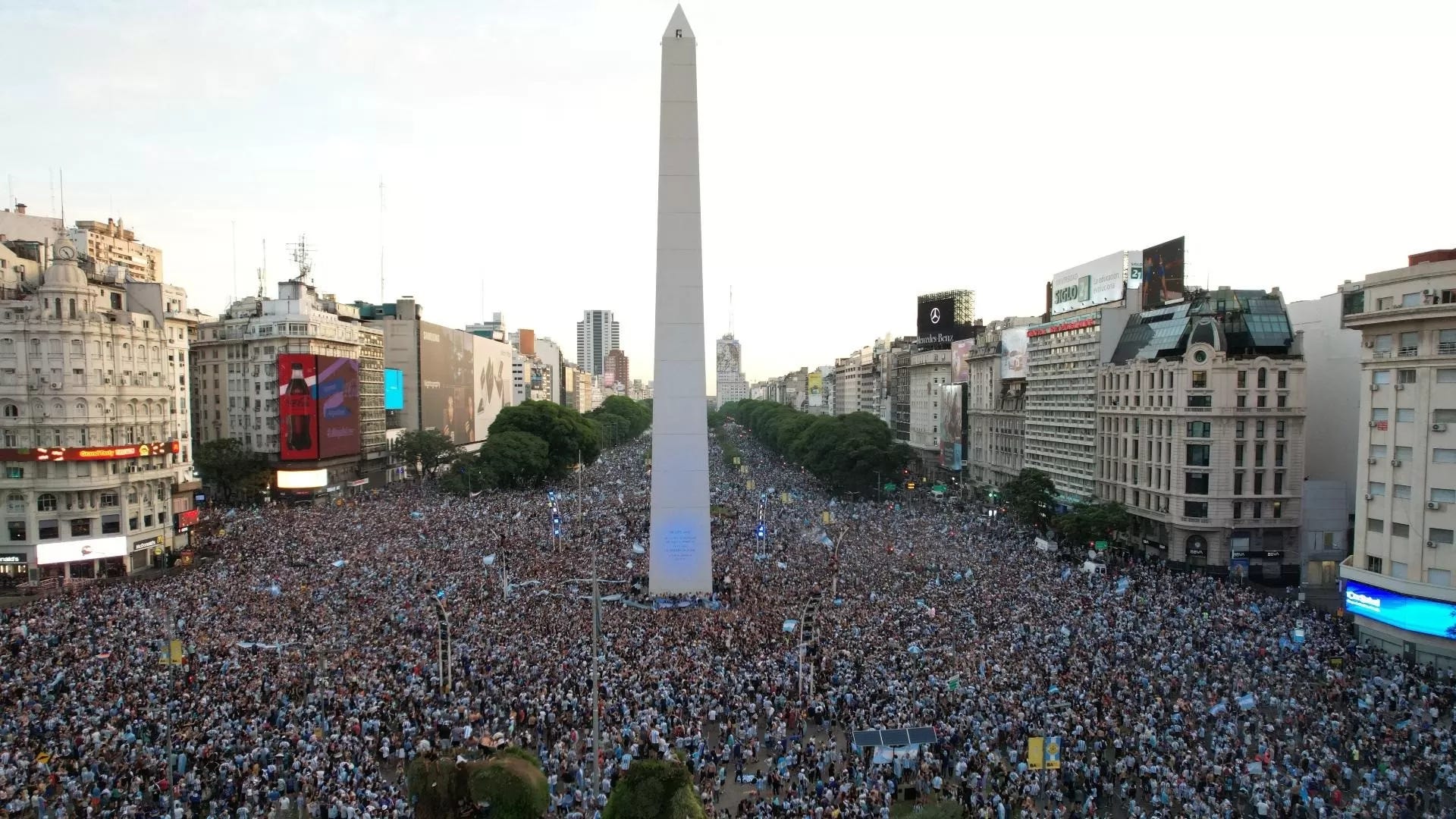
And so that one entered the net, and there I was, 100 metres from my home, running like crazy to see my family as quickly as possible, and in the meantime I hugged a woman I had never seen and have never seen since. I saw old and young crying in a way I had never seen in my life. It was probably what I felt too: a cry of release, of meeting the dream of our lives — of all of our lives.
I know there were people from around the world who wanted this to happen because of one Lionel Messi, and that’s something amazing that happens in this beautiful game. But for me and for the people surrounding me, it was for us — for those who wanted to dream and still did.
And now here we are, three and a half years later. I wanted to bring this up (besides keeping the tradition) because that feeling, that memory, is what the World Cup has always meant to me. But the question for me, for you, and for everyone is: what now?
The only thing I’m certain about, two weeks before kick-off, is that I was watching the last match of an era that was already ending. The 2026 World Cup is the first one this series is writing about in real time, and the commercial decisions that define it are happening simultaneously with the tournament about to begin.
This is Part 4 of a 5-part series on the commercial history of the FIFA World Cup. I want to understand how a sporting event became the most commercially powerful property in the world — and to do that, we need to go back to where we left off last week.
If you missed Part 3, find it here:


Revenuemaxxing™ and the Revenue Curve
FIFA reports revenue in four-year cycles anchored on the World Cup year, capturing roughly 80–85% of cycle revenue. The arc:
2014 Brazil: ~$1.4bn in marketing rights, record-breaking at the time, marked by social protests
2018 Russia: $1.45bn, dipped following the FIFAGate 2015 indictments
2022 Qatar: ~$1.8bn, commercial recovery, record retail and hospitality
2023–2026: $13bn, revised twice upward from an initial $11bn projection, as of March 2025
Going from $1.8bn to $13bn in a single cycle is not growth in the normal sense. It’s a structural change in what FIFA is now.
The name for that change is revenuemaxxing3: FIFA operating as a vertically integrated business unit optimizing revenue across every touchpoint of its commercial universe — closer a Saas like Apple than to a governing body, whose product is the experience itself, built to capture value at every layer, whose ideal customer has shifted from the general consumer to the premium one.
The composition of the $13bn shows how. Broadcasting at $3.92bn and marketing at $2.69bn track the established pattern, broadcasting grew roughly 30% from Qatar’s $3bn, marketing roughly 50% from Qatar’s 1.8bn.
But hospitality and ticketing at $3.097bn is new: for the first time in World Cup history, equal to broadcasting as a revenue source. FIFA unlocked that number by insourcing hospitality (previously outsourced under a rights-fee model) and by building the tournament around NFL stadiums with luxury suite inventory that Qatar’s purpose-built venues couldn’t match.
The consequence is a shift in who FIFA is selling to. The ideal customer for 2026 is the corporate hospitality buyer, the premium package client, the brand executive treating a match as a strategic activation. The fan who built the tournament’s emotional foundation is still there — but the commercial architecture is built around someone else now.
The Co-Branding Architecture
The 2026 World Cup has three hosts, 16 host cities, and a commercial architecture unlike anything FIFA has attempted before; one in which the host’s political brand, commercial identity, and national narrative are woven directly into the tournament’s own positioning. This is what I’m calling co-branding: not just hosting, but co-authoring the commercial universe around the event.
The US market is the engine. Bank of America entered as the first-ever global sponsor in the banking category, with a reported $100 million investment — described as the largest in its sports marketing history.
Verizon joined as Official Telecommunication Services Sponsor, centered on stadium connectivity. Neither of these brands came in as football sponsors. They came in because the 2026 World Cup is the closest thing to Super Bowl-level commercial saturation available in the North American market, and that saturation was the product they were buying.
The host city supporters program extends the architecture downward. Each local organizing committee can sign up to ten companies at approximately $5 million per package, carrying city-specific marks rather than official FIFA logos. Houston is targeting up to $90 million from local backers alone. Cities have become commercial participants in the tournament rather than venues for it, co-branding partners at the municipal level.
The practical result is that the liturgy of the 2026 World Cup (the rituals, the aesthetics, the emotional architecture) is being co-authored (and charged) by FIFA, its global partners, and the governments and city administrations of three countries simultaneously. Who owns that story when the tournament ends is genuinely unclear.
From Democratizing to Productizing
FIFA has consistently framed every expansion as a mission statement about inclusion. The 1998 expansion from 24 to 32 teams was real in its consequences: Senegal’s quarterfinal run in 2002 and Ghana’s last eight in 2010 happened because the format created space for them. The democratization narrative earned its credibility.
The 48-team format tells a different story. 104 matches instead of 64, more inventory, more access points for broadcasters and commercial partners — the format decision is as much about revenue architecture as about football. And the decisions surrounding it follow the same logic: hospitality insourcing, tiered sponsorship with category exclusivity, a host city supporters program that turns municipalities into commercial entities. Every level of access is priced and packaged, from global partner down to local supporter.
Furthermore, 5.5 million tickets are projected for 2026, more than any previous edition. But what’s under pressure is the sense that it belongs to everyone, which has always been the source of its emotional power. When the premium hospitality tier generates as much revenue as the broadcast, and when the ICP has shifted from the football fan to the corporate buyer, the answer to “who is this for?” starts to look different.
The Marketing Stack of Era 4
Era 4 is also the era in which the World Cup became genuinely global as a business, not just as a competition. The expansion to 48 teams in 2026 opens qualification paths across confederations that have historically been underrepresented, but unlike the 1998 expansion, the commercial rationale here is explicit from the start. The marketing stack built on top of it reflects that logic at every layer.
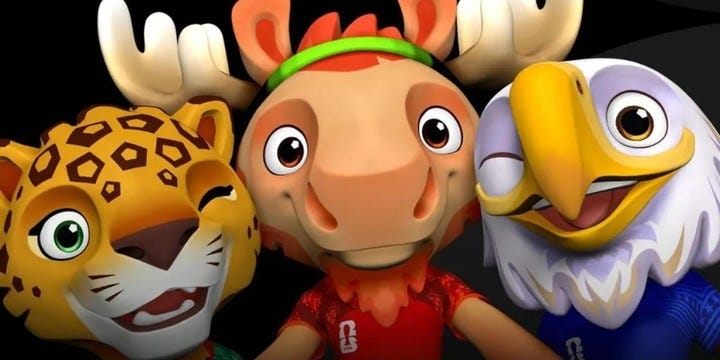
🏆 Mascots became a three-way co-branding statement For the first time in World Cup history, the 2026 edition has three official mascots, one per host nation: Clutch (a bald eagle for the US), Zayu (a jaguar for Mexico), and Maple (a moose for Canada). Unveiled in September 2025, the trio mirrors the tournament’s co-hosting architecture in a way no previous mascot program has. All three were designed with digital and social deployment as the primary channel—characters built backwards from platforms rather than as plush toys. The question this raises is whether a mascot trio optimized for social media can generate the individual intergenerational attachment that made single mascots like Footix commercially durable across decades.
🏆 Logos became motion assets The 2026 World Cup logo is the first in the tournament’s history designed to animate by default. Built for digital deployment from the ground up, the physical version is treated as a secondary application. The logo has moved from a cultural artifact, to a brand asset, to a motion asset distributed natively across every platform.
🏆 Anthems fragmented beyond recovery No World Cup anthem since Shakira’s “Waka Waka” in 2010 has achieved standalone cultural footprint — surviving the tournament that produced it as a recognizable artifact in its own right. The multi-track, multi-artist strategy of 2018 and 2022 optimized for territorial market reach at the direct expense of the cultural concentration that makes a single song become the sound of a summer. The anthem economy of the World Cup, which peaked with Ricky Martin in 1998 and produced its last genuinely universal moment in 2010, has become a licensing portfolio.
🏆 Jerseys became a fashion category Argentina’s three-star post-Qatar 2022 shirt was reportedly the best-selling national kit of 2023 globally, purchased as a cultural object regardless of the buyer’s actual team affiliation. This era also elevated the pre-match jersey from a functional warm-up top to a standalone fashion asset. Because they exist outside the rigid design rules of official on-pitch kits, brands have turned pre-match wear into a playground for bolder, lifestyle-driven aesthetics that appeal directly to the streetwear market. It is the natural conclusion of a process that began when Brazil’s yellow first popped on color television: the garment’s commercial value is no longer strictly tied to what happens on the pitch.
🏆 Broadcast fragmented into a portfolio model No single distribution channel reaches the full 2026 audience. In the US, Fox Sports carries English-language rights, Telemundo/Peacock carries the full slate in Spanish, and Tubi (free-to-air) airs select key matches. In Brazil, CazéTV carries all 104 matches on YouTube with no traditional broadcast partner. The model is now a portfolio of distribution channels, each optimized for a different audience segment.
🏆 Digital infrastructure became the primary commercial universe The parallel digital ecosystem that began with EA Sports’ FIFA International Soccer launching in December 1993 (before the 1994 World Cup had even started) has matured into the dominant commercial layer of the tournament. The Panini digital sticker album for Qatar 2022 reached 27 million users. FIFA+ launched as an OTT streaming platform. EA’s franchise generates billions annually regardless of whether the World Cup is happening. Every touchpoint now has a commercial layer, and every commercial layer connects to every other: the tournament has become a content universe with football at its center, and that universe is large enough that football is no longer required to activate it.
The Fragile Economics Layer
The $13bn commercial cycle creates a concentration of risk no previous edition has faced. The $900 million cancellation insurance FIFA held for Qatar 2022, significant at the time, would cover less than 7% of the 2026 projection. Insourcing hospitality means FIFA is carrying operational risk it previously transferred to rights-holders. Prize money confirmed at $871m, over double the $440m distributed in Qatar, means national federations are more financially dependent on the tournament’s full delivery than at any prior edition.
The co-branding architecture adds a different kind of exposure. Qatar 2022 was politically complex, but Qatar had total sovereign control over its environment.
The 2026 tripartite structure involves federal appropriations, Congressional disputes, and municipal administrations operating under significant political pressure, none of which FIFA controls.
The $625 million in federal security funding for US host cities is the clearest illustration of this exposure. Congress passed the funding under the One Big Beautiful Bill Act in July 2025, but the Department of Homeland Security and FEMA stalled the release for months. Hindered by three separate federal funding lapses, the agencies missed their own internal January 30, 2026 deadline, leaving host cities in operational limbo just months before the tournament. Lawmakers and local organizers sounded the alarm, warning that the delay threatened years of careful preparation and left municipalities waiting on critical cash flow for police and emergency response. The money was eventually released on March 18, 2026—less than twelve weeks before kick-off.
The tournament’s commercial architecture assumed a reliable federal co-organizer. What it got was a co-organizer that delivered, but on a timeline that exposed exactly how dependent that architecture is on political and legislative factors FIFA doesn’t control.
The current US political context creates specific risks for a tournament whose commercial thesis depends on the free movement of fans, athletes, and commercial partners across North American borders.
A World Cup whose ICP has shifted to the premium international buyer is particularly exposed to any friction in cross-border access. The commercial projection and the political reality are in tension, and how that resolves will determine whether $13bn holds.
What This Era Is Building
This is the part of the series where I’d normally summarize what the era built. But the era isn’t over — the 2026 World Cup hasn’t been played. The final at MetLife Stadium is scheduled for July 19, and none of the numbers we’ve been discussing are settled yet.
What we can say is that Era 4 has made the World Cup into something the previous three eras were building toward without fully naming: a vertically integrated commercial enterprise that captures value at every layer of the experience, tied to the political and institutional context of its hosts in ways that create both opportunity and exposure, optimized for a customer who is increasingly not the fan who built the tournament’s emotional foundation.
The question is whether that foundation can carry the weight of what’s been built on top of it. The 2022 Qatar final (and everything that night in Buenos Aires meant) suggests it still can. But the gap between the commercial logic and the emotional logic that made this worth anything has never been wider, and 2026 will tell us more about where that gap is going than any previous edition.
In Part 5 (and last of this series) we’ll look into the future of the World Cup as a commercial property, and what comes after the empire.
What do you think? Let’s discuss below.
Thank you for being part of this journey!
Carla | Off-Ball Logic
That’s an issue I have. In the quarterfinals against the Netherlands I had to go into a room and put headphones on to avoid listening until the final whistle.
If you want a good perspective on what I’m describing from an outside view, I highly recommend Copa 90.
This is a term coined by your humble servant.
Politics aside, this World Cup is a tipping point - can product quality and value be retained when volume increases? Premium hospitality revenue can’t be sustained in future if the show is poor. Also, I’m confused by your numbers, going from 1.8bn marketing rights revenue to a projection of 13bn seems a little odd - figures I’ve seen put Qatar at 7.5bn. Not to be pedantic as it’s another enjoyable read.
It will be interesting to see if this growth in monetisation is sustainable through the 2030 event, as Spain, Portugal and Morocco (not forgetting Uruguay too) are no where near similar in capitalist commercialisation terms as, in particular, the US is.