

The Business of the World Cup, Part 2: Heroes, Villains, and Sponsorship Deals
How color television, the cult of personality, and one German executive built the commercial architecture that still powers the World Cup today

Hi everyone! I’m Carla, and this is Off-Ball Logic, the weekly newsletter where we step away from the 90 minutes on the pitch to dissect the business strategies, marketing mechanics, and economic engines that are really driving the modern sports world.
This is Part 2 of my series tracing the full commercial history of the FIFA World Cup — from its founding in 1930 to the $13 billion commercial cycle it is today.
Subscribe to get it in your inbox:

In the last post, I started talking about a photo of me at five years old wearing USA 94 gear and how that merch cemented a lifelong obsession with the World Cup’s commercial universe. The photo is where my memory starts — but the story had been running for years before. In Argentina in the 90s, certain World Cups already lived in the air around you. The ones that really lived in the air were 1978 and, mostly, 1986.
The last one was not the least relevant — if anything, the most. Yes, Argentina won the World Cup in 1986, but what cemented the mythology, and what I’m going to trace through this post, wasn’t just the final. It was a quarter-final against England, and two moments that people have never stopped arguing about: The Hand of God came first, and always has. Then the Goal of the Century.
The first could divide a room. The second never did.
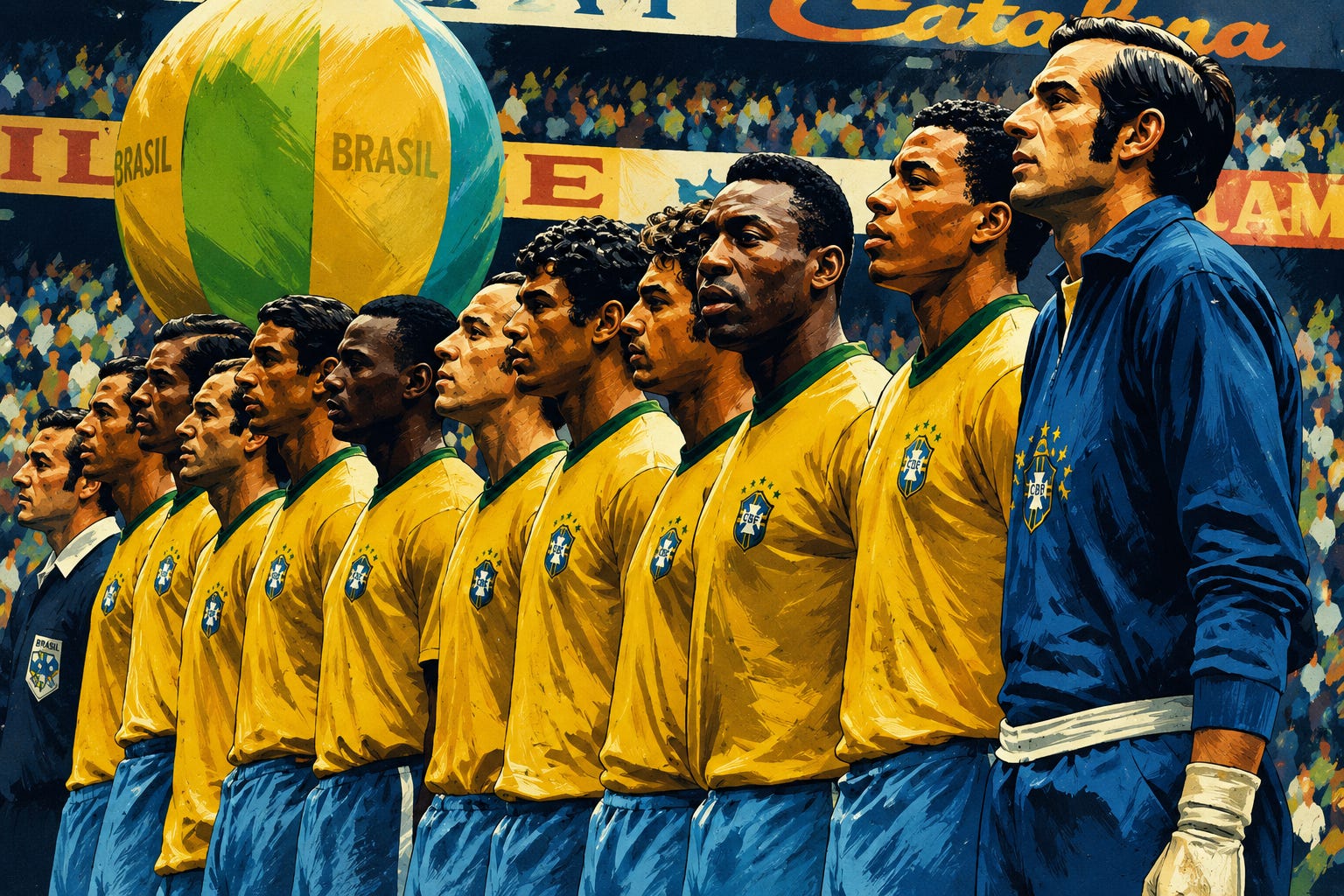
By Mexico 86 and Italia 90, this era had already crested. What I grew up watching wasn’t new — it was the result of thirty years of foundational work.
This is Part 2 of a 5-part series on the commercial history of the FIFA World Cup. I want to understand how a sporting event became the most commercially powerful property in the world — and to do that, we need to go back to where we left off last week.
If you missed Part 1, find it here:

Television Changes Everything
Before television, the World Cup reached you through someone else’s words. England 1966 was the first World Cup to be commercially broadcast on television in the host country (ITV) — the numbers were still limited, sets were a relative novelty in many markets, but the model was set.
But Mexico 1970 changed the parameters entirely: the first transmitted in color via satellite, globally. In the black-and-white era, kit design had a specific functional constraint — teams needed to differentiate by contrast. Color was irrelevant because color couldn’t be transmitted.
The moment color arrived, that logic shifted. Brazil’s canary yellow, already a national symbol since 1958, became a visual event. The Netherlands’ orange. Kit identity, in the commercial sense, starts here.
But the most underrated consequence of television was what it did to spectatorship.
Watching the World Cup became a collective domestic ritual.
Families gathered around the television, neighbors crowded into the same room, and bars filled up. The World Cup stopped being something you followed and became something you experienced together.
One more structural change arrived in 1974: The Jules Rimet Trophy — which Brazil had won permanently after their third title — was replaced by the current version. It was no longer named after its founder. It became simply the FIFA World Cup Trophy — an institutional symbol rather than a personal tribute. And the new World Cup immediately made it an image of a new era, directly linked to the figures we’ll talk about next.
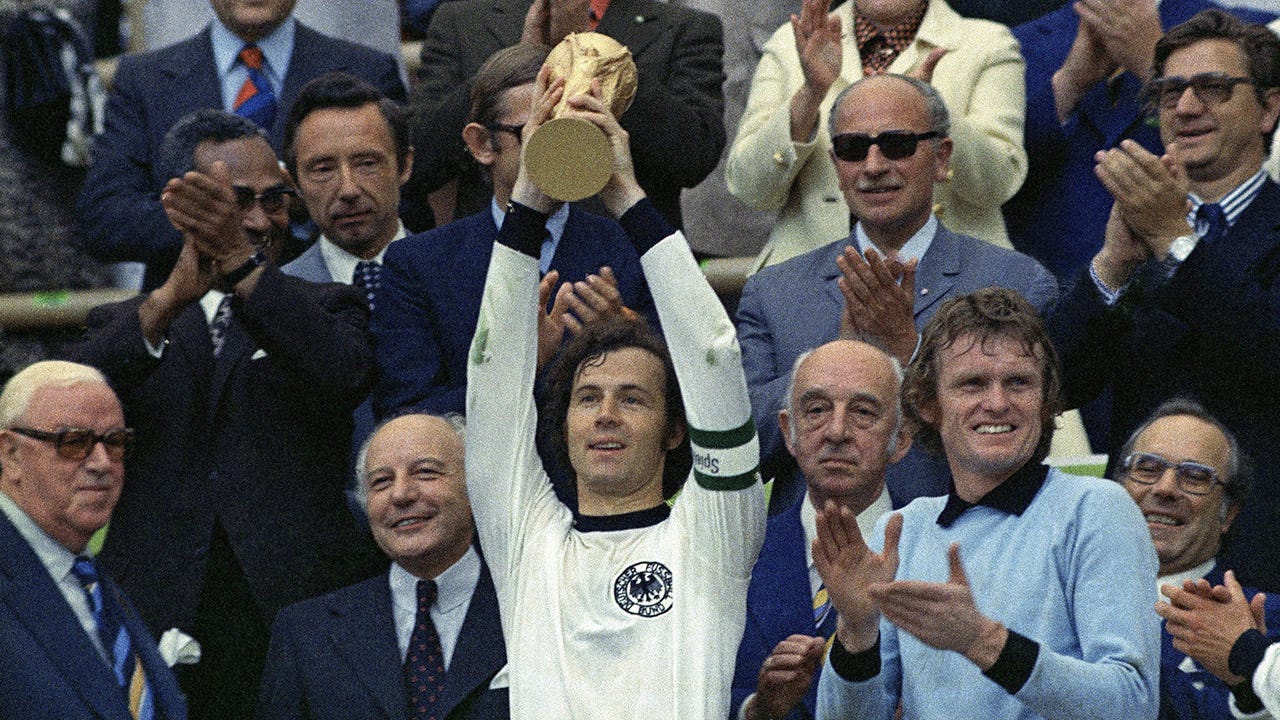
Combined with the return to a stable quadrennial cycle after World War II, the tournament was now a predictable, recurring event on the global calendar. No more interruptions or ad-hoc organizing. A reliable institution — which was a precondition for a reliable commercial one.
Speaking of which: television is usually celebrated as the force that democratized the World Cup, that gave it to the world. That reading is true, and it misses something more important. Television didn’t give the World Cup to the world. It gave the World Cup to FIFA. Before broadcast rights existed, commercial value accrued locally — to the organizing committee, the host economy, the stadium. The moment a broadcaster paid to transmit it globally, that value transferred upward. FIFA held the rights.
The Birth of the Cult of Personality
To understand where football’s commercial ecosystem started, you need to understand the tension that created it. Era 1 gave us collective heroes: he Garra Charrúa, the Mighty Magyars, the Wunderteam. No single figure was bigger than the team, and no team was bigger than the tournament.
Era 2 dismantled that entirely. What Pelé, Beckenbauer, and Maradona built wasn’t just personal commercial reach — it was a cult of personality model: one figure per nation, around whom the entire emotional narrative organized itself.
But this goes beyond marketing: A cult of personality has psychological and political dimensions that a brand deal doesn’t capture.
Pelé was the template. By 1970 he was already the first global single-athlete brand whose commercial value transcended his sport, with deals with Pepsi and Puma, his image circulating globally with commercial intent in a way no non-North American athlete had achieved before. But Pelé’s power wasn’t only commercial: in Mexico 1970, he was the protagonist of the most aesthetically complete football the World Cup had ever seen. Brazil’s yellow, Pelé’s number 10, the Jogo Bonito — the first World Cup brand that didn’t know it was a brand.
Beckenbauer gave the model a European register — the libero, the captain, the embodiment of German tactical and organizational authority; proof that the template could travel.
But Diego Maradona took it somewhere else entirely: into moral complexity. The 1986 World Cup is where the cult of personality model produced its most sophisticated and enduring narrative, because Maradona gave the tournament something it hadn’t had before: a figure who was simultaneously hero and villain, depending entirely on which side of the globe you were standing on.
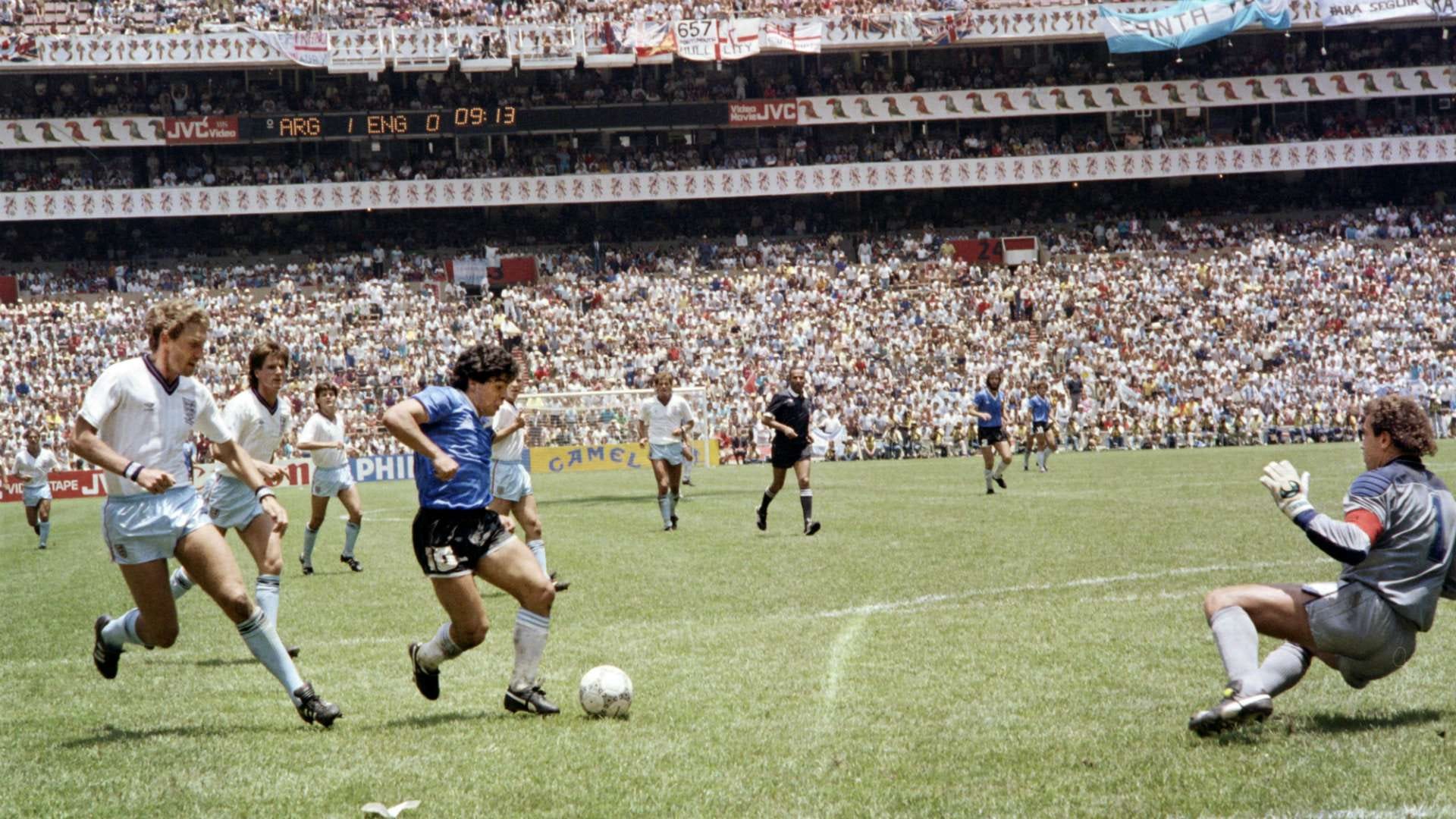
For Argentina, he was a god. For England, he was the man who cheated and got away with it. Both readings were legitimate, and were fueled by the same two moments: the Hand of God1 and the Goal of the Century, in that order, three minutes apart in the same match.
The political context underneath those minutes was fundamental: the match carried the weight of the war — without a word of official acknowledgment from FIFA, without any institutional narrative, just two teams on a pitch and a global television audience that understood exactly what it was watching.
The cult of personality model would define the World Cup’s storytelling through the entire era. Every tournament had its protagonist — Paolo Rossi in 1982, Schillaci in 1990. The commercial logic followed: sponsors aligned with individuals, endorsement structures built around faces, the athlete as a mobile billboard in an era when television made those faces globally recognizable.
The Marketing Stack of Era 2, 1966–1994
If Era 1's marketing stack was posters, radio, and print — locally controlled, fragmented, host-defined — Era 2's stack is television, mascots-as-IP, logo standardization, and the first formal merchandising infrastructure.
🏆 Television was the infrastructure everything else was built on And made everything in this era possible. The most immediate effect: a ball — the Adidas Telstar in 1970 — could now be marketed globally off the back of a broadcast. Panini partnered with FIFA that same year to launch the first World Cup sticker album, sparking a collecting obsession that has never really stopped.
The functional job to be done — shirts, balls, stickers, mascots — became a real commercial layer for the first time, because television gave those objects global visibility.
🏆 Mascots became cultural and political objects Every host nation’s mascot is a controlled image of how that country wants to be seen by a global television audience. The first was World Cup Willie — a lion wearing a Union Jack kit, introduced in England 1966. Straightforward national symbolism, but the template was set. Argentina 1978’s Gauchito (a traditional gaucho child, romantic and folkloric) projected national heritage and pastoral identity to a watching world. Spain 1982’s Naranjito (a smiling orange) projected warmth and European identity at a moment of Spanish democratic transition after Franco. Italy 1990’s Ciao (a faceless tricolore stick figure in a deliberate design-school modernist aesthetic) was a signal of cultural sophistication, a country presenting itself through its design tradition rather than through a cuddly character. Mixed reception at launch, design canon reference now.
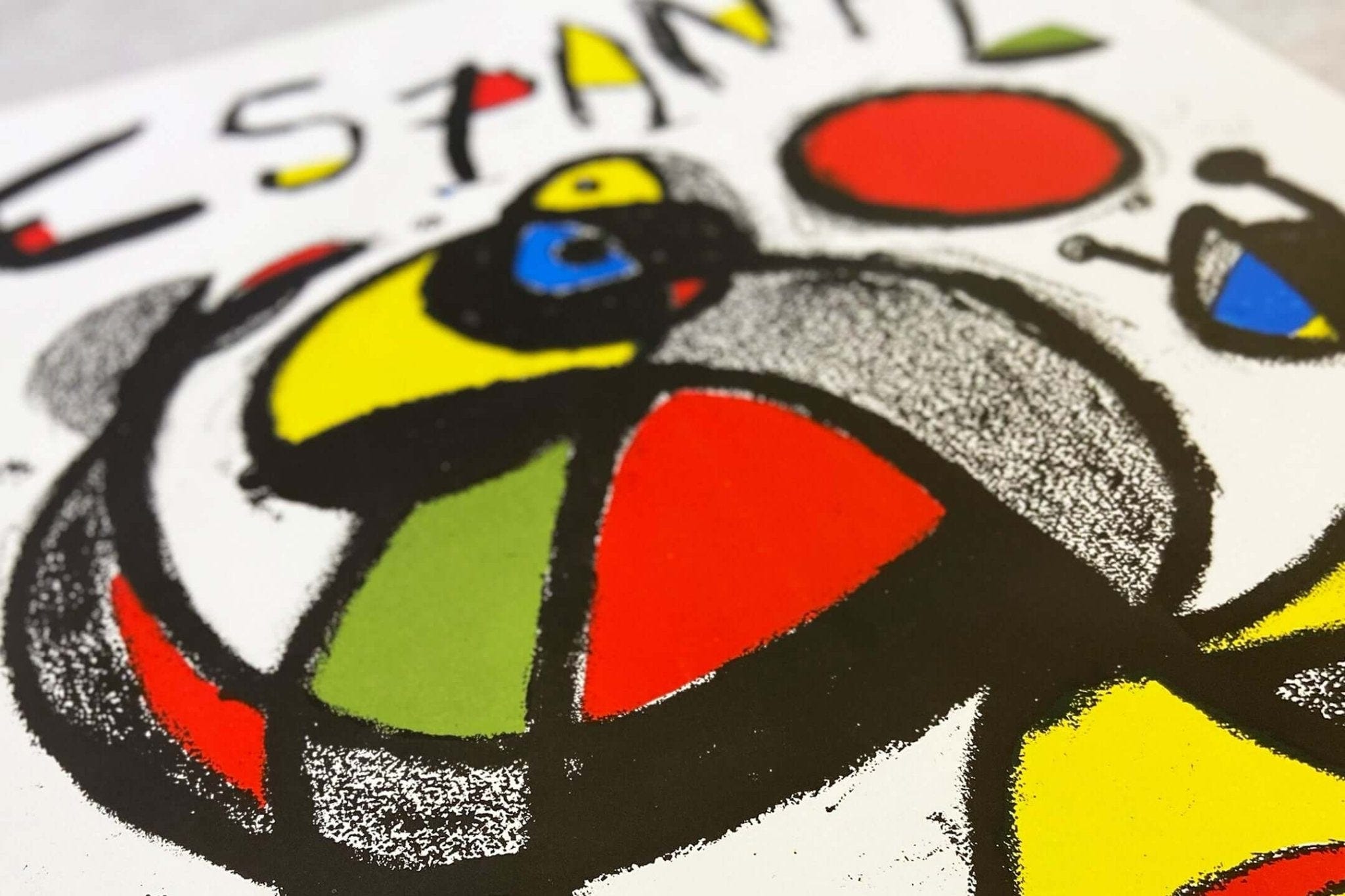
🏆 Visual identity was perfected in this era Before 1970, host countries designed their own everything, locally and independently. The 1970 Mexico logo marked a shift: FIFA’s first stripped-down design, an abstract football graphic that established the visual grammar for everything that followed. From there, it became a joint project between FIFA designers and host-country agencies. The 1974 Germany logo went further into abstraction — single color, virtually no cultural reference beyond “WM” (Weltmeisterschaft). From Argentina 1978 onward, host nation flag colors became a consistent design element, running through España 82, Mexico 86, Italia 90, and France 98. The poster tradition ran alongside it — in 1982, Joan Miró designed the Spain poster. The World Cup had become a cultural commission significant enough to attract figures from entirely outside sport.
🏆 Kit branding went from forbidden to foundational Manufacturers were prohibited from displaying logos on national team kits until 1974. The first prominent display came in 1978 — Adidas trefoil on Argentina’s shirts, visible in color on global television for the first time. The commercial logic was immediate: hundreds of millions of people watching a kit with your logo on it, for 90 minutes, across a month-long tournament. The kit deal became one of the most valuable assets in sports sponsorship from that moment forward.
The Infrastructure Gets Built
The commercial infrastructure of the modern World Cup was assembled through a combination of personal ambition, corporate strategy, and a specific alignment between FIFA’s need for revenue and one man’s vision of what sports marketing could become: Horst Dassler.
The son of Adidas founder Adi Dassler, Horst was the architect of the modern sports marketing industry in a way that is genuinely difficult to overstate. In 1978, in partnership with marketing agent Patrick Nally, he orchestrated the first formal tripartite arrangement between Coca-Cola, Adidas, and FIFA — the founding structure of what would become the global sponsorship program. The logic was simple and revolutionary: instead of ad-hoc local deals negotiated tournament by tournament, a small number of global brands would buy category-exclusive access to the World Cup across multiple editions, that guaranteed global visibility and category protection.
Post-1982, Dassler partnered with Japanese advertising giant Dentsu to create International Sport and Leisure (ISL), which aggregated, sold, and serviced FIFA’s commercial rights from 1982 until its bankruptcy in May 2001. For nearly two decades, it was the operating system of global sports commercialization2.
The brands that entered in this period — Coca-Cola formalizing its FIFA partnership in 1978, Adidas as co-architect of the entire system, Budweiser arriving in 1986, McDonald’s in 1994 — are still FIFA Tier 1 partners today. The commercial relationships forged in this era have proved more durable than almost anything else in sports business.
Politics, Soft Power, and the Precedents Set
The World Cup has never been politically neutral, as established in Part 1. Era 2 produced two precedents worth examining directly, because both have echoes that run all the way to the present.
Argentina 1978 established a precedent the tournament hasn’t stopped repeating: FIFA’s willingness to proceed with a host regardless of the political conditions surrounding it. The questions that surrounded that tournament — about the regime, about the circumstances of certain results — were never formally resolved, and FIFA’s institutional position was, as it would be again, to treat them as outside its remit.
The second precedent is commercially more specific: Mexico 1986 and the tobacco sponsor. FIFA overrode Mexico’s national tobacco advertising ban to accommodate RJ Reynolds/Camel as an official sponsor — a sovereign nation’s public health regulation set aside because it conflicted with a commercial commitment. This established a template that would resurface explicitly in Brazil 2014, when legislation was passed (the so-called “Budweiser Law”) allowing alcohol sales in stadiums despite Brazilian law prohibiting them.
The Heroes of this Era
Johan Cruyff’s 1974 remains one of the tournament’s great unresolved stories — the most complete footballer of his generation, leading arguably the most technically advanced team in World Cup history, and finishing second. Total Football’s peak expression produced no trophy, but it produced a legacy that outlasted every winner of that decade.
By 1990, the model was producing results of a different kind. Salvatore Schillaci, a Sicilian striker in only his first season at Juventus, became the World Cup’s top scorer and the emotional center of an Italia 90 that was, culturally, possibly the most complete World Cup ever staged. Pavarotti’s Nessun Dorma as the BBC’s theme. Un’estate Italiana by Bennato and Nannini. A cumulative television audience of 26.7 billion by FIFA’s count.
By 1990, the World Cup had become something that transcended sport — a moment of global shared culture, experienced simultaneously across the planet, with a single national hero at the center of each competing story.
What Era 2 Built
Era 1 built the emotional infrastructure. Era 2 built the commercial architecture on top of it.
A formal global sponsorship program with category-exclusive partners paying meaningful money.
A rights agency managing its entire commercial portfolio.
Kit manufacturers competing for national team deals, with an official ball carrying embedded sponsorship value.
A sticker album in its third decade by 1994 and mascots capable of anchoring animated television series.
Logos designed to function as brand assets across merchandise and broadcast.
The emotional layer was also deeper, not because the stories were better than the Maracanazo, but because television had made them shared in a way print and radio never could.
The overwhelming event that exists today — the $13 billion quadrennial institution that generates more simultaneous global attention than anything else in sport — was shaped in the era between England 1966 and USA 1994. The 90s, where many of us grew up hearing the stories of 1970 and 1986, were already living in the world that era had built.
What do you think? Let’s discuss below.
Thank you for being part of this journey!
Carla | Off-Ball Logic
Next in the series: Nike enters, the replica shirt economy explodes, and the World Cup becomes the most valuable commercial property in sport.
The fact that people called it “the Hand of God” speaks for itself about the religious dimension of how these figures were perceived at the time. I won’t even start on the cult of Maradona in both Argentina and Napoli — that deserves its own article.
This is also where the Olympics and the World Cup part ways commercially — the IOC overhauled its model in 1984 and moved ahead; FIFA, kept in place by Dassler’s arrangement, followed a decade later.
Looking back, television was one of the turning points. Before that, football largely lived through radio voices locals recognised instantly and grew attached. Television transformed the scale. Remember the black and white broadcasts? Not that I was born in those days, but our generation still grew up aware of that era. Arguably simpler times.