

The Business of the World Cup, Part 3: When the Event Went Truly Global
How the World Cup stopped being just a tournament and became a commercial machine — and what that cost
Hi everyone! I’m Carla, and this is Off-Ball Logic, the weekly newsletter where we step away from the 90 minutes on the pitch to dissect the business strategies, marketing mechanics, and economic engines that are really driving the modern sports world.
This is Part 3 of my series tracing the full commercial history of the FIFA World Cup — from its founding in 1930 to the $13 billion commercial cycle it is today.
Subscribe to get it in your inbox:

There is a specific feeling that comes from watching something happen that shouldn’t be happening, where each goal arrives before you’ve finished absorbing the last one, and the scoreboard starts to feel like it’s lying.
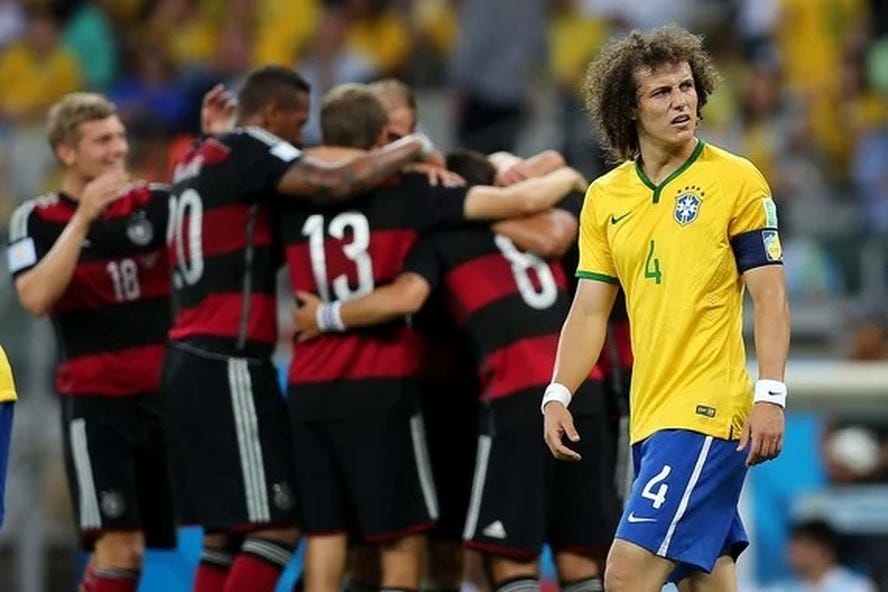
I was at home the afternoon Germany beat Brazil 7-1 in Belo Horizonte, books open on the desk and the television on in the background, and somewhere around the fourth goal I stopped processing what I was watching as football at all.
Brazil was falling apart in real time, in their own country, in a World Cup semifinal, and the pace of it — the way it kept going, kept accelerating — made it feel less like a match and more like watching something happen to people who didn’t yet know they were inside history. The players on the pitch didn’t know the final score, and neither did I. Every time I was sure it couldn’t get worse, it did.
I didn’t understand it then as anything more than a football match. But I was watching Era 3 at its most concentrated.
But this era, like the previous ones, didn't arrive suddenly.
To understand how the 7-1 became the symbol it did (of a tournament that now operated as much on the internet as on the pitch) you have to go back a few years and look at what was changing in the world the World Cup was trying to inhabit.
This is Part 3 of a 5-part series on the commercial history of the FIFA World Cup. I want to understand how a sporting event became the most commercially powerful property in the world — and to do that, we need to go back to where we left off last week.
If you missed Part 2, find it here:

The Two Decisions That Rewired Football
The Premier League was founded in February 1992 with a commercial thesis that sounds obvious in retrospect but was genuinely radical at the time: top-flight English football would be sold to broadcasters as a premium product at a premium price, and the money from that sale would fund a quality of football that justified an even larger sale next time round. BSkyB paid £304 million for five years of rights — nearly five times the value of the previous deal.
Almost simultaneously, UEFA rebranded the European Cup as the Champions League from the 1992-93 season — a name chosen to evoke something global rather than merely continental, to position the competition as a stage rather than a tournament, and building on the group format introduced the previous year. The group format meant more matches, more inventory, more access points for broadcasters and commercial partners.
European club football was no longer a domestic competition with an international audience. It was a media property — one that ran every year, with the world's best players, distributed globally with production values that hadn't existed in football a decade earlier.
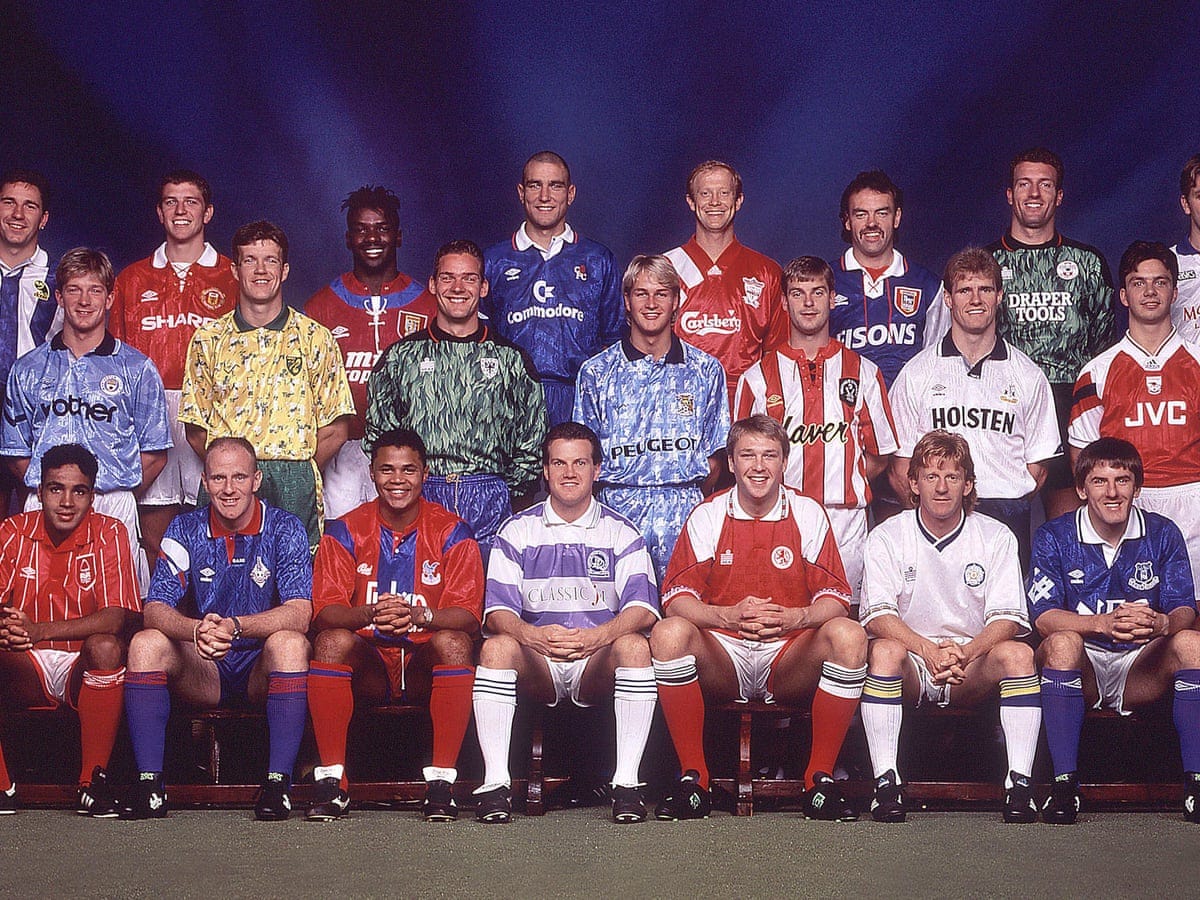
These two decisions rewired the commercial logic of the entire sport, and their significance for the World Cup is often overlooked. For the first time, the tournament had to reckon with a consistent, high-quality, annually available competitor for the global football audience's attention — and that competitor was club football itself.
The Champions League didn't threaten the World Cup's primacy; nothing could do that. But it changed the conditions under which the World Cup operated, and it created a commercial grammar that the World Cup would eventually have to learn to speak.
The War for Football's Story
The club game had demonstrated something Nike understood before most: football’s commercial value was partly about the sport and largely about narrative — the story of the competition, the personality of its participants, the emotional investment of its audience. In 1996, they acted on that reading. Nike signed Brazil at a moment when Nike's global football business was still finding its footing. The Brazil shirt was the most concentrated vehicle for that narrative in the sport — and they bought the vehicle.
What followed resolved in the most structurally interesting way possible: Nike won the narrative without always winning the contract. In South Africa, Adidas was the official World Cup partner but Nike dominated the conversation anyway. The lesson was structural — in the internet era, the story you tell can be worth more than the rights you hold.
Sixty Million Co-Authors
What keeps returning to me about that afternoon is how the story of the match was assembled, not through any channel FIFA owned or controlled, but by millions of people writing it simultaneously, in real time. Germany 7-1 Brazil generated 35.6 million tweets. And Era 3 made this possible for the first time.
Era 1 transmitted the World Cup through radio and print — the story was controlled by journalists and mediated by institutions. Era 2 added television, which expanded the audience enormously but kept the storytelling architecture essentially unchanged: a small number of broadcasters, a large number of passive viewers. But now, the social media layer that matured between roughly 2006 and 2014 transformed viewers into participants in the production of meaning — people who could amplify, interpret, satirize, and reshape the tournament’s narrative in real time, and whose collective output often proved more resonant than anything the official broadcast structure produced.
“It’s Coming Home” went viral in 2018 because England fans decided it was the thing — not because any broadcaster or sponsor activated it.
The organic cultural moment generates a quality of attention that no planned activation can replicate. The brands that understood this shifted accordingly: less produced content, more presence inside the conversation the audience was already having.
And what this changed wasn’t just how stories were told: it was which stories could travel. Rivalry no longer needed geopolitical backstory to reach a global audience. The internet made emotional stakes legible in minutes, without context or history behind them.
From National Exports to Global Personal Brands
Heroes from the previous era were national exports — Pelé represented Brazil to the world, Cruyff represented the Netherlands, Maradona represented Argentina. Enormous, globally visible figures, but the frame was always national. Their identity was inseparable from the shirt they wore.
Era 3 dissolved that frame. The proof of concept was Beckham — something I’ve traced in earlier posts, but worth naming here: what Real Madrid built wasn’t just a transfer, it was the first commercial architecture explicitly reverse-engineered around a single player’s cultural visibility. A footballer, for the first time, operated as a brand capable of crossing sectors and markets independently of his team’s results. What followed scaled that model by an order of magnitude.
Messi, Cristiano Ronaldo, Neymar — players whose global following existed independently of which national team they represented or how that team performed. Fans worldwide were no longer just fans of their country. They were fans of a personality, a style, a story. The rivalry between Messi and Ronaldo required no geopolitical frame to be globally legible — you didn’t need to know anything about Argentina or Portugal to understand what was at stake.
Players had become the primary force of storytelling in football, and the World Cup was where those stories finally got their verdict.
The Marketing Stack of Era 3: 1994–Present
Era 3 is also the era in which the World Cup became genuinely global as a competition, not just as a broadcast. The expansion to 32 teams in 1998 opened the door to confederations that had been structurally underrepresented, and the results followed. Senegal and South Korea reached the quarterfinals in 2002. Ghana reached the last eight in 2010. For the first time, all five continental confederations had meaningful stakes in the outcome of a tournament, not just a presence in it. The commercial architecture of Era 3 was built on top of that expansion — and shaped by it.
🏆 Mascots became an entertainment industry commission The 1994 edition introduced Striker, a dog designed by Warner Bros. — the first Hollywood studio commission in World Cup history, and the beginning of outsourcing mascot creation to entertainment rather than design. France 1998’s Footix generated an unexpected linguistic legacy: “footix” became French slang for “bandwagon football fan.” Germany 2006’s Goleo VI, created by Jim Henson Creature Shop, produced the most expensive mascot-related commercial failure in World Cup history when toy company NICI went into bankruptcy protection after the mascot failed to generate expected merchandise demand. Qatar 2022’s La’eeb was designed primarily for animated social-first deployment — for the first time, a World Cup mascot built backwards from the platform rather than the plush toy.
🏆 Logos evolved from static to digital-native Era 3’s logo evolution follows a single arc: from descriptive to kinetic to digital-native. From 2002 onward, the World Cup Trophy shape became a consistent element in logo design, made formally compulsory by FIFA regulation in 2014. Brazil 2014’s logo was the first designed with kinetics in mind, treating the mark as a motion element rather than a static emblem. The 2026 edition will be the first logo designed to animate by default, built for digital deployment from the ground up.
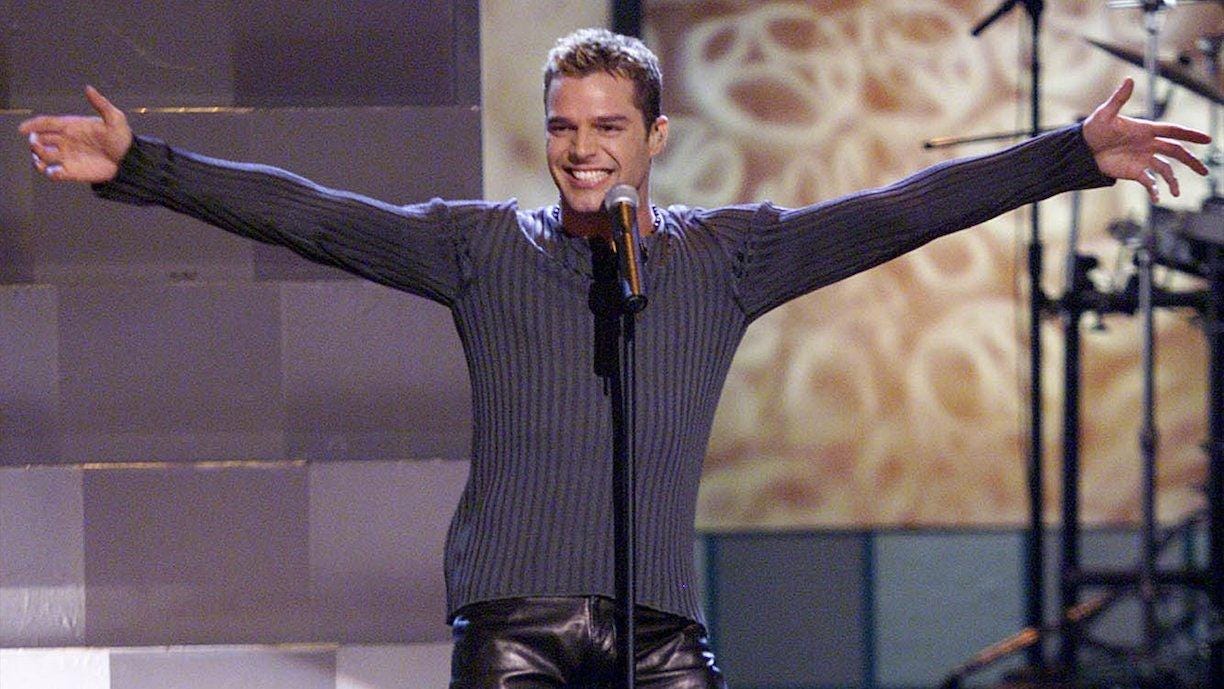
🏆 Anthems peaked and then fragmented The anthem economy of Era 3 has the shape of an inverted parabola. Ricky Martin’s “The Cup of Life” in 1998 was the first genuinely global World Cup anthem1. The 2010 edition produced two standalone cultural artifacts from a single tournament: Shakira’s “Waka Waka” alongside K’naan’s “Wavin’ Flag” for Coca-Cola. Since then, the multi-track, multi-artist strategy has diluted the cultural impact that comes from a single song becoming the sound of a summer — optimizing for market reach at the expense of the resonance that makes an anthem survive the tournament that produced it.
🏆 Jerseys stopped being about the team Argentina’s three-star post-Qatar 2022 shirt became the best-selling national kit of 2023 globally, including in markets with no connection to Argentine football — purchased as a cultural object, an aesthetic signal, an affiliation with a global narrative. The jersey now circulates on its own commercial logic, one that is not primarily about football fandom. Blokecore (the wearing of football shirts as casual streetwear, entirely divorced from match attendance or team loyalty) is the endpoint of this process, the moment when the sport itself becomes optional.
🏆 Digital infrastructure created a parallel commercial universe EA Sports’ FIFA International Soccer launched in December 1993 — before the 1994 World Cup had even begun — creating a parallel commercial ecosystem for a tournament that hadn’t yet started. The Coca-Cola and Panini digital sticker album for Qatar 2022 reached twenty-seven million users. FIFA+ launched as an OTT streaming platform during the same cycle.
Every touchpoint now has a commercial layer, and every commercial layer connects to every other: the tournament has become a content universe with football at its center.
The Sponsor Architecture Mutates
The ISL collapse of May 2001 is the event Era 3’s commercial structure is most directly a response to. ISL had held FIFA’s marketing rights since 1982, when Horst Dassler engineered the deal that gave his company control of the World Cup’s commercial infrastructure. When it went bankrupt, FIFA brought its marketing rights in-house through FIFA Marketing AG and began building the tiered sponsorship architecture that defines the tournament today.
The structure that emerged — Partners, World Cup Sponsors, Regional Supporters — codified something the Premier League and Champions League had already demonstrated: that exclusivity, properly managed, creates scarcity value. The 2002 Korea/Japan edition ran with fifteen partners, which the trade press described as saturation point, and it was. The structure was refined from there.
The more interesting story is who those brands were. The 2015 FIFAGate indictments triggered public pressure from major sponsors, and the 2018 Russia cycle struggled to fill all sponsorship slots as a result. What filled the gap was structurally significant: Chinese brands. Wanda, Hisense, Vivo, and Mengniu entered as Western commercial credibility was temporarily disrupted. Hyundai and Kia, who signed at Korea/Japan 2002 and have never left, represent the cleaner version of this thesis: when the competition goes genuinely global, the commercial case for brands from newly competitive regions becomes self-sustaining.
The Soft Power Turn and the Broken Spell
The World Cup’s emotional job — the thing it has always done better than any other sporting event — is create the conditions for collective belonging. For ninety minutes, and for the weeks surrounding those ninety minutes, the tournament makes national identity feel uncomplicated. No commercial infrastructure can manufacture this. It has to be felt.
Era 3 made that feeling harder to sustain. Brazil 2014 is the inflection point: the “FIFA-quality hospitals” slogan (coined by protesters) captured a political argument that no World Cup host had made so publicly before. Brazil 2014 was not the first expensive World Cup, nor the first held under a compromised political context. But it was the first where the cost was legible to the public as a political choice, and the internet ensured that argument reached a global audience simultaneously with the tournament itself.
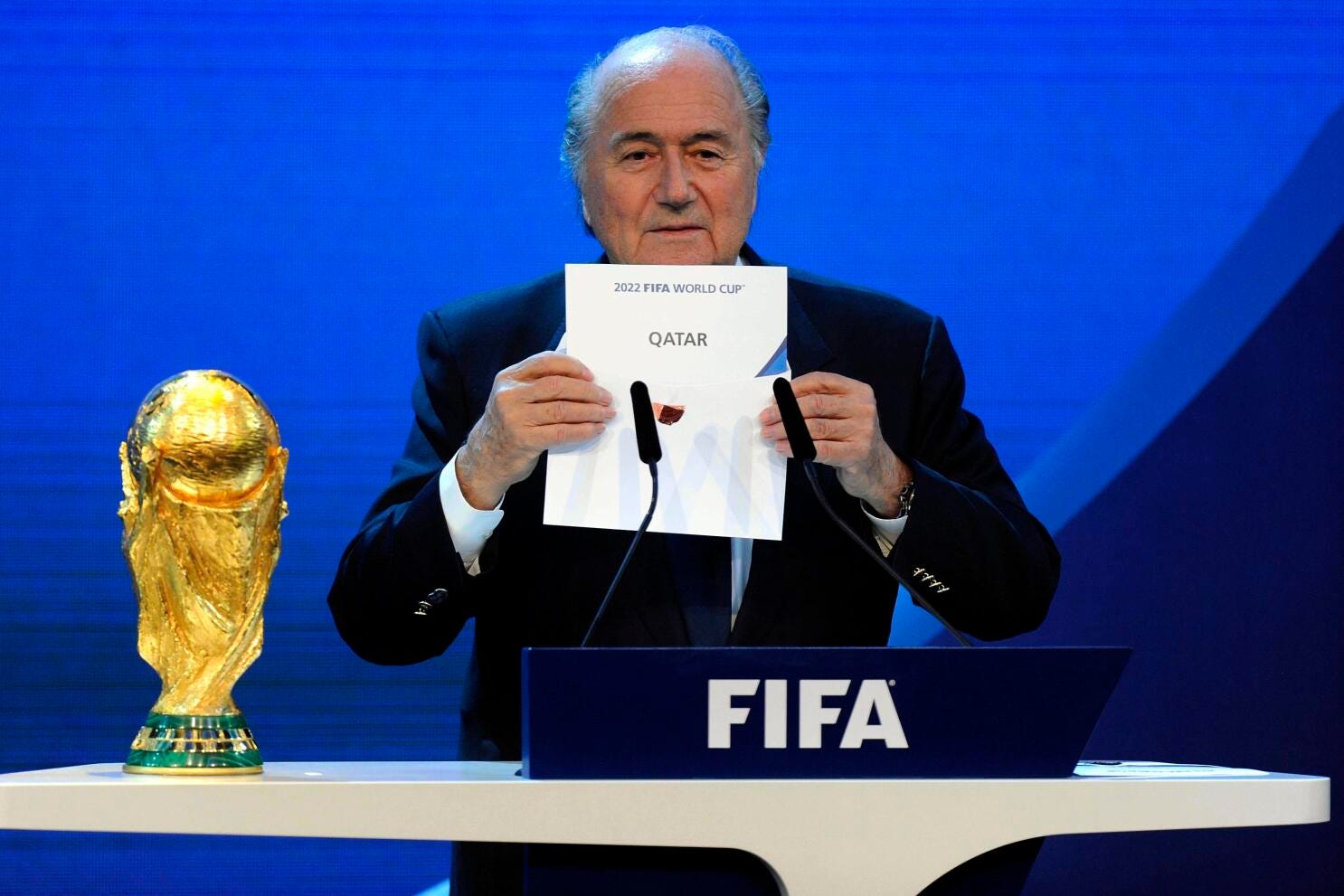
Russia 2018 and Qatar 2022 deepened this dynamic. The spell held commercially — Qatar 2022 generated $7.57 billion in revenue for FIFA, an eighteen percent increase on the prior period. But it held differently. For a growing segment of the global football audience, the suspension of disbelief the World Cup had always requested required more deliberate effort than it once did. The product kept selling but the relationship with their “customers” changed.
What Era 3 Built
Era 1 built the emotional infrastructure. Era 2 built the commercial architecture. Era 3 turned that architecture into an empire:
A tiered global sponsorship structure built in-house, with category exclusivity creating genuine scarcity value.
A narrative economy where the story you tell can be worth more than the rights you hold.
Players as global personal brands, whose commercial value existed independently of the shirt they wore.
Sixty million co-authors writing the tournament’s story in real time, producing meaning no official broadcast could replicate.
A digital infrastructure — video games, OTT platforms, digital sticker albums — running as a parallel commercial universe alongside the sport itself.
A jersey that stopped being about the team and started circulating on its own cultural logic.
A genuinely global competition, where all five continents had meaningful stakes in the outcome for the first time.
The emotional layer is still there, still capable of producing what I watched at home that afternoon in June 2014. But in Era 3 it became harder to access cleanly. The internet that made the co-authorship possible also made the machinery visible. . But for the first time, the audience could see exactly what they were watching. Most kept watching. The relationship changed anyway.
In Part IV, we’ll look at what this empire looks like right now — and what the World Cup is being asked to become.
What do you think? Let’s discuss below.
Thank you for being part of this journey!
Carla | Off-Ball Logic
in my opinion
Loved the breakdown
A really interesting read. What’s the lesson running through each of these eras?