

FFE is Over. What Stopped It?
How Cory Doctorow's enshittification framework explains how four days in July turned a funding proposal into a question about who owns the World Cup, and why it matters.

Hi everyone! I’m Carla, and this is Off-Ball Logic, the weekly newsletter where we step away from the 90 minutes on the pitch to dissect the business strategies, marketing mechanics, and economic engines that are really driving the modern sports world.
Subscribe to get it in your inbox:

Before the tournament, I coined the term revenuemaxxing™ for what FIFA had been doing to the World Cup: optimizing revenue streams to the max, keeping the product it intended to keep to the max. Four days at the end of July showed me the ceiling of my own idea.
Since I’m a lateral thinker, I cannot help arguing my own theory: revenuemaxxing describes what an owner does to a product it plans to keep. FFE, or FIFA Forward Enterprise, was a proposed FIFA-controlled subsidiary that would consolidate the commercial rights and operational delivery of FIFA tournaments, with minority, non-controlling stakes sold to private investors.
FFE was the moment FIFA (or, as we would soon learn, Gianni Infantino) stopped assuming it had to keep everything. After that, a line was drawn between revenuemaxxing on one side, and the loss of authority and ownership on the other.
If FIFA no longer assumes it has to keep everything, the useful question is what kind of owner behaves that way, and why. That question has been answered thoroughly in another industry, by someone with no stakes in football.
So today, we are going to talk about the term “enshittification.” The term describes a specific political-economic framework developed by Cory Doctorow, who expanded on it in a book I recommend you read1. The term also carries other meanings relevant to the future of businesses and how customers interact with the world around them.
This is a cautionary tale about how products abandon their core purpose and trap users inside a walled garden. The paradox of enshittification is that the product still provides just enough residual value to keep audiences consuming it. But over time, the decay accelerates, driven directly by ownership structures and shifting commercial incentives.
The Story
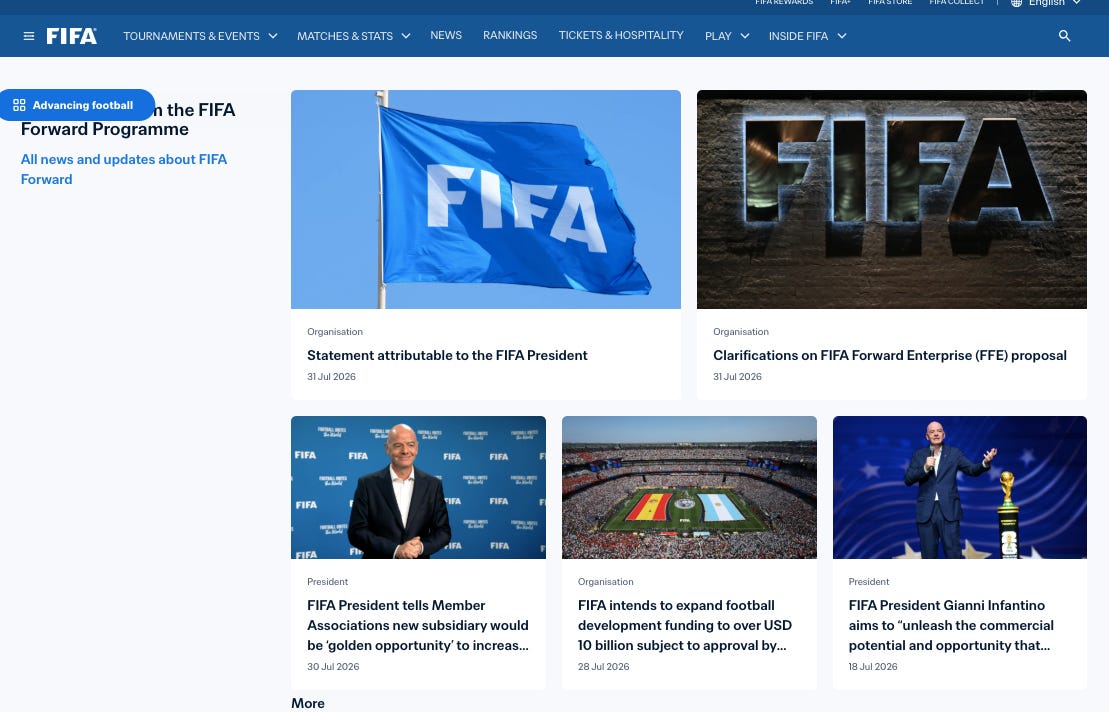
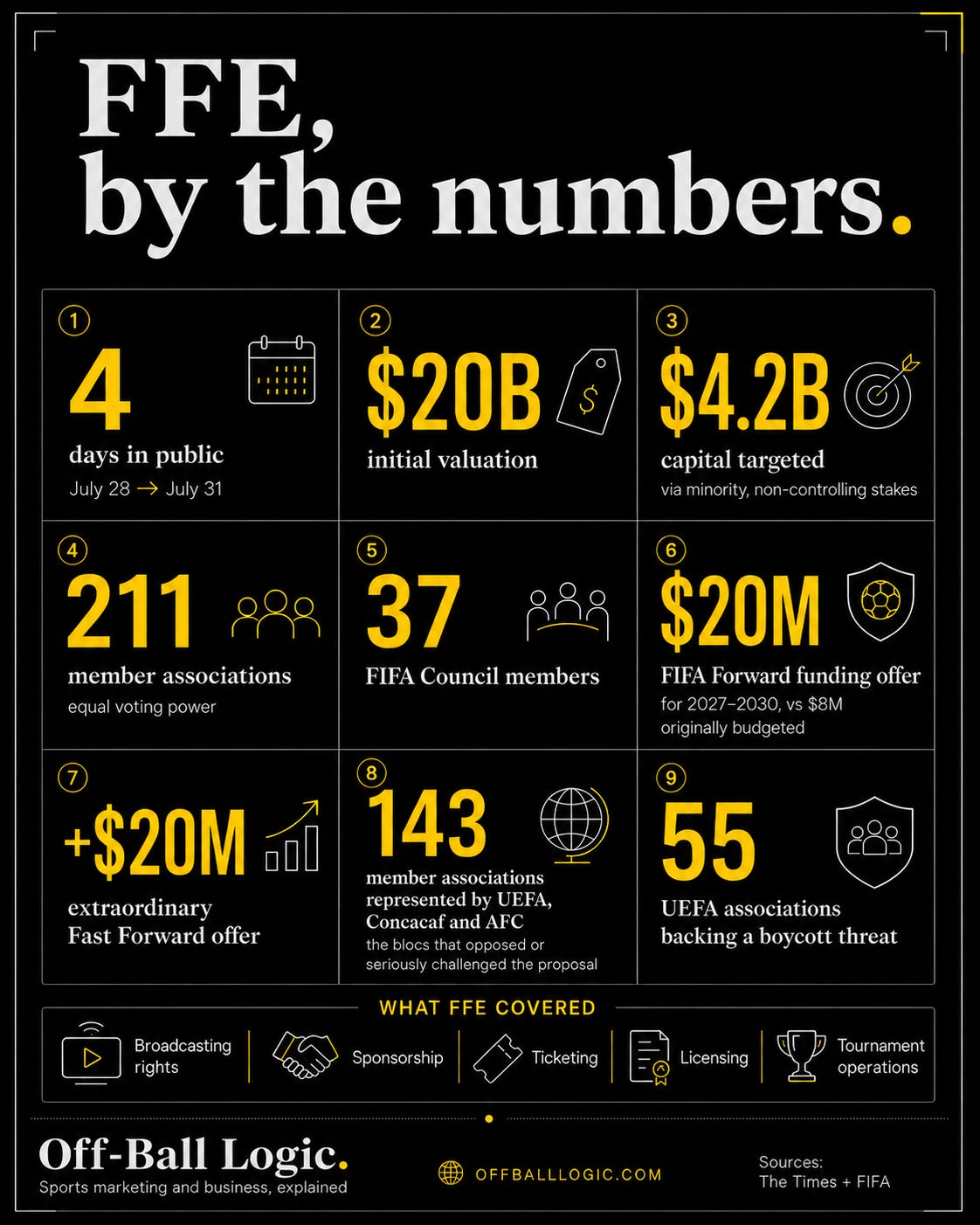
It started on July 28, when Martyn Ziegler, an award-decorated journalist at The Times and The Sunday Times, published on The Times2 that Infantino planned to create a new company named FIFA Forward Enterprise (FFE) around the FIFA World Cup competition, and sought the approval of the 211 MAs3.
FFE would have been a FIFA-controlled subsidiary consolidating FIFA’s commercial rights and tournament operations, including broadcasting rights; sponsorship; ticketing and licensing; and the operation of FIFA tournaments.
The proposal contemplated raising to $4.2 billion by selling minority, non-controlling stakes at an initial valuation of $20 billion. Thrive Eternal4 appeared among the potential investors, with J.P. Morgan advising FIFA.
For member associations, the package had two components:
$20 million in FIFA Forward funding for 2027- 2030, compared with the $8 million originally budgeted.
Up to an additional and extraordinary $20 million through the new FIFA Fast Forward Programme
FIFA then published the confirmation of this plan, saying it would proceed only with the support of a majority of its 211 member associations and the relevant approvals of the FIFA Council. It also was framed as a natural evolution of the currently existing FIFA Forward programme.
Ziegler reported that Infantino was seeking to establish a new company around the program, where he could later assume an executive position within the new entity.
UEFA responded on the same day, arguing that FIFA was crossing an institutional line5. The main objection: FIFA did not own the World Cup outright and therefore lacked the legitimacy to transfer part of it to private capital without transparency over who would benefit.
Then, the FA said it had been totally unaware of the proposal, while Concacaf and the AFC raised concerns over consultation, due process, and governance.
Following an emergency meeting, UEFA’s 55 member associations backed a boycott of FIFA competitions if FFE remained active.
Late on Friday, Infantino announced that FFE will not proceed because the divisions it created made it impossible to fulfill its original purpose. He does not acknowledge a governance failure. Instead, he frames the withdrawal as a decision to preserve unity.
FFE lasted four days in public. The withdrawal did not end the crisis. The dispute shifted from private equity to a larger question about how Infantino governs FIFA, how much power he has concentrated, and whether he can remain president. And last but not least: Why is he leaning towards a shareholder model?
Enough has been written about Infantino himself, but I have been thinking that FIFA has had contested leadership for decades. FIFA’s own independent Ethics Committee issued the 2015 ban imposed on Blatter. If Infantino leaves (the next election is scheduled for March 2027), will this end? Are we sure this is not a component of something bigger? Will this stop with the end of FFE?
Enter enshittification.
The theory
Enshittification is not simply a word for products becoming worse. Doctorow uses it to describe a specific political-economic process through which digital platforms systematically transfer value away from the groups that depend on them and toward the platform’s owners.
The deterioration is not accidental or technological: platforms worsen because concentrated market power allows their operators to manipulate users, suppliers, advertisers, workers, and creators without fear that those groups will leave.
Doctorow accepts that language develops. People can use enshittification informally to mean that something has become worse. The term has gained cultural traction precisely because it captures a broad sense that products, institutions, media, cities, services, and workplaces are deteriorating.
Stage One
Attract and lock in end users
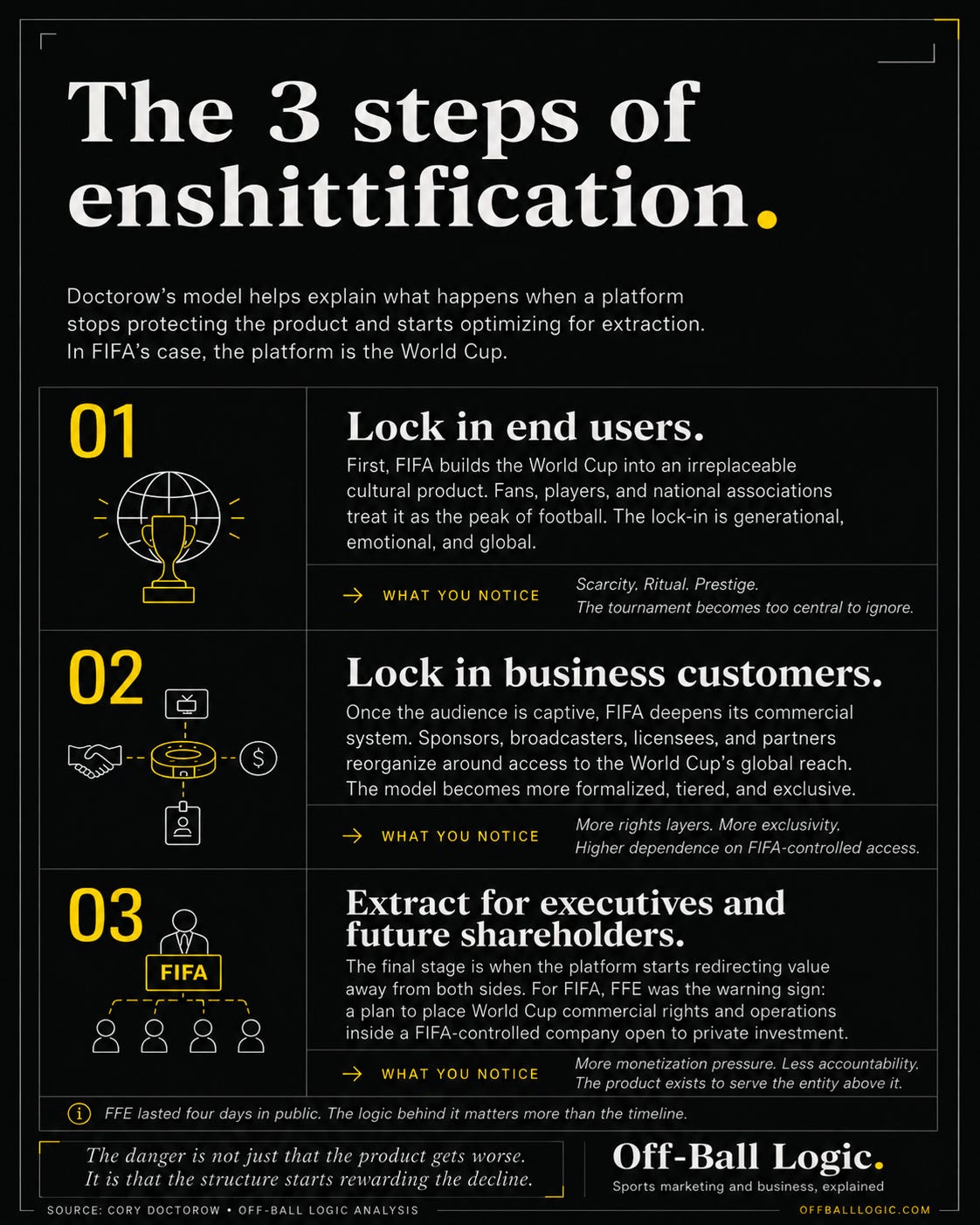
At the start of the enshittification curve, the platform is good for its end users. It offers low prices and useful features, limited advertising, and a satisfying service. It allocates much of the platform’s surplus to them while creating dependency through network effects, stored data, social connections, purchased content, reputation, or high switching costs. Users are engaged; the platform attracts more users and evolves.
The most well-known example is Facebook, a platform made to connect friends, acquaintances, and others in one place.
Stage one of the World Cup is somewhat obvious. You can find more in Part 1 of the Business of the World Cup series: when the tournament was growing as an event, creating meaning, purpose, and storytelling hard to avoid.

Stage Two
Attract and lock in business customers
Once end users are locked in, the platform withdraws some of their surplus. It transfers it to its business customers: advertisers, merchants, publishers, creators, app developers, drivers, or other commercial participants. Access to the captive end-user base becomes the incentive. Business customers reorganize around the platform and become locked in themselves.
He cites both examples from Facebook and its ad model, and X, with the upcoming app integrations and partners that contributed to the platform’s growth pre-Musk.
This is something the World Cup has shown through its sponsorship and broadcast model, which expanded from the 1970s onward.

The FIFA partnership program serves a key role not only in the commercialization of the WC but also in the build-up leading up to the kick-off. We discussed how this was affecting the FIFA 2026 in this article6.

Each restructuring made access to the World Cup’s global audience more formalized, tiered, and exclusive, which fits the logic of stage two.
Stage Three
Extract value for shareholders and executives
What Doctorow describes as the final stage of the process is what happens when both users, end and business, are in the loop. The platform withdraws surplus from end users and business customers and retains only the minimum required to prevent either group from leaving. The remaining surplus is directed to shareholders and executives.
He does not describe this as an immediate effect or as a behavior that acts equally across all processes. For example, in X’s case, it was pushed aggressively after Musk’s buyout, leading to debt acquisition and repayment, creating a loop that degraded the core product.
This is important for two reasons:
The first is that it’s not a one-off. FFE’s emergence is not an immediate effect but a signal that this is part of a major process.
The second is more important: this does not happen because the service merely deteriorates. It deteriorates because the platform has enough control to profit from worsening conditions for both sides.
Hydration breaks or halftime shows are not necessarily signals, though they could be tipping points for what’s been pointed out: the platform (FIFA) is gaining control to profit from worsening conditions.
FIFA itself has no shareholders, which makes the analogy imperfect. But FFE matters because it would have introduced outside equity holders into a FIFA-controlled commercial subsidiary.
The key factor here, and to see how it develops in the times to come, is that Infantino is not FIFA. In fact, UEFA argues that FIFA has met only one of its conditions — withdrawing FFE — but has not provided binding guarantees against similar future projects. UEFA also maintains its declaration of no confidence in Infantino.
If Infantino leaves and there is no guarantee this won’t happen again, how can we be sure it’s just a one-man job and not a deeper process going on in FIFA’s leadership?
Who is Allowed to Decide
Doctorow’s most important causal claim is that the current condition of the internet did not emerge from an unavoidable law of markets or technology. It resulted from policy choices.
I’m not an expert on FIFA’s policy; but here’s an overview after researching:
Policy-making depends on the type of decision. Most proposals are developed by the FIFA administration, sometimes with input from committees, confederations, MAs , or external stakeholders.
The FIFA Congress, where each of the 211 MAs has one vote, decides constitutional matters such as amendments to the FIFA Statutes, elections, budgets, membership, and World Cup hosts.
The 37-member FIFA Council handles most strategic, regulatory, commercial, financial, and development policies between Congresses. It can adopt major policies without a vote by all 211 associations, provided the matter falls within its statutory powers.
The President can initiate and promote proposals, but cannot create policy on their own. The General Secretariat prepares, drafts, and implements decisions approved by the Council or Congress.
The Laws of the Game are a separate case: they are controlled by IFAB7, where FIFA holds four of eight votes.
For FFE, FIFA itself said the proposal required majority support from its MAs together with the relevant approvals of the FIFA Council; it did not announce a formal Congress vote.
These 211 member associations influence electoral power, with that power distributed equally among them. This is important because, as mentioned, FFE was positioned as an improved version of FIFA Forward, striving to invest in MAs that don’t have the same income as the powerful ones.
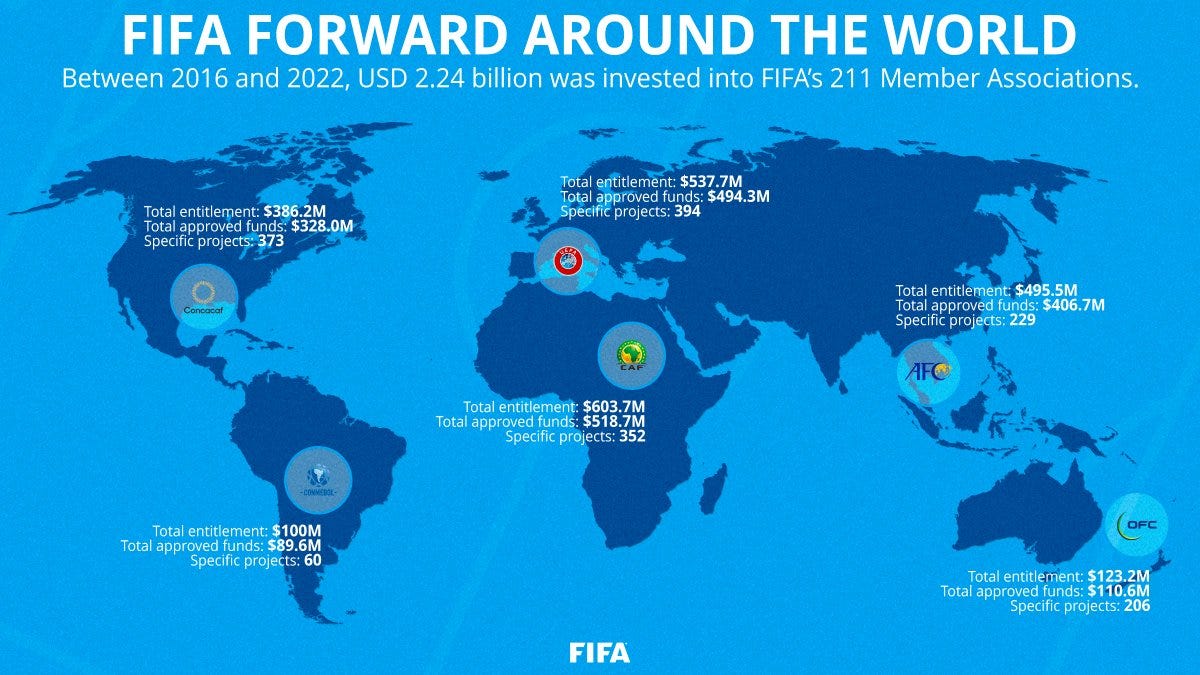
Twenty million dollars is meaningful for the FA; for some associations in the AFC or the OFC, it can be structurally transformative. For many analysts, the offer was calibrated to the associations whose votes weigh the same as everyone else’s and whose needs do not.
However, by the end of the week, UEFA, Concacaf, and the AFC — together representing 143 of FIFA’s 211 member associations — had opposed or seriously challenged the proposal.
The Solution
Doctorow identifies four constraints that can prevent or reverse enshittification.
First, competition: it makes deterioration costly because abusive conduct risks lost revenue. Antitrust enforcement, merger restrictions, and limits on self-preferencing restore that threat. This is the least realistic of the four, since the World Cup is an event of its own, not competing with or replacing other events, and too large for a rival of matching scale to exist.
Then, regulation: if legal penalties exceed its expected gains. A hard one due to the game’s global aspect; however, in tech companies, this can be positive, even if not globalized: for example, GDPR rules are exclusive to the EU but help develop product privacy policies to comply with them. For football, it could be a regional regulation strong enough to affect the game’s worldwide development.
The third constraint is called self-help, and refers to the technical capacity of affected groups to protect themselves (e.g., using ad blockers, third-party clients, reverse engineering, etc.).
This one is aimed at us fans, and it’s something it’s hard to push back with our limited power. Still, I’m thinking out loud about whether there are any alternatives fans have at their disposal that are similar to what tech companies offer their customers.
And the last one, but no less important, is labor: Workers can constrain enshittification from inside the company. Workers may refuse harmful changes, organize, expose misconduct, or leave—strong labor markets, unions, whistle-blower protections, and mobility increase that power.
This is key to this story, because itʼs what, for many people, led to the FFEʼs news publication, and other stories came up after:
Carlos Cordeiro, a senior adviser to Infantino and a former Goldman Sachs executive, resigned, calling FFE a bad deal for football, and questioned why FIFA needed to sell part of its most valuable asset when it had significant reserves and no debt problem8.
Then, FIFA COO Kevin Lamour said employees had been misled and described FFE as “one personʼs project. ˮ His comments suggest that the proposal had not solely excluded the confederations and associations. It also lacked consensus inside FIFAʼs own administration9.
Look at which constraints actually mattered. Competition played no meaningful role, no external regulator intervened, and supporters had no effective self-help mechanism. Internal dissent mattered, but labor alone did not stop FFE. The decisive pressure also came from institutional actors — particularly UEFA — with the power to threaten withdrawal from FIFA competitions.
Whatʼs Next
To wrap up on a positive note: I love the World Cup. I enjoyed this one enormously, and it still does what it was built to do: it gives children something to dream about, and adults something to remember, and it assembles a sense of belonging for people with nowhere else to look for one.
I don’t believe it’s “enshittified,” in the concrete terms of Doctorow’s book. However, FFE looked like FIFA’s closest move yet toward stage three, and it was repelled by one of the four constraints mentioned before, and FIFA has given no binding commitment that would make the next attempt harder than this one.
The organization that has held this responsibility for a century spent four days demonstrating that its strongest safeguards were workers willing to dissent and institutions powerful enough to walk away.
What I want to know before March 2027 is whether FIFA can examine the structure that produced FFE, rather than just the man who signed it.
What do you think? Let’s discuss below.
Carla | Off-Ball Logic
About this article:
The core concept, sourcing, structure, and original drafting are entirely my own. I use Grammarly for baseline syntax and Claude for occasional rephrasing when an idea needs sharper delivery (affecting roughly 10% of this piece, 7% according to Pangram). As a non-native English speaker, these tools act as a sounding board to help me find the most precise way to express my analysis. I also use ChatGPT as a secondary fact-checking layer—even when pulling primary sources myself, it helps flag rebutted news or evolving narratives I might have missed. All infographics and the cover image were generated using ChatGPT and/or Gemini.
Cory Doctorow, Enshittification: Why Everything Suddenly Got Worse and What to Do About It (2025). You can also read more of his work at Pluralistic.
https://www.thetimes.com/sport/football/article/world-cup-for-sale-gianni-infantino-fifa-wdvtsqfc6
“Member associations”
Joshua Kushner’s (brother of Jared) fund.
UEFA drove its major announcements primarily through its official social channels—a communication strategy mirrored by the other federations mentioned here (CONMEBOL, AFC).
Note: I have a pending analysis of how this effectively came to fruition in the actual WC 2026.
“International Football Association Board”
https://www.nytimes.com/athletic/7482493/2026/07/31/infantino-fifa-world-cup-plans-cordeiro/
https://www.theguardian.com/football/2026/jul/31/infantino-under-huge-pressure-after-plan-for-world-cup-sell-off-sparks-resignation-and-rebuke
Really appreciate the walk through and connection with the trend of enshittification. A bit of a different read than the usual takes that have come over the past week.
Nice. The twist worth adding is the missing shareholder you flag: FIFA has none, and it didn't need the money. Strip those out and what FFE was buying was a longer run at the top for one man, which makes your closing question the right one: the structure, not just him.