

The Business of the World Cup, Part 5: Someone Will Be Watching
What the World Cup's confirmed future tells us — and what we can only imagine

Hi everyone! I’m Carla, and this is Off-Ball Logic, the weekly newsletter where we step away from the 90 minutes on the pitch to dissect the business strategies, marketing mechanics, and economic engines that are really driving the modern sports world.
This is Part 5 — the final installment — of my series tracing the full commercial history of the FIFA World Cup, from its founding in 1930 to the $13 billion commercial cycle it is today.
Subscribe to get it in your inbox:

We came a long way so far. As you may remember, the series opened with a scene of myself at five years old wanting the USA 94 gear — a kid who had no concept of licensing deals or commercial cycles, who just wanted to be part of something she didn’t yet understand.
Four posts later, we’ve traced how that feeling was built: the foundational mythology of Era 1: posters, radio commentary, and the storytelling that preceded any commercial infrastructure; the television revolution and the cult of personality of Era 2, the social media layer and the personal brand empire of Era 3, and the revenuemaxxing architecture of Era 4, with FIFA operating as a vertically integrated enterprise, and an ICP that has shifted from the football fan to the corporate buyer.
The question at the end of Part 4 was: can the thing that makes the World Cup worth $13 billion1 survive the model built on top of it?
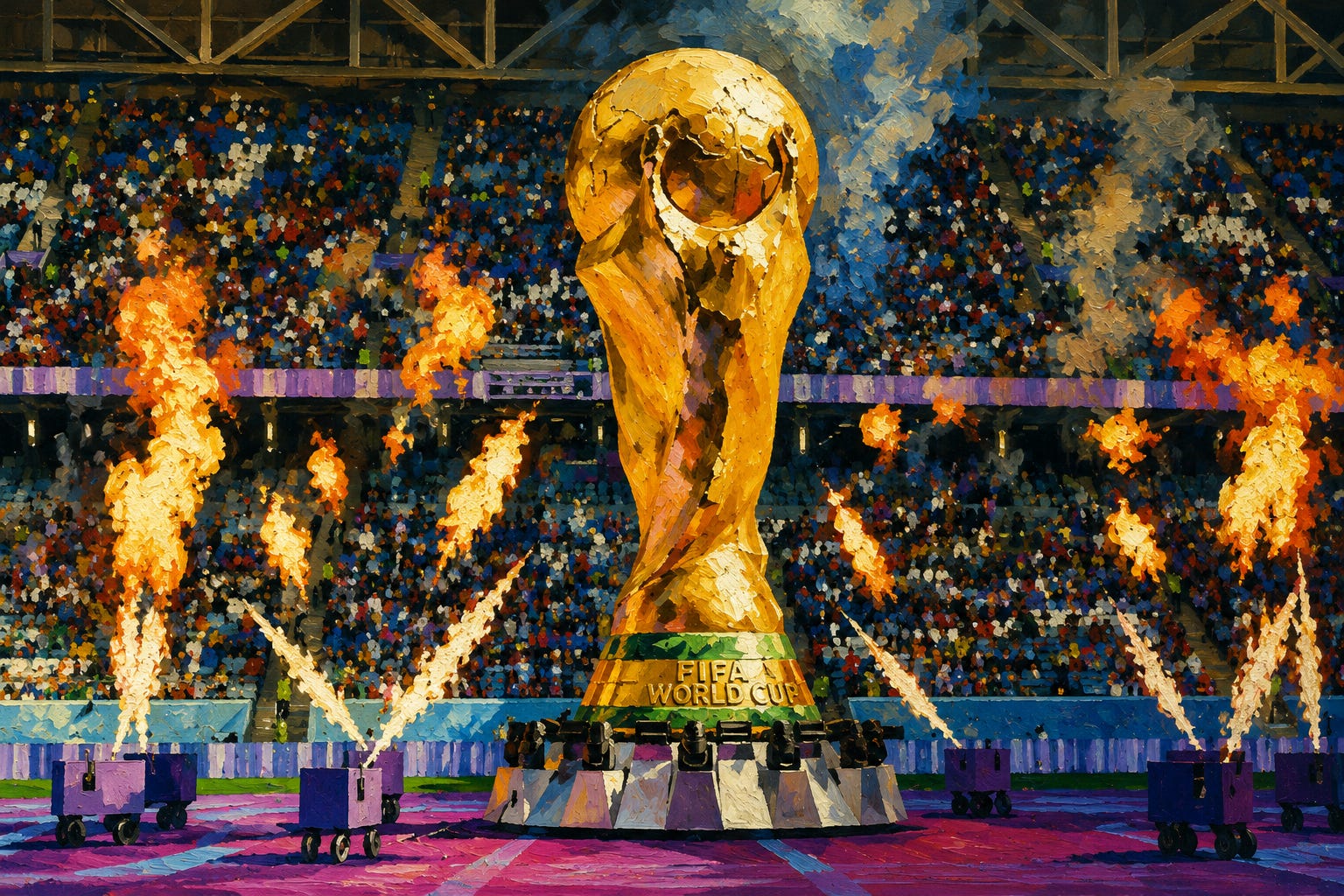
We don’t have the answer yet, obviously, since the last details of the 2026 World Cup are still being settled as this is written. But I wanted to look a bit into the future and think about how the children being born now will experience what I experienced in 1994.
This is Part 5 — and the last one — of a 5-part series on the commercial history of the FIFA World Cup. This series started with a simple question: how did a football tournament become the most commercially powerful property in the world? Four posts answered that. This one asks what comes next, which means stepping out of analysis and into something closer to informed speculation.
If you missed the previous parts, find them here:
What We Know So Far: 2030 and 2034
Two World Cups beyond 2026 are already confirmed, and the decisions around them tell enough about where FIFA’s priorities sit.
2030 is the first centenary of this competition — 100 years since Uruguay hosted the first tournament. FIFA’s solution is commercially ambitious and logistically staggering: Spain, Portugal, and Morocco host the majority of matches across an expected 17 cities and approximately 20 stadiums2, with the final venue reportedly still to be confirmed between Spain and Morocco. Uruguay will host the opener at the Estadio Centenario in Montevideo, with Argentina and Paraguay each hosting a single celebratory match3. Six nations across three continents, all qualifying automatically.
Football Supporters Europe called it FIFA’s “cycle of destruction.”4 The intercontinental travel this format requires — 13-hour flights between Buenos Aires and Madrid for fans following their team — is both a logistical nightmare and an ESG worst-case at a moment when sustainability scrutiny of major events is at its highest. The centenary was an opportunity to return to where it started, and it could have been straightforward — Argentina, Uruguay, and one or two neighbouring nations could have provided the required stadiums between them. Instead, FIFA used it to create the largest hosting footprint in tournament history.
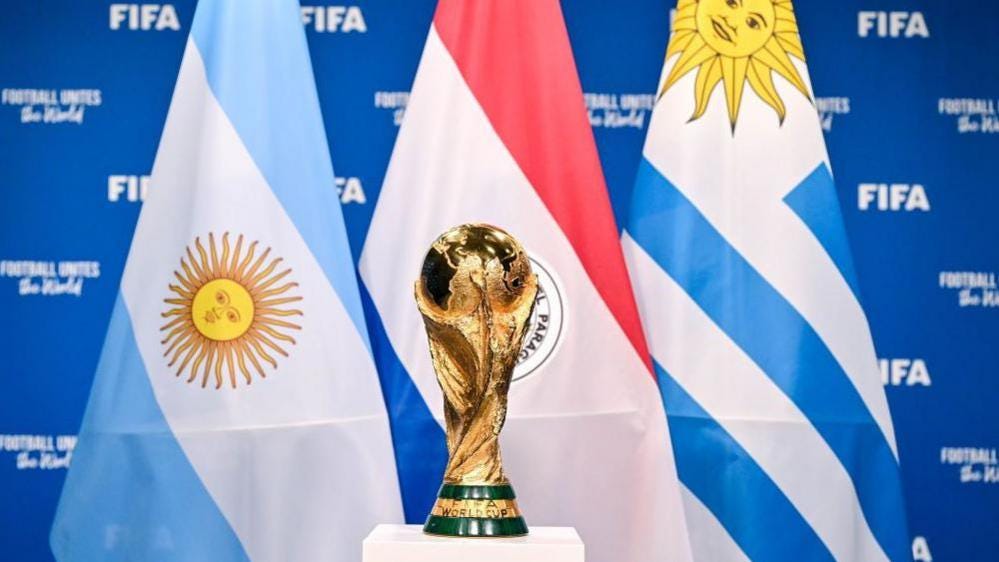
The commercial logic looks coherent on paper, even if the optics don’t. Six automatic host qualifications means six commercial ecosystems activated simultaneously: six national federations deploying their full sponsor portfolios against a guaranteed World Cup platform. The co-branding architecture that defined 2026 scales to six countries in 2030. Whether it holds together operationally is a different question. And the branding complexity is real: Spain, South American countries that were former Spanish colonies, and Portugal and Morocco all bring overlapping and occasionally competing cultural identities to the same tournament. If you want to understand how Spanish colonization shaped football in South America, the Copa Libertadores is the clearest example — named after the heroes of Latin American independence from Spanish colonial rule, among them José de San Martín (yes, the one who crossed the Andes) and Simón Bolívar.
What’s also worth watching is the qualification structure, particularly in CONMEBOL: with 10 member associations in the federation, 3 qualifying automatically as hosts, and — under the expected allocation — 3 qualifying directly through the qualifying tournament, that would leave two teams in the playoff. If those teams win, CONMEBOL would have eight out of ten of its members at a single World Cup. That has never happened before in any confederation, and it raises real questions about competitive balance and the meaning of qualification.
2034 tells a more direct story. Saudi Arabia was confirmed as sole host at the same Extraordinary FIFA Congress — the only eligible bidder under confederation rotation rules restricting the award to AFC and OFC nations5, given that UEFA, CONMEBOL, and CAF were all involved in hosting 2030. The tournament will almost certainly run November–December, as Qatar 2022 did. Aramco’s 2024 signing as a Major Worldwide Partner (energy category through 2027) was read by analysts as the financial precondition for the hosting award — a commercial relationship established before the hosting decision was formalized.
The human rights debate will replay the Qatar template exactly: migrant labor conditions, women’s rights, alcohol policy, sponsor due-diligence playbooks developed for Qatar repurposed for Riyadh. The estimated new stadium-only spend is of $20 billion6 — a figure that puts the scale in context when compared to Germany’s entire 2006 organizing budget of €425 million7.
The 2030 and 2034 decisions, taken together, signal that FIFA’s hosting model is moving in two simultaneous directions: centenary symbolism as commercial amplification, and sovereign wealth as structural commercial pillar. The cards are on the table.
The Technology Layer
A few things already operational will define what the World Cup looks like in twenty years.
The ball is a data product. The Adidas Trionda used at 2026 features Connected Ball Technology similar to Qatar 2022’s Al Rihla — an inertial measurement unit transmitting positional data at up to 500Hz to match officials in real time8. Qatar 2022 deployed semi-automated offside technology for the first time — 12 dedicated cameras per stadium plus the ball sensor9. The real-time positional data infrastructure is live; the commercial and broadcast applications are the next layer. 93% of fans say they will second-screen on mobile during matches, scrolling while play continues during the 2026 FIFA World Cup10. This is already the operational baseline.
Piracy is a structural challenge that isn’t going away. More than 40,000 unauthorized streaming links were detected during Russia 2018, and these figures represented 41,371,139 viewers11. The commercial implication is direct: every unauthorized stream is an audience that sponsors paid to reach and didn’t. FIFA’s content protection investment and its market development investment are pointing at the same audiences from opposite directions.
Streaming is already the primary distribution architecture. Brazil’s CazéTV model of delivering all 104 matches on YouTube, the Tubi free-access layer in the US — the single dominant broadcast partner is already gone. The Rest Is Football — Gary Lineker, Alan Shearer, and Micah Richards’s hit podcast — becomes a daily Netflix show throughout the 2026 World Cup, filmed in New York, marking Netflix’s first ever daily show in the UK12.

The question for 2030 and beyond is which streaming architecture captures the full global audience, including the ones currently watching for free on platforms FIFA doesn’t control.
The Sponsorship Categories of 204613
The legacy sponsor architecture of the World Cup — food & beverage, apparel, automotive, electronics — was built in the 1980s and has been eroding at the edges ever since. Tobacco left in 1986. Imaging and film (Fuji, JVC, and Canon were all World Cup sponsors) exited during the 2000s. Beer and soft drinks face growing regulatory pressure in health-conscious markets and are already navigating alcohol bans in host countries.
The stack Horst Dassler built in the 1970s is not the stack that will be at the 2046 World Cup.
What replaces it is partly visible and partly open.
🏆 Big Tech is the largest open question: Apple and Amazon are not yet FIFA Partners. Neither company has made a structural commitment to football sponsorship at this level14. If either does before 2034, it reshapes the entire commercial architecture — the distribution layer, the data layer, and the brand layer collapsing into a single partner relationship. Whether it does is the most commercially consequential uncertainty in football sponsorship right now.
🏆 AI will reshape the experience in two directions simultaneously. The concern is real: AI-generated content (deepfake footage, fabricated player quotes, synthetic match highlights) already circulates in lower-stakes digital environments, and the risk of it contaminating how major events are experienced is not hypothetical. The organic emotional power of something like the 7-1 in 2014 — a moment rooted in real, verifiable events — now competes in the same information environment as convincing fabrications. That’s a new kind of vulnerability for a property whose value is built on authentic narrative. The optimistic version is equally real: AI is already being considered for automated highlights, multi-language commentary, and real-time personalization at scale. AI-generated broadcast commentary tailored to individual viewers, in their language and adapted to technical knowledge, is a near-term application. Both directions are coming. Which one dominates the fan experience is an open question.
🏆 Brand identity and positioning may be forced to evolve. Formula 1 has spent the last decade repositioning itself as a premium, luxury-adjacent property — the Drive to Survive effect brought a new audience, and LVMH’s partnership cemented the aesthetic. Will FIFA follow a similar path, with brand identity calibrated to the host country and its audience each cycle? And if it does — luxury in 2034 Riyadh, something else in 2038, something else again in 2042 — does that coherence cost something? The risk of chasing the F1 model is that F1 owns a specific audience. The World Cup’s power has always come from owning every audience simultaneously.
🏆 In-stadium and in-home advertising is already transforming — faster than most people realise. Virtual Board Replacement technology is already deployed across the Bundesliga, UEFA EURO 2024, the NBA, and the NHL15 — meaning a viewer in Manchester and a viewer in Tokyo could watch the same match with different brands on the pitch-side boards, simultaneously. Dynamic advertising that changes message based on live match events is the next layer. For viewers watching at home on OTT platforms, personalized advertising based on consumption history could be the next operational move. The Coca-Cola first ad from the 1950s was a static asset visible to everyone in the stadium. The equivalent in 2046 will be a real-time, market-specific, viewer-specific message that doesn’t exist as a physical object at all.
🏆 Live and gaming experiences are already being reinvented. FIFA Super Soccer on Roblox — launched in December 2025 with 9.5 million monthly active users16 — already lets players compete as official national teams. During the FIFA Club World Cup 2025, a Roblox activation generated 20 million gameplay sessions, and 61% of surveyed players said it made them more likely to watch the real tournament. FIFA has also partnered with Netflix, Epic Games, and SEGA as part of a broader digital gaming ecosystem ahead of 202617. This is already the present — the question is what it scales into. VR stadium experiences for those who can’t attend in person are the logical next layer, and the infrastructure for it is being built now.
🏆 EVs are the most likely near-term entrant. Hyundai and Kia set the precedent at Korea/Japan 2002 and have never left. BYD, Tesla, and Polestar are the credible next wave — brands whose target demographics overlap with the World Cup’s premium international audience and who need the global platform that only the World Cup provides.
🏆 The Saudi dimension is different in kind from the others. Aramco is already a FIFA partner. PIF-backed brands are likely to form a structural commercial pillar at 2034 — not filling a category gap, but potentially replacing the Western legacy stack wholesale. The Visit Saudi episode at the 2023 Women’s World Cup18 — added as a sponsor, then dropped after a player revolt — was the clearest precedent for sponsor backlash forcing FIFA’s hand on geopolitics. What that precedent means for 2034, when Saudi Arabia is both host and major commercial partner, is genuinely open. It is the most complex tension in the commercial future of the World Cup, and it has no clean resolution.
What the World Cup Becomes
The series started with a question that felt simple: how did a football tournament become the most commercially powerful sporting property in the world?
The answer, across four posts, is that it didn’t happen by design. Era 1 built emotional infrastructure without commercial intent. Era 2 built commercial architecture around television and individuals who weren’t trying to be brands. Era 3 turned accidental assets into an empire through social media, and the understanding that narrative can outrun contractual rights. Era 4 priced all of it explicitly for the first time.
The next twenty years will be shaped by whether the thing that made all of that possible — the feeling that the World Cup belongs to everyone, that it is the place where dreams come true — survives the commercial logic built on top of it.
The honest answer is: probably yes, with significant and visible cost.
The emotional foundation has absorbed a great deal already. It absorbed Italy 1934 and Argentina 1978. It absorbed FIFAGate and Qatar. It absorbed the ICP shift from fan to corporate buyer, the price of a hospitality package that most fans will never see. Each time, the tournament produced something that reminded you why the infrastructure exists — a Maracanazo, a Goal of the Century, a night in Buenos Aires when strangers hugged each other in the street.
The child who will one day write about 2026 the way I'm writing about 1994 is somewhere right now, watching the World Cup for the first time, not thinking about commercial cycles or ICP shifts or co-branding architecture. They are watching because something is happening that feels like it matters.
What that child is watching has never been more commercially sophisticated, more geopolitically entangled, or more expensive to produce and attend and activate around. And it has never been more capable of producing the moment that makes all of that irrelevant.
Whether those two things can continue to coexist — at $13 billion, at 48 teams, at 2034 in Saudi Arabia, at wherever the future lands — is the question the next twenty years will answer. We don’t have the answer yet. But someone will be watching.
This is the final post in a 5-part series on the commercial history of the FIFA World Cup. Thank you for reading all of it.
What does the World Cup look like in 2046? Let’s discuss below.
Carla | Off-Ball Logic
Source: FIFA 2025 financials in review, according to FIFA's 2023–2026 commercial cycle budget.
Source: FIFA World Cup 2030™
Source: FIFA World Cup 2034™
Source: Webuildvalue.com. Not officially confirmed by Saudi authorities.
Source: IOTinsider
Source: Embryoagency
What follows is analyst and industry projection, and some intuition — not established fact.
Although there were actually rumors of a partnership between FIFA and Apple for a new tournament.
Congrats this was an awesome series to read. Perhaps, the future doesn’t yet account for a leadership change, FIFA reforms and growing player power… it will be an interesting next 30 years